
2/9/25
Girls Just Wanna Have Funds - The Sunday Times Bestseller
As a Female Invest member, you get 30% off all our books - including this one

A few years ago, Emma, Anna and Camilla kept coming back to the same question: Why does no one teach women how to manage and grow their money?
Time and time again, we saw our friends, sisters, mothers, colleagues - women everywhere - being left out of pivotal conversations that shaped their futures.
So we decided to do something about it. And that’s how Female Invest - and the very app you’re using right now - was born.
But we also wrote a book.
Its called Girls Just Wanna Have Funds - and it’s a feminist guide to investing, packed with everything we wish we’d known earlier.
It breaks down the systems that historically have excluded women from building wealth - and shows you exactly how to get started yourself, step by step.
We are still so proud of the fact that the book became a Sunday Times bestseller and now has sold more than 150,000 copies.
Because financial literacy shouldn’t be a privilege reserved for wealthy individuals - primarily men - it should be a birthright.
We wanted to empower women everywhere to take control of their financial future.
Not someday. Right now.
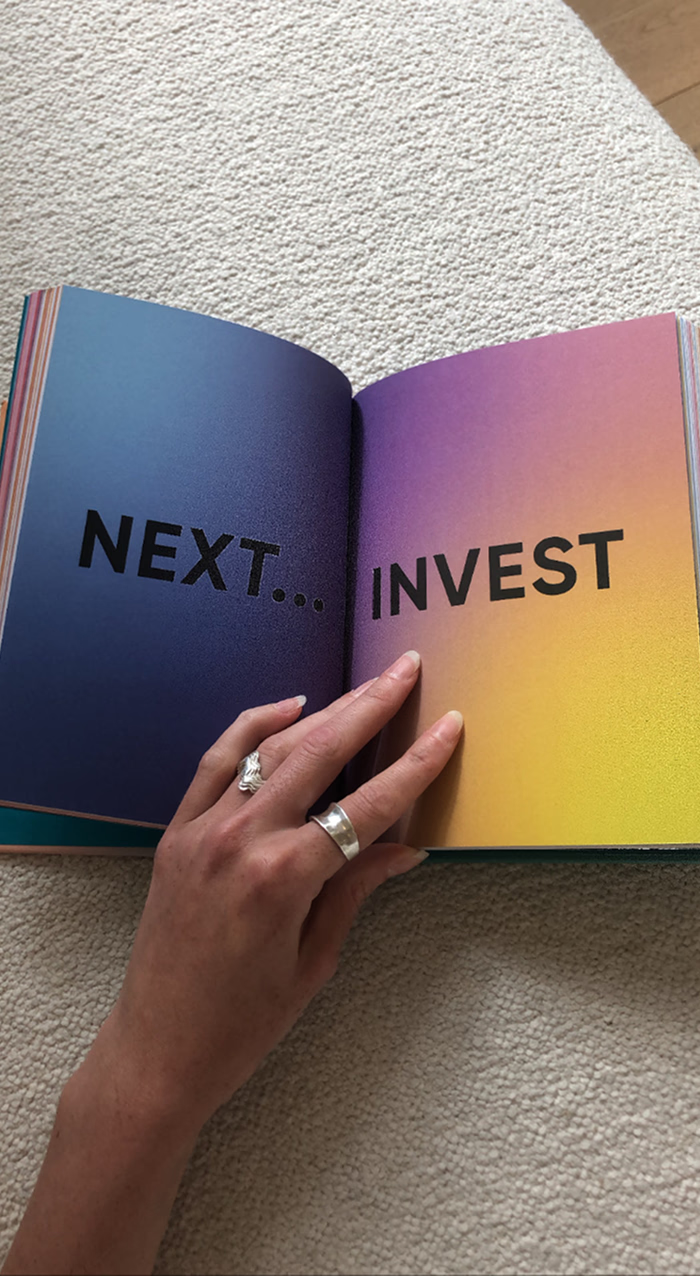
So with that, here’s a sneak peek into the first few pages of Girls Just Wanna Have Funds. It sets the scene for why this conversation is so urgent - and why we need everyone to be part of it.
P.S. As a Female Invest member, you get 30% off all our books - including this one.
Just as our way of saying: we’ve got your back.
Money is power
Women are now entering higher education in record numbers. They are climbing the corporate ladder, running for political office, pushing against the glass ceiling and pursuing power as seldom before. However, there is one area yet to be addressed: money.
Money equals power and opportunity.
It brings you the essentials in life – food, shelter, clothing and education – but it can also do so much more than that. It can buy you the freedom to do what you’ve always wanted. Take that trip. Make music. Build a company. Get your kids off to a good start.
Perhaps even use it to do your bit to make the world a better place.
But although money is an essential element of life, it is something that women and marginalized communities have historically been excluded from earning and managing.
As a result, there’s not a single country in the world where men and women are financially equal.
In fact, the World Economic Forum estimates that it will take 257 years to close the financial gender gap. This effectively means that, today, no woman will live long enough to experience a world in which she has the same level of freedom and opportunity as her male peers.
Let’s get this straight: nothing bad happens when women have more money. In fact, quite the opposite – it benefits individuals, companies and society as a whole when women are able to spend and invest.
A McKinsey & Company study from 2015 found that if women were to participate in the economy on equal terms to men, they could add as much as the combined size of the economies of the United States and China today to the world’s GDP.
How remarkable is that?
Still, the discussion around money is sensitive, tainted with emotions, values and personal beliefs held by ourselves and instilled in us by the generations before us.

In this book, we’ll do our best to outline the current state of financial equality – and what you can do to improve it for women of our generation and for those to come.
We do not have to sit around and wait for change to happen.
There are many ways by which we can take action ourselves, and our aim with this book is to offer you concrete advice on what you can do to optimize your own financial situation and to help everyone around you achieve the same success.
Gender stereotyping is still alive and well in the twenty-first century.
From the moment babies are born, their assigned sex immediately begins to shape how they will be treated, what opportunities they will receive, and how they will behave according to dominant gender stereotypes in their society.
The most significant influence on gender role development occurs within the family setting, with parents modelling and passing on to their children their own beliefs about gender.
You may recognize this trend from your own childhood.
For example, did your parents teach you how to manage money?
Did they participate equally in all of your family’s financial decision-making?
In the UK today, 68% of girls feel held back by harmful gender stereotypes.
It would be easy to make a case about men versus women, but when talking about financial gender inequality we need to consider factors beyond gender, too. “Women” are not a homogenous group, and different categories of people have different experiences.
As formulated by Kimberlé Crenshaw, an American law professor and the woman who coined the term intersectional feminism:
“All inequality is not created equal.”
Simply put, this means that different types of discrimination, such as gender, race, class and sexuality, overlap, creating compounding experiences of discrimination.
We can’t talk about one without recognizing the existence and impact of others.
For example, Black, Asian and minority ethnic women experience sexism differently from white women in a society that affords privilege to whiteness.
Trans women don’t have the privilege of cis-gender women; people with disabilities are not enabled to participate in work to the same extent as able-bodied citizens; migrants are often excluded from the very financial systems that we want to help you understand.
Therefore, looking at the current state of financial inequality isn’t enough to change attitudes; we also need to recognize the historical context of the issue.
Decades of systemic discrimination have created deep inequities that disadvantage some people in society from the very beginning, and this extends across generations.

This is especially important when we are talking about money, as we know that women have historically been excluded from earning, saving and managing it – especially women and girls of colour.
Another factor that significantly impacts your relationship with money is your current life situation.
Do you have a job?
Are you in a relationship?
How is your health?
How is your financial health?
We all have different starting points when it comes to investing, which is why we encourage everyone to read this book with their own experience in mind.
The Current State of Financial Inequality
When it comes to money, we like to think that men and women will receive the same opportunities if they put in the same amount of work and dedication.
But the uncomfortable truth is that women face a large number of discriminatory barriers, some of which are so deeply ingrained in society that many are blind to them or even deny their existence.
For starters, women earn less than men – even when they are doing the same jobs.
In developed countries, women in higher education outnumber men. They achieve better academic results and make better leaders once they enter the workforce.
However, they still earn less, are poorly represented in politics, and are less likely to join the top ranks in business or become entrepreneurs.

The Gender Wage Gap
The wage gap, combined with factors such as women being more likely to live longer and more likely to take a career break or choose part-time work, can have a major impact on a woman’s financial situation over her lifetime.
For example, a 10% pay gap alone can lead to approximately 38% less wealth by the age of 65. Could women change this themselves?
Probably not, because even when women ask for a raise, they are less likely to get it and more likely to be viewed as greedy and demanding.
These facts refer to women who are in paid work but, globally, 42% of women aren’t in the paid workforce because they are doing unpaid, largely invisible work at home.
Does this work have value?
Very much so.
In fact, a study into unpaid labour conducted by PwC found that, in the US alone, the value of the unpaid economy was $565 billion – worth around a third of the entire economy – and the vast majority of this is attributed to childcare.
So this concerns the gender pay gap, but we also have to consider the gender wealth gap.

The Gender Investment Gap
The depressing news continues, because when it comes to investing, women are falling behind here, too. Female investors are still a minority, and in the financial industry, women are a rare sight in executive positions.
The fact that women are underrepresented in financial markets inevitably raises the question:
“Are men better investors?”
The answer to this is a clear-cut “no”.
That’s not just our experience from running one of the world’s largest investment communities – we are backed up on this by several studies that have concluded that women investing in stocks are better at it than men.
So that’s what this book is all about. We’re going to help women to get onto the investment ladder and take control of their financial future.
We’ve got this – we’ve just got to get started.

This marks the end of the first pages of our book Girls Just Wanna Have Funds.
As always we would love to your thougths and feecback in the comment section.
And If you would like to read more we offer all our members 30% discount on all our books.