3/9/25
A Stellar August for Stocks -Despite the Shadow of Trump's Power Plays, Growth Fears, and Rate Uncertainty
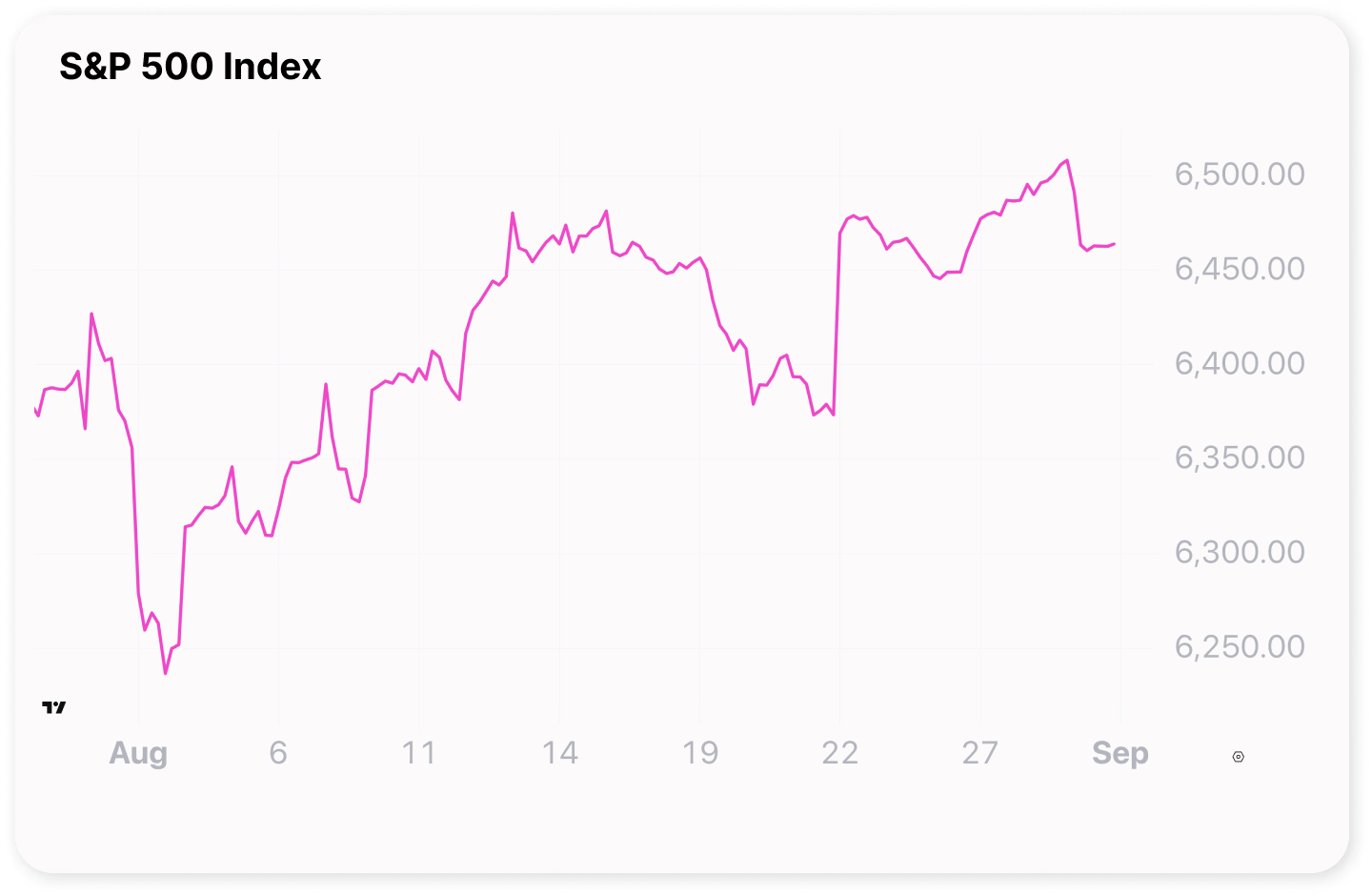
August saw new records across all three major U.S. stock indexes - the Dow Jones, Nasdaq, and S&P 500

Investors showed healthy appetite for equities in August.
This hunger was fueled by an extended trade truce between China and the U.S., strong tech earnings, and surprisingly positive economic data from the world’s largest economy.
This data has fueled hopes that the U.S. Federal Reserve will cut rates in September.
Negotiations for peace in Ukraine and the trade agreement between the EU and the U.S. also contributed to the positive sentiment, continuing the frenetic activity we've seen on financial markets over the past few months.
August saw new records across all three major U.S. stock indexes - the Dow Jones, Nasdaq, and S&P 500.
The broad European STOXX 600 index was just a few points shy of its highest level for the year, reached in March.
In Hong Kong, the Hang Seng index hit a three-year high, while the FTSE 100 in the UK posted a series of new closing records throughout August.
If we examine at the market's mood barometer - the VIX, also known as the "Fear Index"—we can see that investors are feeling relaxed after their summer holiday. In August, the index hit its lowest level of the year, at around 14. In comparison, the index was up at 60 when Trump launched his trade war back in April.

For now, the market seems to have forgotten about the trade war, fears of a weakened U.S. economy, and warnings of a new tech bubble.
However, the market can still experience dips when the American president attacks the U.S.'s independent institutions. Two recent firings by Trump have caused concern in the financial markets and led to a drop in stock prices. The same is true for the Trump administration's historic acquisition of a U.S. chip giant.
A Growing Rift in U.S.-India Relations
But let’s start in Asia. Here, a new dance is finding its rhythm - The Elephant Dragon Tango.
August 12 was the deadline for a trade agreement between the U.S. and China, which had a 145% tariff imposed by the U.S. back in April.
The two countries have now agreed on a framework deal with a 30% tariff on Chinese goods and 10% on American ones.
A new deadline for a final agreement has been moved to early November.
India was not so lucky.
Here, the American president raised the tariff by an additional 25% to 50%. This is because India has continued to import oil from Russia following the invasion of Ukraine in 2022.
This has become a thorn in Trump's side. He announced at the beginning of the year that he could stop the war in Ukraine in 24 hours. We all know that hasn't happened, and therefore Trump can no longer turn a blind eye to the Indian and Russian oil deal, which is helping to finance Russia's invasion of Ukraine.
Trump's tariff hammer has caused cracks in the otherwise warm relationship between him and Indian President Narendra Modi, who have had a bromance going since Trump's first presidential term back in 2020.
Even if India and the U.S. later reach a new trade agreement, deep cracks have now been created in the relationship between the world's largest and fifth-largest economies.
The Elephant and the Dragon
India is already busy finding new friends. The country is in ongoing negotiations for a major free trade agreement with the EU. But perhaps more interesting, it could push two former enemies into each other's arms.
Back in April, Chinese President Xi Jinping used the phrase "Dragon-Elephant Tango" to symbolize a new spirit of cooperation between India and China.
Historically, the two countries are very far from each other on the dance floor. Their last armed border conflict was only in 2020, and the two Asian giants are locked in an intense competition in Africa, where they both seek economic and trade dominance.
As a result, Trump's "America First" policy could very well undermine the U.S.'s role in Asia—and unintentionally give China more economic and strategic power if India chooses to see the Middle Kingdom as a more reliable partner than the U.S.
Trump, the Peacemaker
However, trade wars and broken friendships aren't what preoccupy the U.S. president most. No, he wants to be considered for the Nobel Peace Prize and to be remembered as a "peacemaker."
"My proudest legacy will be that of a peacemaker and unifier."
To work on his legacy, Trump traveled to Alaska in August. Here, he met with the Russian president for initial peace talks on Ukraine. The EU and Ukraine were not invited, so there was likely great satisfaction that a deal wasn't made over their heads.
Subsequently, Ukrainian President Zelensky visited Washington along with the EU and NATO to discuss things with the American president. This meeting went much better than the last time Trump and Zelensky met.
That was a cringeworthy experience for everyone.
During the meeting in the Oval Office, the Ukrainian president was accused of being poorly dressed, forgetting to say thank you to the U.S., and starting World War III.
Zelensky has apparently learned his lesson and remembered to thank the U.S. for its support - I stopped counting at "thank you" number eight.
The meeting resulted in Trump now working to set up a face-to-face meeting between Zelensky and Putin, possibly as early as the beginning of September.
A "Kinder Surprise" from the U.S.
Bringing the spotlight back to domestic events, we now look at unexpected moves within the U.S.
At the beginning of the month, the U.S. jobs report landed, which was much weaker than expected. July saw an increase of 73,000 jobs, compared to an expected increase of around 110,000. At the same time, the job creation numbers for June were sharply revised downward.
The weak job numbers created renewed doubt about the strength of the U.S. economy, and in the wake of the report, the S&P 500 index took its biggest dip in over two months.
The Numbers Back Trump's Dream
The weak job count is bad news for the American (and therefore global) economy, but it's good news for Trump's desire for a rate cut from the U.S. central bank, the Federal Reserve.
Trump wants to cut the interest rate so the U.S.'s rapidly growing national debt becomes sustainable. Lower interest rates will make it cheaper for Americans to borrow money for consumption (U.S. private consumption accounts for 70% of U.S. GDP) and easier for companies to finance new projects.
Bonds will also become less attractive, pushing investors into stocks. All of this will make the economy look stronger, especially in the short term, which would be politically favorable for Trump leading up to the 2026 midterm elections.
The U.S. inflation numbers for July (CPI figures) brought the president's wish closer to reality. The U.S. consumer price index remained unchanged at 2.7%, while a small increase to 2.8% was expected.
This means there are no signs yet that the tariff increases on imported goods are truly pushing prices up.
Inflation has been the big concern for the Federal Reserve (the Fed) and the main reason why Fed Chair Jerome Powell has resisted Trump's pressure to lower the rate.
However, when you combine the past month's weak job numbers with the unchanged inflation, a rate cut from the Fed in September is now seriously on the table.
A rate cut from the Fed in September is now seriously on the table
Jerome Powell himself confirmed this during his speech at the central bank's annual conference in Jackson Hole, Wyoming, in late August.
You're Fired
Not a month goes by without a controversial firing from the American president on his social media platform, Truth Social.
The disappointing jobs report led to Trump immediately firing the chief statistician behind the numbers, Dr. Erika McEntarfer. This is another example of the Trump administration interfering with otherwise independent institutions in the American system.
It has raised concerns in the financial markets. We saw this on Monday, August 25, when the S&P 500 closed in the red.
Here, the Federal Reserve's independence was once again put to the test when Trump fired female Fed board member Lisa Cook.
The U.S. president cannot fire a Fed member just because he disagrees with their interest rate decisions. Otherwise, Fed Chair Jerome Powell would have been out of his office long ago. But the Trump administration claims it can prove that Cook committed mortgage fraud, and that's enough for a firing.
Trump has instead nominated Stephen Miran, who is behind Trump's major "economic plan" to weaken the dollar.
He must still be approved by the Senate, but with Miran, Trump would gain indirect influence within the Federal Reserve.
TINA survived the summer
Shifting to critical market drivers, we look at whether tech stocks can keep the 'TINA' dynamic going.
In recent months, institutional investors have redirected an allocation of their investments in the U.S. to Europe and Asia, among other places.
Private investors, however, have continued their record-breaking purchases of U.S. stocks, thereby supporting American valuations.
The investment bank Goldman Sachs has said that the "TINA trade" is still alive and well.
The acronym stands for "There Is No Alternative," referring to investors' preference for American stocks.
TINA - There Is No Alternative
Warnings of a coming correction (a drop of 10 to 20%) among the highly-priced U.S. tech stocks are, for now, being ignored.
One of the concerns is the challenges tech companies face in China. We saw this when the long-awaited earnings report from chip giant Nvidia landed on August 27. The report beat market expectations, but uncertainty about future sales in China is creating volatility in the stock.
Adding to the tech concerns is the fact that the U.S. government has now announced a 10% state-owned stake in the chip giant Intel.
"I will make these kinds of deals for our country all day long," Donald Trump wrote on Truth Social.
I will make these kinds of deals for our country all day long
It's a bit of a wildcard to throw into a sector that is carrying the majority of the upturn in the U.S. stock indexes.
It also represents the first tentative steps toward state capitalism in the American tech industry.
This is interesting, as Trump is known for celebrating free market forces, but it's apparently a path the American president intends to continue down.
Buy Danish?
We'll wrap up with another stock market record - a boring one.
The Danish OMXC25 index is now officially the worst-performing leading stock index in developed markets this year.
The index is down almost 7% for the year and closed August with a loss of just over 5%. This poor performance can mainly be attributed to a downward guidance revision from Denmark's most valuable company, the pharmaceutical giant Novo Nordisk.
Headwinds for Ørsted, a global leader in offshore wind turbines, have also cost Danish investors dearly.
This means that there is currently a discount on high-quality Danish companies.
Maybe in the final months of the year, some investors will be tempted to follow the legendary value investor Warren Buffett's famous saying: "Buy Low, Sell High.”