
4/1/26
Financial Markets 2025 – A Turbulent, Record-Breaking Year Learning to Live with Trump
From Trump’s Liberation Day, gold’s all-time-high to interest rate discussions - this is the wrap up for the year.

2025 was a rollercoaster for financial markets.
The year started with optimism, fueled by hopes for U.S. tax cuts and deregulation. Investors were riding high, expecting smooth sailing ahead.
Then came April 2 – Trump’s self-styled “Liberation Day.”
With a sudden imposition of steep tariffs on goods from much of the world, the U.S. president sent shockwaves through global markets.
Confidence in the world’s largest economy wavered, and questions about global growth multiplied.
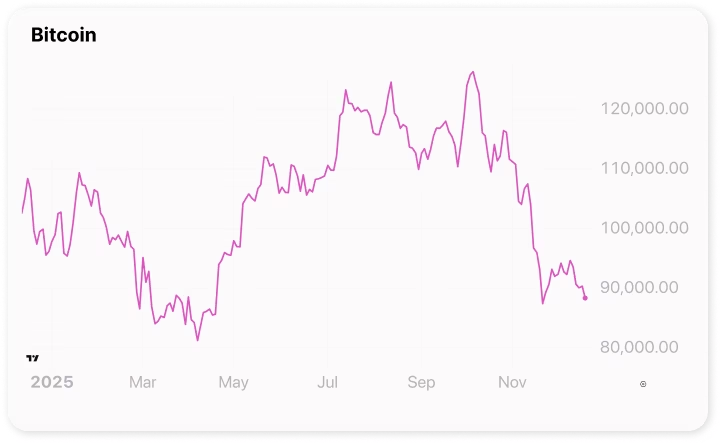
Investors sought refuge in traditional “safe havens.” Gold surged to record levels, while Bitcoin solidified its reputation as “digital gold,” as faith in the dollar waned.
Meanwhile, China made its move in the AI race with the launch of DeepSeek AI, its answer to ChatGPT.
The debut not only signaled China’s serious ambitions but also rattled U.S. tech giants and equity markets alike.
AI emerged as more than a technological megatrend - it became a central driver of both market sentiment and growth expectations.
As the year progressed, the intersection of technology and macroeconomics dominated headlines.
Massive AI investments, sky-high valuations, and growing political noise pushed markets to focus increasingly on U.S. interest rate policy: Would the Federal Reserve (Fed) cut rates, and if so, how many times?
Trump’s public attacks on the Fed only heightened concerns about the independence of the world’s most influential central bank.
Underlying all of this was the dual tension of an AI bubble and rising geopolitical friction, shaping a new world order.
One where Europe faces the challenge of standing alone, and Asia asserts its growing influence.
A Christmas Gift from the U.S.
December’s headline event was the Federal Reserve’s final meeting of the year.
Rarely has market uncertainty been so high ahead of a Fed decision.
The only certainty?
If rates weren’t cut, equity markets worldwide were poised for a sharp sell-off.
Fed Chair Jerome Powell, however, delivered a gift. Rates were lowered for the third time this year, by 25 basis points, to a target range of 3.50–3.75%.
Yet the decision exposed historic divisions within the FOMC’s 19 members (12 of whom vote): two voting members wanted rates unchanged, one supported a larger 50-basis-point cut, and four non-voting members backed maintaining current rates.
The Fed’s dot plot continued to signal a single rate cut next year.
Powell, however, left markets guessing, keeping the door open for further cuts in 2026.
With Powell’s term ending early next year, Trump now has the chance to nominate a more dovish Fed Chair, potentially aligning monetary policy with his economic agenda.
Speculation points to former Fed Governor Kevin Warsh or National Economic Council Director Kevin Hassett, fuelling market expectations for additional rate cuts.
The Goldilocks Scenario
Alongside the rate cut, the Fed also raised its growth forecast.
GDP projections rose from 1.8% to 2.3%, while inflation expectations for the coming year were lowered.
Economists call this a “Goldilocks scenario”—growth accelerating without corresponding price pressures.
The Fed is betting that Trump’s tax cuts will gradually translate into stronger economic activity.
The labor market, however, remains a wildcard.
Since May, monthly job growth has slowed by an average of 17,000 positions, the main driver of the Fed’s rate cuts.
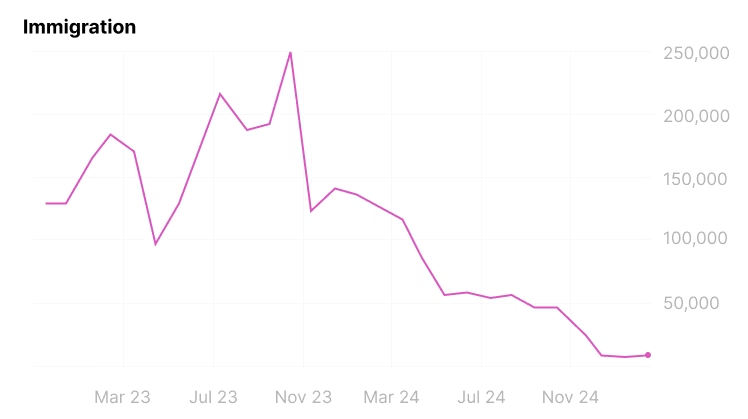
Part of the slowdown is linked to Trump’s immigration policies: annual arrivals of undocumented immigrants have dropped from 250,000–350,000 to under 50,000, reducing labor availability and limiting job creation.
Europe on Its Own
The ECB’s final meeting of the year brought no surprises.
Christine Lagarde left rates unchanged as inflation hovers around 2%.
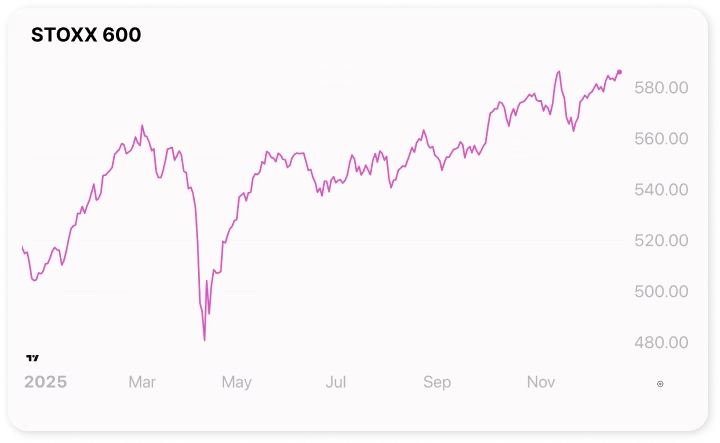
Unlike the Fed, the ECB may have room to raise rates in 2026. Europe’s growth outlook is improving, though industrial production still lacks momentum, and Trump’s tariffs hit less than feared.
Germany has suspended its debt brake, opening €500 billion for infrastructure and defense investments.
With Europe’s largest economy loosening fiscal policy, the ECB may need to tighten rates to maintain economic balance.
December also highlighted Europe’s isolation. The U.S. unveiled a new security strategy, identifying the EU—not Russia or China—as the adversary.
Trump reinforced this, calling Europe a “decadent collection of nations led by weak leaders.”
A more self-reliant Europe will require increased public spending.
This is likely to support economic growth, but it may also put upward pressure on inflation. In turn, this could prompt the ECB to raise interest rates.
China: Independent and Resilient
The year’s global stage was dominated by Xi Jinping and Donald Trump.
Triple-digit tariffs from the world’s two largest economies shook global supply chains.
Markets cheered late-year when Xi and Trump met face-to-face—the first time since 2019—agreeing on a temporary trade truce.
Xi entered negotiations from strength.
China dominates rare earth markets, both in mining and processing, securing a key role in the world’s green and tech-driven future.
December surprised markets: exports remained China’s growth engine despite Trump’s tariffs.
Dollar-denominated exports rose 5.9% in November year-on-year, while exports to the U.S. fell 28%, marking eight consecutive months of decline.
Innovation Power
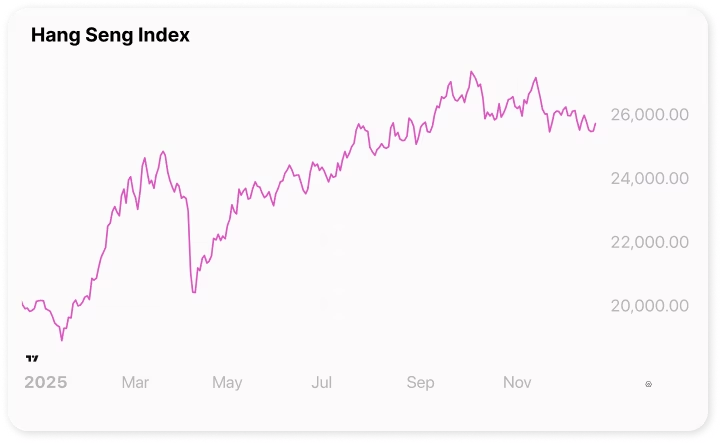
China’s export success contrasts with domestic challenges: weak consumer spending, sluggish investment, and a cooling property market.
Beijing has yet to deliver breakthrough measures to boost consumption, but 2026 may reveal more ambitious policies.
The March rollout of China’s five-year plan at the National People’s Congress will signal priorities. In 2025, China celebrated major advances in AI and robotics.
The launch of DeepSeek AI highlighted the country’s ability to bypass chip restrictions and achieve self-sufficiency through software optimization.
The old cliché—“USA innovates, Europe regulates, China copies”—is now outdated. China rivals the U.S. in innovation, and the West increasingly looks east for inspiration.
Cautious Optimism for 2026
After a turbulent 2025, some optimism has returned.
Post-April tariff shocks, several trade agreements have eased tensions and reduced the risk of severe economic disruption.
The 2026 midterm elections approach - a historically protest-driven vote that can weaken the president’s party - potentially limiting Trump’s policy leverage and reducing fears of interference in independent U.S. institutions.
U.S. companies continue to deliver strong earnings, with double-digit growth among S&P 500 constituents.
Valuations remain high, but robust earnings justify price levels.
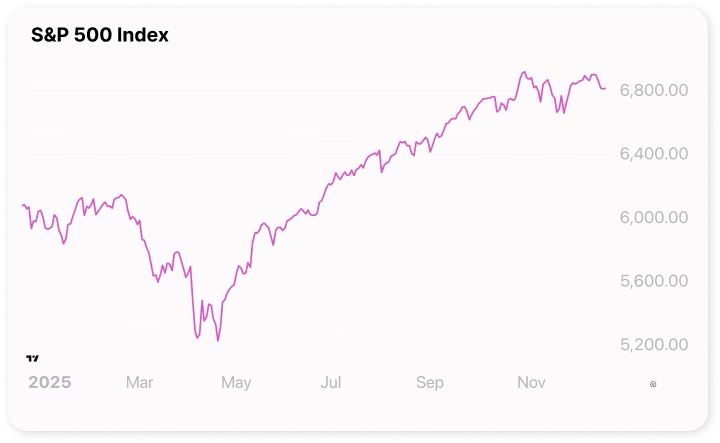
AI uncertainty carries into 2026.
Key questions: Can AI investments be funded from earnings, or increasingly through debt? AI is boosting productivity and profits, yet overvalued companies remain.
Investors are spreading risk into Emerging Markets and Europe.
Overall, expectations point to roughly 7% returns for the U.S. equity market in 2026, supporting a continued positive global market environment, with the U.S. remaining the primary growth driver.