
28/5/26
Kim Kardashian's New Fundraise: How Skims Became a Cultural and Economic Powerhouse
Kim kardashians new fundraise: how skims became a cultural and economic powerhouse

Certain companies manage, early on, to position themselves at the front of cultural conversation.
Skims is one of them. In less than five years, the brand has evolved from a shapewear startup into a global apparel force that doesn’t just follow cultural currents - it often predicts them and, at times even sets them in motion.
And this week, Skims reached its newest milestone: a $225 million funding round valuing the company at $5 billion.
The number is impressive.
But the deeper story - the one that explains why Skims has become impossible to ignore - is how it built its influence: with sharp cultural timing, surprisingly good products, and a willingness to push boundaries even when it draws backlash.
Now, there is steady speculation over whether Skims may eventually pursue an IPO. CEO Jens Grede has hinted at the possibility, though without a timeline.
A public listing would, for the first time, allow everyday investors to buy shares in the company.
For now, Skims remains a private company, accessible only to institutional players.
What follows is how Skims arrived at this moment and why its path has been shaped by controversy as much as by success.
How Skims Learned to Hit Culture at the Exact Right Moment
Few companies in the fashion industry - celebrity-backed or not - have demonstrated Skims’ ability to release campaigns at the precise moment the audience is paying attention.
Take The White Lotus.
The show instantly became a cultural juggernaut. Its second season dominated group chats, TikTok, Twitter, and awards conversations for weeks, with fans obsessing over everything from conspiracy theories to costumes.
And among the most beloved characters were Simona Tabasco and Beatrice Grannò, who played two charismatic, sharp-witted local sex workers. Their scenes became iconic.

Skims released a Valentine’s Day campaign featuring the pair the same week the finale aired.
The timing was so exact that it felt less like marketing and more like a continuation of the storyline fans were already emotionally invested in. How they managed to predict the virality of the show, book the actresses, shoot the campaign and release it in that week is still beyond me.
The subsequent Sabrina Carpenter campaign followed the same pattern.
Days after her single went number one and she became the internet’s unofficial sweetheart, Skims dropped a campaign featuring her. It hit at the highest possible point of her visibility.
These aren’t isolated wins. Skims pulled similar timing with campaigns featuring Ice Spice, SZA, and the entire U.S. Olympic women’s basketball team - each calibrated to moments when those figures were dominating the public eye.
As a co-founder of Female Invest, I love following and studying what enables certain brands to break through noise.
One perfectly timed campaign can be luck. But doing it over and over, across years, genres, and audiences, signals something much more deliberate and strategic.
However they’re making these timing decisions -through cultural analysis, instinct, or both - the consistency is in my opinion nothing short of astonishing.
The Waitlists, the Basics, and the Products People Actually Wear
For all its viral moments, the core of Skims’ business is surprisingly simple.
The items that sell the most are not the splashy or eccentric pieces—they’re the everyday essentials in neutral colors:
- underwear
- cotton rib tanks
- t-shirts
- pyjamas
- loungewear
These basics routinely rack up waitlists in the hundreds of thousands.
They sell out within minutes.
They’re quiet products that consumers actually reach for every day, which is likely why they keep selling at such velocity.
I learned this firsthand. Although I have admired their branding from a far, I wasn’t really interested in trying the products as I find that celebrity brands rarely justify their price tags.
But last year I received some Skims underwear as a birthday present - and eight months later I wear it almost exclusively (I have since bought more of course).
The quality, comfort and fit were far better than I expected. I hate to say it, but I 100% understand why people keep coming back.
A Brand That Didn’t Grow by Avoiding Controversy
Skims’ rise has not been flawless. If anything, some of its biggest leaps happened after missteps.
The “Kimono” Name
Before the brand officially launched, it attempted to debut under the name “Kimono,” which sparked enormous global outrage. Social media erupted and Japanese officials even publicly criticized the name.
Kardashian ultimately backed down and rebranded to Skims before launch. It was a stumble, but it also forced the company to confront the cultural weight of its decisions early.
The Face-Sculpting Mask
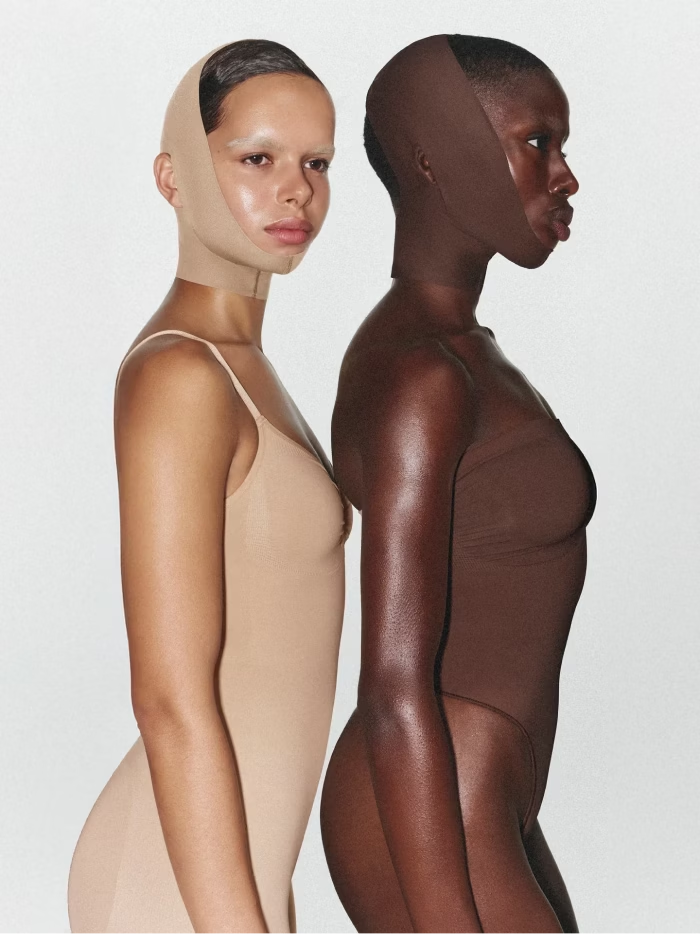
More recently there was the so called “face-sculpting mask” - a sort of elastic facial wrap promising tighter “contours”. More than anything a bizarre contraption that I still can’t wrap my head around.
The product was instantly mocked. With good reason might I add. Twitter and TikTok filled with users calling it dystopian and ridiculous.
Memes flourished.
The loudest critiques argued it played into unrealistic beauty pressures.
But here’s what’s interesting: part of me suspects Skims knew exactly what it was doing.
Launching a deliberately strange, almost theatrical product generates enormous attention. Whether customers love it or loathe it, they talk about it.
They share it with their friends. And in a media environment where attention is everything, Skims seems fully aware that outrage can be its own marketing tool.
The controversy didn’t hurt the brand.
If anything, it reinforced a pattern: Skims is willing to enter uncomfortable territory, and it understands that sometimes the public pushback only amplifies its presence.
Partnerships That Signal Expansion, Not Just Hype
Beyond viral campaigns and controversies, Skims has also expanded through collaborations that bring the brand into new categories.
The North Face partnership placed Skims alongside a trusted outdoor brand, introducing a surprising crossover between technical outerwear and everyday basics.
The NikeSkims collaboration pushed the brand directly into performance and activewear - one of the few categories where large companies have historically underserved women.
It was a sign not just of Skims’ cultural influence but its ambition to become a full-spectrum apparel player, far beyond shapewear.
These collaborations worked because they placed Skims in contexts where consumers wouldn’t normally expect to see it—and yet, once there, it somehow couldn't be more fitting.
Community Activation: Skims’ New Play for Physical Presence
Another factor in Skims’ cultural staying power is its ability to turn digital momentum into real-world experiences.
One of the brand’s most talked-about stunts this year was its takeover of an old-school American diner - a fully Skims-branded pop-up that served as both a marketing event and a community activation.
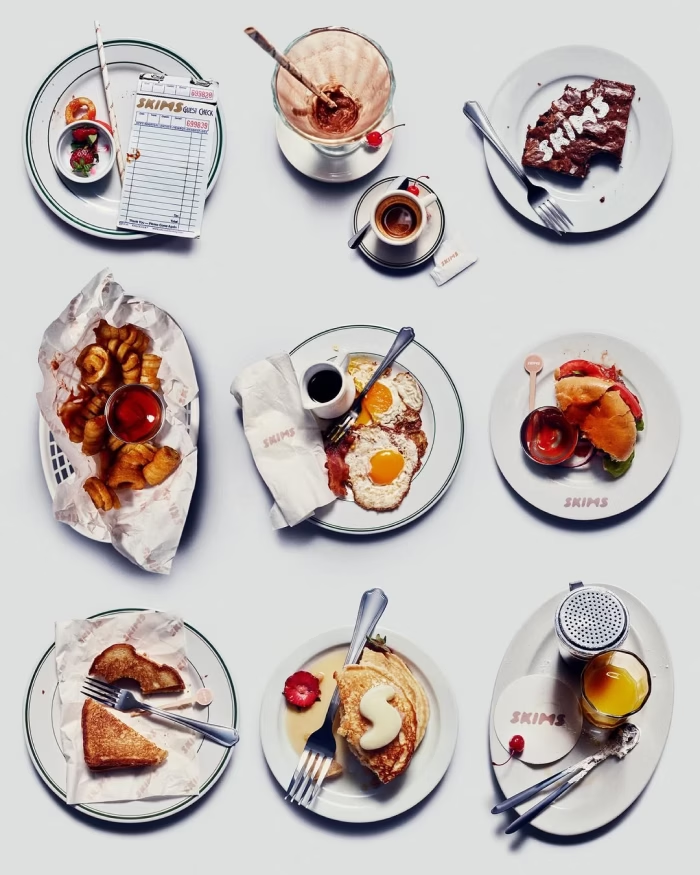
Fans lined up for hours not just to buy product, but to be part of the moment: snapping photos in Skims-wrapped booths, ordering from a cheeky custom menu, and posting the experience across TikTok and Instagram.
It was a clever inversion of traditional retail - the store wasn’t a store, the menu wasn’t really a menu, and the point wasn’t sales so much as presence.
What Skims engineered was a physical manifestation of its digital ecosystem: a place where fans could step inside the brand’s world.
For a company built on online virality, these pop-ups show an understanding that culture still happens in physical space - and that community, when activated thoughtfully, can become its own form of marketing.
What Kim Actually Does Inside the Company
Despite her celebrity image, Kardashian has repeatedly emphasized that Skims is not a passive investment or a licensing deal.
“I do everything from all the design to pick out all the campaigns. That’s my daily job.”

It’s one of the more overlooked aspects of the company’s rise.
Kardashian is deeply involved in product decisions, creative direction, photography, and campaign strategy.
Whether or not one likes her public persona, she is not simply lending her name to a business run by others. Inside Skims, she is - as she puts it - working.
Still Private - But With Public Market Energy
Despite its massive consumer presence, Skims is still a private company — meaning retail investors can’t buy shares.
Ownership remains with Kim Kardashian, the Gredes (who, based on the podcast interviews I devoured whilst researching this piece, both come across as very talented and visionary), and a group of private equity and institutional backers, including Goldman Sachs Alternatives and BDT & MSD Partners.
But the company’s scale, profitability, category expansion, and brand recognition have pushed the conversation about a possible IPO into more serious territory.
An initial public offering would force transparency, require financial disclosures, and bring Skims into a more structured corporate environment.
It would also be a symbolic shift: the transition from cultural force to publicly traded institution.
Jens Grede, the company’s CEO, has been careful not to overpromise. Still, the question of whether Skims is preparing for public markets now shadows every announcement the company makes.
Why Skims Matters
Skims’ rise has been messy, controversial, and often bold. But that is precisely what makes it so fascinating to watch from the sidelines.
It understands cultural timing better than almost any other brand in the market.It moves with unusual speed.
It doesn’t avoid controversy; it incorporates it.
It gets attention through spectacle but earns loyalty through incredible products.
Whether Skims stays private or eventually lands on the public markets, it's definitely a company worth paying attention to.