2/9/26
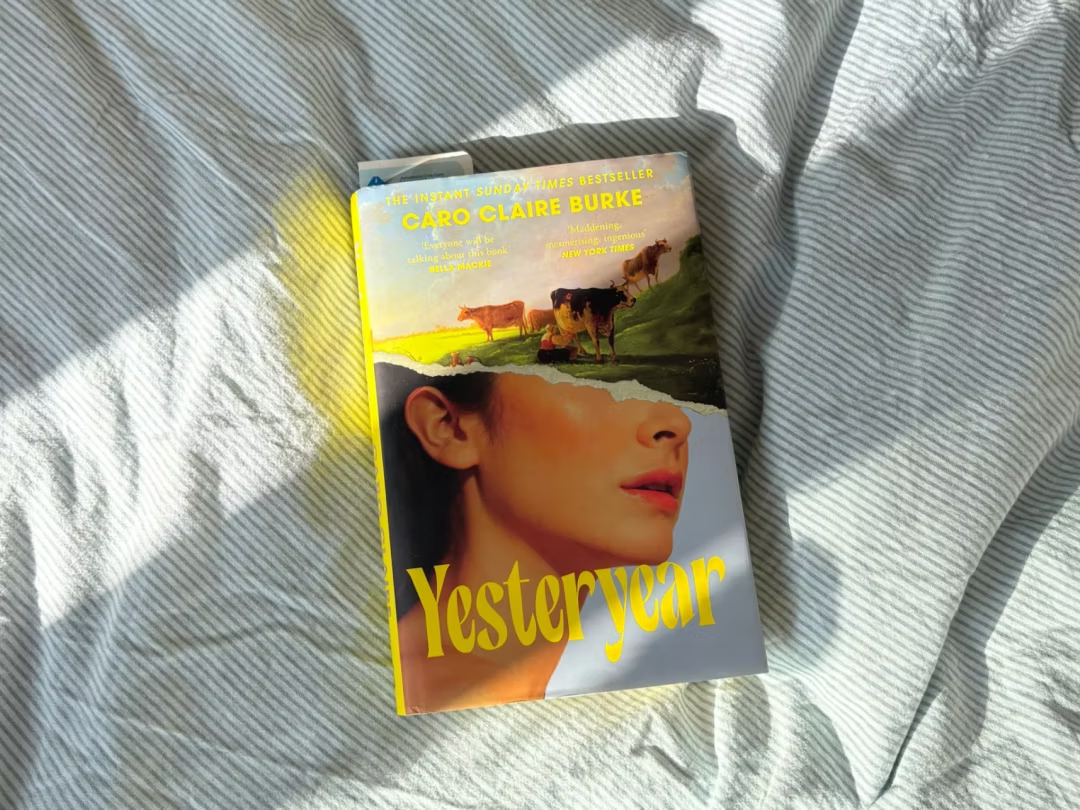
My 3 key takeaways from reading this summer’s most hyped book, Yesteryear
Spoiler: it's not just about tradwives.

I gave the most hyped book of the summer a read, and went into it thinking I was going to read a light, satirical story.
I was so wrong.
I laughed, was shocked, but most importantly, Yesteryear led me to reflect heavily on the world we live in.
So here are my three take-aways on why Yesteryear matters even more than I expected.
Spoiler alert: there's a lot to unpack.
What Yesteryear is about
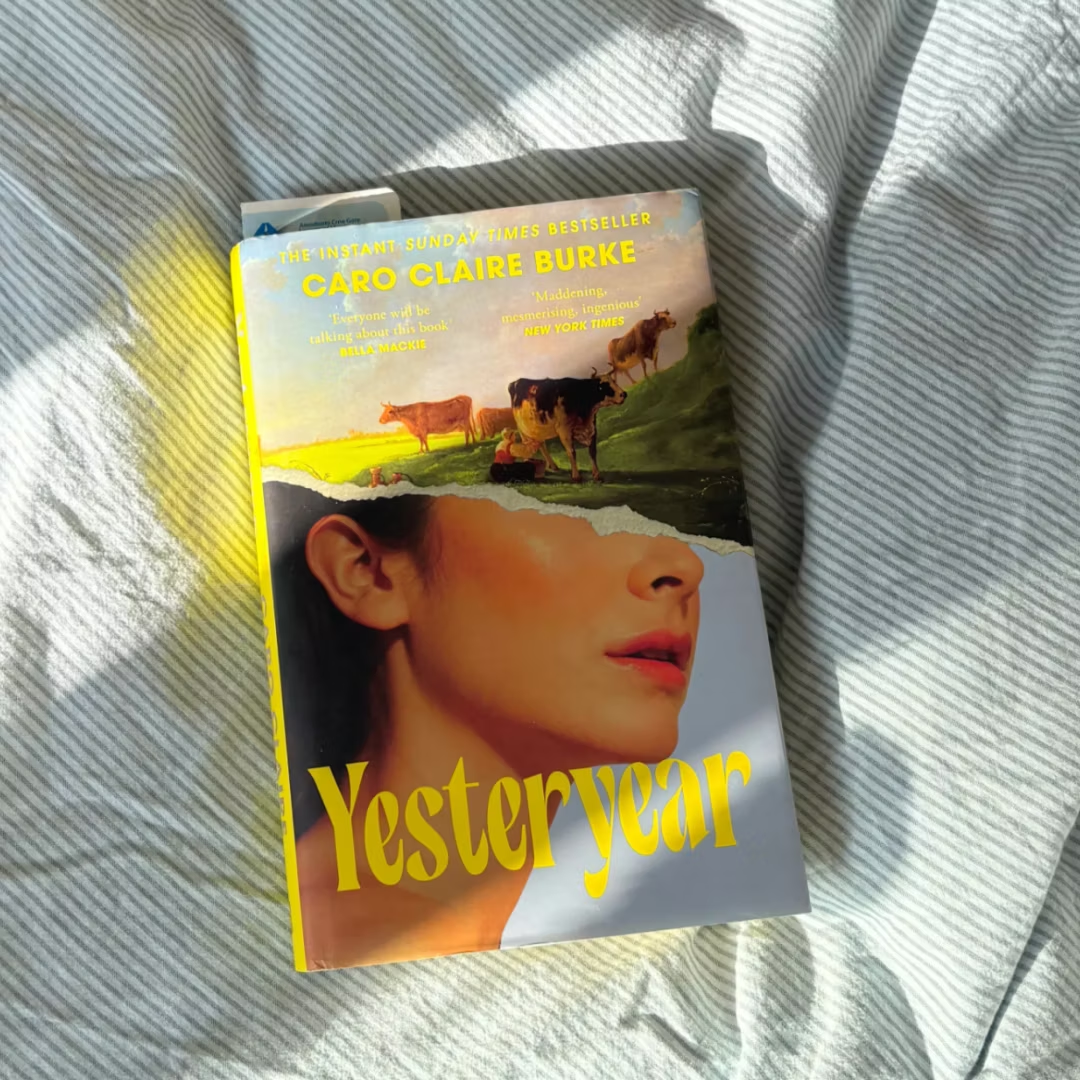
If you’re on social media, and your algorithm puts you even remotely close to “booktok”, you’ve probably seen what arguably is this summer’s most talked about book: Yesteryear by Caro Claire Burke.
Before we get into it, a quick recap of what Yesteryear is actually about — and FYI, I kept it as free of spoilers as possible!
Yesteryear is the fictional story of a “tradwife” influencer, Natalie Heller Mills, who one day wakes up in the 1800s instead of the 2020s, and has to actually live the life she promotes.
Natalie lives on a farm in Idaho with her husband and five (soon to be six) children.
Her husband, Caleb, is the youngest son of a wealthy and conservative US senator, and, more importantly, a complete manchild and dimwit.

She bakes bread from scratch, and sells cookbooks and raw milk, and the fantasy of a “real American family” to her followers. In her own words:
"And who was I?A flawless Christian woman. The manic pixie American dream girl of this nation’s deepest, darkest fantasies. The mother every woman wanted to be, and the wife every man wanted to come home to. Like a nun in a porno, it didn’t make sense, but also, by God: it worked.My name is Natalie Heller Mills, and I was perfect at being alive."
Early on, we learn that she is excellent at upholding this fantasy persona, but on the inside is quite the opposite of the joyful, graceful and straight up “perfect” woman she portrays to the outside (and by outside I mean not just her followers, but also her husband, parents in law, and her own family).
On numerous occasions, she is calculated and jealous, but also simply overwhelmed, frustrated, and exhausted.
So what’s my ruling?
Ahead of my summer vacation, I had already picked out the 2-3 books I wanted to read - Yesteryear was not one of them, also after seeing some mixed reviews.
But the book’s topic did really catch my attention, and when my roomie had bought and read it, simply borrowing it from her made it too enticing not to read, and too hard to not feel like a part of all the online conversation going on.

Now let's get to it.
Overall, I liked it – and let me tell you why:
- It makes you reflect. I love books I still think about days after finishing them. I've caught myself bringing it up more than once over dinner, and of course over lunch with my Female Invest colleagues.
- It reads differently depending on who picks it up. Your background, your values, your upbringing – they all shape how you take this one in. I'm coming at it from a feminist, Gen Z perspective... I mean, I work at Female Invest, come on. In the book, Natalie likes to call the outspoken feminists "the Angry Women" — I happily identify as that.
- It opens an important conversation about #tradwife culture, one that might be more important than ever. Let's get into that.
My 3 key takeaways
Now, what will follow is not a classic book review (even though I’ll gladly debate the book and would be super keen to hear what you think, I’ve you’ve read it!). Because when I was reading the book, I kept coming back to these three topics that I think we should talk about.
1. Women preaching and upholding patriarchal structures are a big part of the problem.
Where Natalie's values come from
If Yesteryear did one thing well, it is creating a deeply unlikeable main character and narrator.
As a reader, you get deep insight into Natalie's thoughts, most of which are filled with negativity, bitterness, and a sprinkle of rage.
To the outside, though, she is very controlled, with a clear set of values she carries.
Those values didn't come from anywhere.
She grew up with a mother who passed on a very clear idea of what it means to be a good, Christian woman: that women are the natural-born homemakers, that your deepest joy and purpose in life is serving your husband and kids, that you only get married once, and that rape in a marriage doesn't exist, because it's your husband, and your body is his to take.
The little lies that hold it together
Natalie learns early on that upholding these values to the outside takes a little white lie here and there.
Her father had left her mother, but instead of stating that fact, her mother simply keeps referring to him as "no longer with us."
Everyone assumes he died – but there's nothing wrong with just not correcting people, is there?
As she grows older, these values become what she preaches day in, day out.
One day she asks her "Mama" how she handled being a mother and homemaker so seemingly easily. Her mother shares a "tip": when doing chores, pretend you're being watched.
Translation: even in private, put on a happy face, so you can save face. You already know you need to be perfect when you're actually being watched, so why not also do it when you're not?
The book might play this out in an extreme version, but I am sure a lot of us can relate to the underlying assumption and associated feeling: women need to be this, they need to look this way, they need to be put together to be taken seriously.

While we get a lot of insight into Natalie's internal monologue, and see her question some of these assumptions the teeniest bit, she brushes those questions aside just as quickly.
She never really questions the system that makes her think this way (hello patriarchy!) – quite the opposite, she actively promotes it, preaching what her mother told her, and her mother was probably told by hers.
And while this book tells a fictional story, we know this thinking is alive and well in our reality too.
With the rise of "tradwives," it's being broadcast on social media to millions of viewers.
And that, quite frankly, is very, very problematic.
To put it in a nutshell: Yesteryear made me gain a newfound awareness that the women preaching and upholding patriarchal structures are a big part of the problem, too.
2. Internalised misogyny is well and alive.
The women Natalie can't stop judging
But Natalie's harshest judgment isn't reserved for herself – it's the women around her who bear the brunt of it.
The probably most interesting relationships in the book to me are the women-to-women ones.
Or shall I say women-vs-women?
I’ve already shared that a lot of Natalie’s thoughts are extremely negative.
To me, those internal thoughts come most alive whenever Natalie is thinking about some of the women in her life: her mother-in-law Amelia, her sister Abigail, her first-born daughter Clementine, her liberal, future-management consultant colleague roommate Reena, the “Angry Women” online.
She never really sees them as allies, and she judges them harshly.
One of the most amusing moments for me actually was whenever Natalie thought about Reena (maybe because I can relate a bit to her - an ambitious career woman who went into management consulting after graduating from business school).

The sheer amount of mentions Reena gets without even being in the room - Natalie just thinking about her, assuming her to be struggling in the corporate world which is so not meant for her, or any women for that matter.
One particular time, she imagines how miserable Reena must be after accepting an internship at McKinsey and wanting to climb the corporate ladder:
"From here on out, Reena's life was going to be hard. She would have to work hard to get the job, hard to keep it, and even harder to get promoted — and any promotion would lead only to more work, more hours, more responsibility."
Structural bias vs. the bias we carry ourselves
Yesteryear's real problem isn't that Natalie chose a homemaker's life – it's that she believes it's the only right way for a woman to live, and judges every woman who chooses differently.
And where it becomes really problematic is the "thinking out loud" that there's one designated box a woman needs to fit into – and talking down on anyone who doesn't fit it.
It's very clear how much internalised misogyny Natalie holds, and how little she wants women who don't align with her values to succeed.
But structures nurtured for centuries get internalized by all of us, to varying degrees – and it takes conscious effort to notice them and go against the grain.

I'm sure everyone can think of a story, their own or a friend's, where another woman rubbed them the wrong way.
"She has it out for me." "It's her or I, they only want one woman in leadership." "I'd rather work with men, it's always so complicated with women."
See a pattern?
Part of it is structural: companies wanting exactly one woman in leadership to point to for optics.
Part of it is internalised misogyny: feeling like only one of you can succeed, when in reality, you both could.
Women can uplift each other, or they can pick each other apart.
Patriarchal structures, and a lack of awareness of them, often makes us do the latter.
3. Social media is a fantasy (a dangerous one)
The unrealistic economics of "effortless"
Let’s face it - the “tradwife” corner of the internet is a paradox in itself. The literal definition of a “tradwife” is that the man is the primary breadwinner, and the woman takes on the (unpaid) care and house work. Successful “tradwife” influencers, on the other hand, make a – excuse my language – shit ton of money.
Stepping outside the book for a second: this isn't just true for Natalie.
Real "tradwife" influencers work just as hard behind the curated calm — creating concepts for videos, filming, editing, monitoring comment sections.
We learn Natalie is very successful with her account around her family and the "Yesteryear" ranch – successful enough to afford the most deluxe kitchen equipment and hire multiple nannies plus a producer, Shannon, who tries to capture every "candid" and absolutely-not-staged moment of Natalie, her kids, and the chickens they call "the ladies."
When it comes to influencer culture specifically, a very female dominated industry, I have a lot of respect for those working very hard.
And despite what it might look like, the fewest influencers come up overnight - it usually takes years of consistency, hard work and putting yourself out there.
It’s a hustle.
Yet, what I find quite problematic about influencer culture is that they often pretend (or are made to pretend?) that everything is sooooo easy.
They are selling a fantasy - “get ready with me” and put on flawless makeup and a stylish outfit in 15 mins, push a few buttons to publish some real-time edited videos, have a fun night with the girls, wake up to a million likes.
Many of them, and so does Natalie, hide the work that comes with being an influencer: the unglamorous hours spent editing, answering emails, figuring out tax rules for freelancers.
It's worth remembering, too: this "effortless" image is often propped up by a full team, like nannies, producers, editors and not one woman doing it all.
The lifestyle being sold isn't real, or replicable.
What she shows, and what she hides
In Yesteryear, Natalie is very strategic about the content she posts: the sourdough she "makes from scratch," the candid moments of her daughters giggling and picking up eggs.
She's equally strategic about what she doesn't show: the army of nannies and farmworkers, the modern stainless-steel kitchen tucked just out of frame, the diseased chicken thrown in the trash — anything that would break the rustic, "authentic" homestead illusion.
Again, the "blame" here isn't on one side.
As the influencer industry grew, being one became a deeply strategic job — find a formula, run with it, grow your followers, make money.
Selling a fantasy life works because there's demand for it.
That demand has materialized in “tradwife” influencers with massive amounts of following like Ballerina Farm (10.3M on Instagram) and Nara Smith (12.5M on Tiktok).
And there’s no doubt that Caro Claire Burke was heavily inspired by them when writing Natalie.
After all, Nara Smith definitely brought up the phrase “made from scratch”, making things like bubble gum, cola, and capri sun from scratch for her children.
It was also Nara Smith who, in a viral "Call Her Daddy" interview, denounced the "tradwife" label.
Some of her points landed for me - how women are expected to fit a neat box, and how people get angry when someone refuses to.
But plenty of feminists, myself included, were frustrated that she only denounced the label once the public narrative had already started to shift against her.
Bottom line: tradwife influencers are selling a fantasy.
In an age of hyperfast media consumption and shrinking attention spans, it takes real effort to pause and question what we're consuming.
Not all of us do.
But what about the men?
I'm aware these three key takeaways put the focus on women - so what about the men?
What about the patriarchy?
Is that not to blame?
Yes, absolutely.
Yesteryear gives us plenty to talk about there too. Natalie's and Caleb's marriage is a good example - it's clearly Natalie who calls the shots, negotiates with Caleb's father to buy the ranch, and has to gently (and not so gently) parent Caleb through most of his own life.
There are nods to the "feminisation" of men, the male loneliness epidemic, and, frankly, how men are failing within a system they built themselves.
However, fundamentally, Yesteryear centers Natalie — her experiences, her internal conflicts, her being caught in the web of her own values and the life she so badly wanted for herself.
So, is it worth the hype?
My verdict: YES. This summer's most talked-about book was an entertaining read, and one that hopefully opens some eyes about how we view and talk about #tradwife culture.
And whether you're a tradwife enthusiast or not, there's one takeaway that has nothing to do with your politics: financial independence is never something to give up, no matter which life you choose.
Whether you're building a homestead or a career, having your own money means you're never staying somewhere – a marriage, a job, a life – because you have no other option.
That's not a political statement.
That's just good financial sense.
You should give Yesteryear a read if:
- You want to know why "tradwife" content is quietly one of the most effective propaganda machines on the internet right now.
- You've ever caught yourself thinking another woman's choices were a threat to your own – and didn't love what that said about you.
- You think the patriarchy died with your mother's generation. It didn't.
- You think financial independence is a nice-to-have, not a non-negotiable. This book, and this platform, would like a word.