7/1/26
Why some women on LinkedIn are pretending to be men
Women are adjusting their profiles to appear less female and, in some cases, watching their visibility rise

According to reporting by The Washington Post, a curious pattern has taken hold on LinkedIn. Women are adjusting their profiles to appear less female and, in some cases, watching their visibility rise.
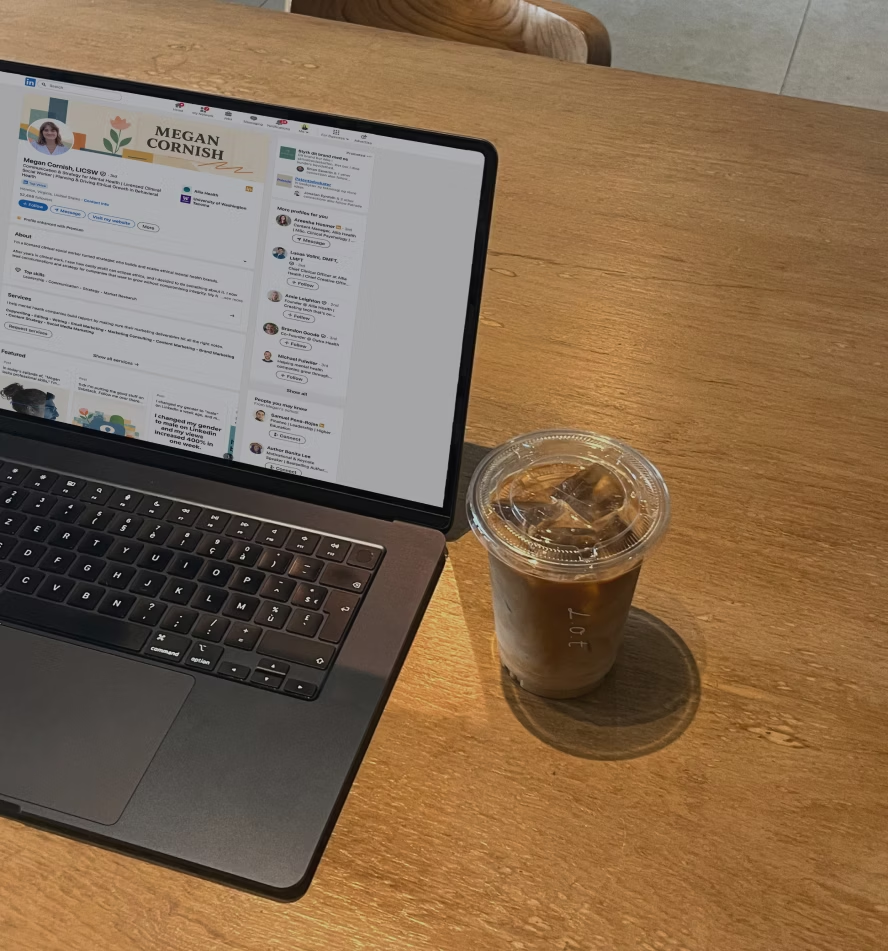
For Megan Cornish, the change began with frustration. As a mental health professional and LinkedIn Top Voice, she had spent months wondering why posts that once reached thousands of people were now stalling.
The drop felt recent, something that had shifted over the past year.
So she tried something small.
Cornish changed her gender marker to “male” and rewrote parts of her profile using more traditionally masculine language. She did not change her experience, her qualifications, or the substance of her work.
Within days, her impressions skyrocketed.
Her newest posts outperformed everything she had shared in weeks.
“I wish I was kidding about this,” she wrote, describing the experiment publicly.
The response was immediate.
LinkedIn filled with screenshots and side-by-side comparisons. Women began testing their own profiles.
Some removed pronouns.
Others rewrote their bios to sound more assertive.
A few changed their names or gender markers altogether.
Many saw sharp and immediate increases in visibility. Others saw no change at all.
Some women, particularly women of colour, reported worse outcomes.
Instead of answers, the experiments produced a sense of unease.
From Lucy to Luke
Jumping on the bandwagon, Lucy Ferguson, founder of the consultancy Fabulous Feminists, changed her name to “Luke” on LinkedIn for one day.
She left everything else the same.
She later said her profile views surged, her posts reached far more people, and job opportunities appeared that she had never seen before.
Others followed.
Simone Bonnett added a fake moustache to her profile photo and described herself as “undercover for a gender bias test.”
Jessica Doyle Mekkes changed only her gender marker and said her impressions jumped several hundred percent.
What counts as credibility
LinkedIn has pushed back on the idea that gender affects visibility.
In official statements, the company said its systems do not use gender or race to decide what content people see.
That response misses a key point.

Professional authority still has a certain sound. Language that signals confidence, ambition, and leadership has long been associated with men.
Platforms that reward engagement tend to amplify what users already see as credible.
Allison Elias, a business professor at the University of Virginia, told The Post that traits often associated with women are still undervalued at work. Systems trained on past behaviour tend to repeat those patterns rather than correct them.
This matters because LinkedIn is not just another social app. It is the app for business opportunities. Being visible often determines who gets considered in the first place.
When the experiment breaks down
Not everyone saw the same results.
Cass Cooper, a Black writer and inclusion strategist, grew sceptical after reading posts celebrating dramatic gains. She suspected race was being left out of the conversation.
When Cooper adjusted her profile to appear as a White man, the reach of her posts fell.
When she appeared as a Black man, it fell even further.
Her experience complicated the story.
Bias online does not work the same way for everyone. Gender and race shape outcomes together, not separately.
“If we’re going to talk about bias, visibility, and influence online, we cannot pretend we all start from the same place,” Cooper later concluded.
The cost of adapting
Cornish never planned to keep the experiment going. She wanted to understand the system, not permanently change how she showed up.
“I don’t want to have to use words like ‘scale’ and ‘drive,’” she said.
After a week, she returned to posting in her own voice.
Others remain frustrated.
Cindy Gallop, entrepreneur and founder of MakeLoveNotPorn, told The Washington Post her reach dropped sharply after LinkedIn changed how posts are distributed.
Gallop has used LinkedIn for decades to connect women to funding opportunities and professional networks. When posts disappear, she said, so do opportunities.
This is the cost of adaptation.
Each experiment shifts the burden onto women to adjust themselves to fit the system. The system itself stays the same.
As AI increasingly shapes hiring and career opportunities, these patterns matter. Studies show that automated systems often favour male- and white-associated names. LinkedIn sits early in that pipeline, as the place where most recruiters find candidates for job opportunities.
The recent experiments are often framed as harmless tests.
Change a word.
Remove a pronoun.
See what happens.
But each test carries the same assumption: that women should adjust themselves to fit the system, rather than ask why the system responds the way it does.