
27/1/26
The IPO Playbook: Why Companies Go Public - and Why Investors Should Care
Every year, headlines shout some version of the same story:

Every year, headlines shout some version of the same story:
“Company X Just Filed for an IPO!”
But despite their unique role in capital markets, it’s not always clear what an IPO really is. This guide breaks down what an IPO is, why it happens, what it means for your portfolio, and how to think about the risks and opportunities like an informed investor.
We’ll also look at what’s happening in Hong Kong right now, showing how these cycles play out in real time.
Let’s dive in.
What Does “IPO” Actually Mean?
IPO stands for Initial Public Offering: the moment a private company sells its shares to the public for the first time. It’s the company’s debut on a stock exchange, where anyone can buy a piece of it, though initial allocations largely favour institutional investors over everyday buyers.
Before an IPO, only founders, employees, early investors, and private funds can own shares. After an IPO, the company becomes publicly traded, opening the door to millions of potential investors.
It’s a huge milestone, and a strategic one.
Why Do Companies Go Public?
Companies choose to go public when they reach a stage where private funding isn’t enough, or no longer makes sense. An IPO opens the door to far more investors, far more capital, and far more opportunities.
Going public allows companies to:
- Raise large amounts of money to expand
- Build new products or enter new markets
- Pay down debt
- Reward early employees with shares they can actually sell
- Give early investors (like private equity funds) an exit, though many exit through mergers or secondary sales, not just IPOs
- Strengthen their reputation with customers, partners, and lenders
Once a company is public, its shares can be traded freely on a stock exchange. That liquidity (the ability to buy and sell easily) is incredibly valuable. It can help the company make acquisitions, attract top talent, and operate with more stability.
In short: an IPO gives a company access to a deeper financial world than it ever had as a private business.
What Does A Company Need To Qualify?
Stock exchanges have rules, and not all companies pass. To list, companies typically need:
- Several years of audited financials (though some exchanges allow earlier-stage listings with lighter requirements, especially on secondary boards)
- Strong internal governance (board of directors, committees, transparency)
- A minimum size or market value
- A clear business model
- Approval from regulators
That’s why very young startups almost never IPO. The process is expensive, slow, and incredibly revealing; you have to publish detailed financial statements every quarter for the world to critique.
Why Do Companies Choose Different Stock Exchanges?
Not all stock exchanges are the same. Each one has its own set of rules, investor audience, regulatory regime, and strategic advantages
Companies choose their exchange based on:
- Where they think investor demand will be strongest
- Which rules, regulations, and tax regimes best fit their business
- How much visibility they want with global investors
- Where similar companies are already listed
- Where they’ll receive the best valuation
For example:
New York is ideal for big tech firms that want global attention.
London is known for established financial and energy companies.
Hong Kong is a gateway to Asia and especially appealing for consumer and tech firms with China exposure.
The exchange a company chooses reflects many factors; not just ambition, but legal, financial, and strategic priorities.
How Is an IPO Priced?
Before a company goes public, one or more investment banks help figure out what its shares should cost. These banks look at the company’s finances, compare it to similar firms, and talk to big investors to estimate demand.
They set an IPO price range, which means they choose the numbers at which shares will be offered on the first day of trading. Typically, banks price IPO shares slightly below what they think the company is truly worth. This gives buyers an incentive to jump in and helps create a strong debut, sometimes leading to a “first-day pop” where the share price rises when trading begins.
This pop is intentional: it makes headlines and signals healthy demand, but it doesn’t guarantee long-term success. After the excitement settles, prices can drop back down, especially if the company was overhyped or underlying fundamentals weren’t strong.
A Little History: IPOs That Shaped The Market
A few IPOs have shaped how investors think today, not necessarily because they went smoothly, but because of what they revealed.
Google (2004)
Google’s IPO didn’t impress on its first day; in fact, the stock barely moved. But over the years that followed, it became one of the strongest performers in the entire market. The lesson: a quiet debut can still become a giant success story.
Facebook (2012)
Facebook’s IPO was messy, with technical glitches and a shaky first week of trading. Yet the company went on to dominate global advertising and dramatically increase in value. Early chaos doesn’t predict long-term performance.
Alibaba (2014)
Alibaba chose to list in New York instead of China, making it the largest IPO in history at that time. The message to investors was clear: companies will list wherever they believe global demand, and valuations, will be strongest.
IPOs reflect the mood of their moment. The long-term story? That’s written later.
What Does An IPO Mean For Investors?
When a company goes public, it steps into the open market for the very first time. For investors, this moment can feel exciting - but also unpredictable. Newly listed companies often move sharply in both directions because the market is still figuring out what they’re truly worth.

Understanding The Risk
Prices often fall after the debut.
A first-day spike doesn’t guarantee strength; many IPOs drift downward once the excitement fades (studies show post-IPO returns often lag broader markets for everyday investors).
You’re buying without a long history.
Private companies don’t have years of public financial behaviour to analyse, so investors rely more on forecasts than proven results.
Some IPOs get overhyped.
Marketing and excitement can temporarily push prices higher than the company’s fundamentals support.
Diversification is your safety net - as always.
If you’re unsure how to value a brand-new company, you can still benefit by holding diversified funds. These funds eventually include new IPOs once the companies mature, without requiring you to pick winners yourself.
Because of these risks, most new investors don’t start by buying IPOs directly. Allocations tend to favour institutions, and retail investors often get exposure later, mainly when the stock is added to index funds or ETFs.
The important thing is understanding what an IPO signals: a new company entering the market, and a snapshot of investor confidence at that moment, not a bandwagon you need to jump on.
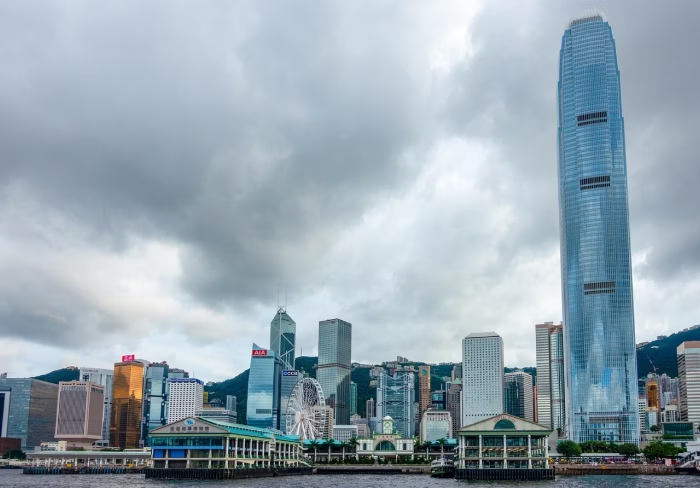
Hong Kong’s IPO Boom: A Real-Time Example
How does all this play out in a real market? Let’s take Hong Kong as an example.
In 2025, Hong Kong saw a bounce back in IPOs:
- Companies raised over $18 billion USD by October, which means more businesses were joining the stock market and raising money from public investors.
The Hang Seng Index (Hong Kong’s main stock market index) went up:
- After a few years of ups and downs, the market showed signs of recovery. This doesn’t mean things are booming, just that investors are becoming a bit more confident and willing to invest again.
Private investors found new ways to cash out:
- With more IPOs happening, people and funds who owned shares in private companies finally had a chance to sell those shares to the public. This is important because they may have waited years for a good moment to do so.
Lots of companies are still waiting to join:
- There’s a big backlog of over 300 companies wanting to have their IPOs, but haven’t been able to do so yet. This tells us that there’s interest, but also that markets can move in cycles: windows can open and close.
Just like the weather changes, so do financial markets. Sometimes IPO activity heats up (lots of companies go public), and other times it cools down (very few IPOs happen).
Hong Kong’s recent wave of IPOs is a sign that investors are becoming more optimistic, but cycles can change quickly. Knowing this helps you understand why IPOs sometimes make headlines, and why trends can shift from hot to cold in just a matter of months.
What This Means For You
Understanding IPOs isn’t about becoming an expert stock picker. It’s about recognising what these moments say about the market.
IPOs tell you when companies feel confident, when investors are hungry for new opportunities, and when global markets are warming up (or pulling back). When you can read those signals, you stop feeling like an outsider looking in.
Because IPOs aren’t just events. They’re turning points - markers of what investors believe about the future.
Sources: