
30/10/25
The New Gold Rush: Why Everyone Is Buying Gold - and What It Means for You
Why are investors suddenly so obsessed with gold, and what does this mean for new investors?

It started quietly, with a glimmer.
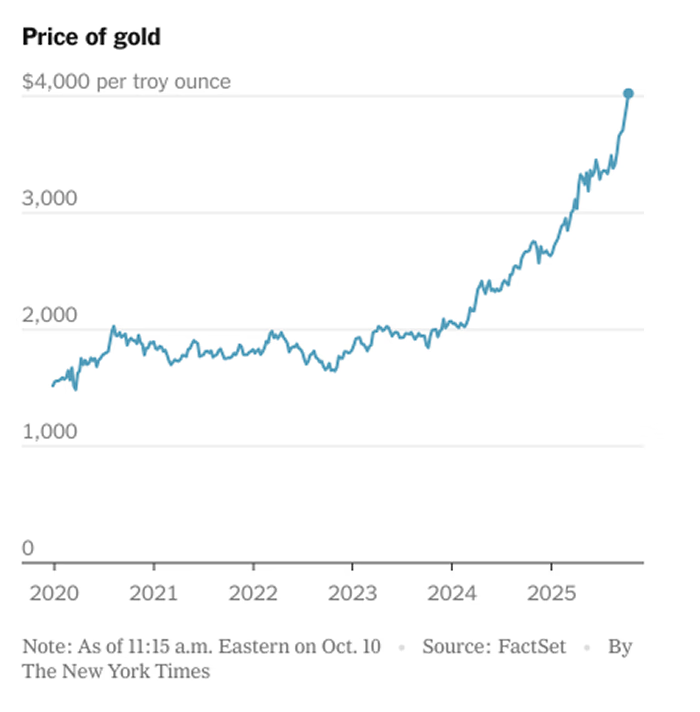
By the time most people noticed, gold had already broken every record in the book. This month, the price of gold surged past $4,000 an ounce for the first time in history. Investors, central banks, and everyday savers around the world have been piling in, sending the metal on its best run since the 1970s.
The headlines call it a “gold rush.” But this rush isn’t for gold in the ground - it’s for reassurance in uncertain times. When the financial world feels shaky, when trust begins to wobble, people turn to the oldest form of security they know: a piece of metal that never rusts, never defaults, and never disappears in a government shutdown.
Between AI hype, stock market highs, and endless digital currencies, gold suddenly feels old-school and solid again.
So what’s going on? Why are investors suddenly so obsessed with gold? And more importantly, what does this mean for someone who’s new to investing, maybe just starting to build their savings or learning to make money work for them?
The Psychology of Gold: Why Fear Makes It Shine
Gold has always had a strange power over us. It doesn’t feed us, it doesn’t fuel us, and it doesn’t produce anything useful. Yet for thousands of years, people have risked their lives for it, built empires with it, and measured their wealth in its glow.
The reason is psychological as much as economic. Gold represents trust when everything else feels uncertain. When currencies lose value, governments argue, or markets wobble, gold feels like an anchor in a storm.
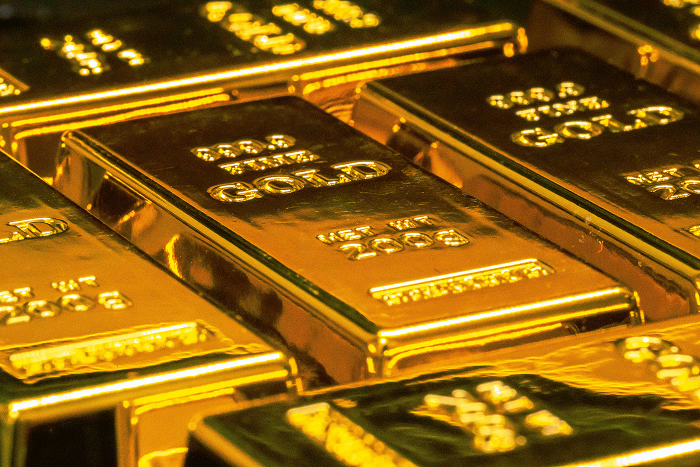
That is what’s happening now. Around the world, investors are uneasy. The U.S. dollar, long considered the safest currency, has started to feel less stable as the country’s debts balloon and its politics grow unpredictable. Central banks, from China to Turkey to India, have been quietly buying up gold to protect themselves against future shocks.
And private investors are following their lead. Legendary hedge fund managers like Ray Dalio are publicly recommending gold as a so-called “safe haven” again. For many, it’s a symbol of security in a world that feels like it could tip at any moment.
“Whenever people fear the system, they buy gold,” as one analyst put it. “It’s the oldest reflex in the finance world.”
The Perfect Storm: Why Gold Is Soaring Right Now
The surge in gold prices is not happening in a vacuum. It’s the result of a perfect storm of factors playing out simultaneously.
First, investors are nervous. Inflation is still lingering, interest rates are shifting, and political divisions are deepening in many countries. Even though stock markets are still near record highs, the sense of confidence beneath them feels fragile.
Second, central banks are buying more gold than at any point in modern history. Over the past two years, countries like China, Russia, and India have dramatically increased their gold reserves. They’re doing this to reduce reliance on the U.S. dollar and to prepare for a more uncertain world order.
Third, supply is tight. The world is not producing much new gold. Few new mines are opening, and only about 22 percent of all gold in existence is actually available to trade. Most of it sits locked in vaults or in jewelry that people will never sell.
That combination - high demand and low supply - has sent prices into orbit.
In other words, investors are rushing for safety at the same time that there’s very little of it to go around.
Gold Versus Everything Else
Normally, gold and stocks move in opposite directions. When investors feel confident, they pour money into companies, pushing the stock market up. When they feel scared, they pull money out and buy gold instead.
But something unusual is happening right now.
Gold is soaring even as stock markets, especially those driven by artificial intelligence and big tech, are reaching record highs. It’s as if investors are living in two parallel realities at once.
On one side, optimism about technology and innovation is driving a powerful rally. On the other, anxiety about inflation, global instability, and government debt is pushing people toward gold.
As one economist said, “Financial markets are like fashion. Sometimes fear and excitement trend at the same time.”
The last time this happened was in the 1970s, when both inflation and stock speculation were rampant. Gold doubled, then doubled again, as people lost faith in paper money. Eventually, as the world stabilized, the price came back down. But the lesson remains: when trust erodes, gold becomes the world’s mirror - reflecting the level of global anxiety.
But markets never move in straight lines, not even during a gold rush.
After climbing to a record $4,381 an ounce earlier this week, gold suddenly dropped more than 5% in a single day - its biggest fall since 2020. Analysts called it a “long-overdue correction,” pointing out that prices had jumped 25% in just six weeks and were “getting a little frothy.”
Still, even after that pullback, gold remains up more than 56% this year, an extraordinary run by any measure.
In other words: the shine hasn’t worn off. It’s just a reminder that even “safe havens” can wobble when too many people rush in at once.
So, Should You Buy Gold?
If you’re new to investing, moments like this can be confusing. On one hand, everyone seems to be talking about gold as the “smart” move. On the other, you might have heard that gold doesn’t actually do anything. Both are true, in a way.
Here’s the simple version:
Gold is not an investment that grows your money. It doesn’t pay dividends like stocks or interest like bonds. It just sits there, shining, while the world moves around it. That means it’s best thought of as insurance, not as a way to build wealth.
Gold can protect your portfolio when everything else is falling. But when markets recover and confidence returns, gold often loses its shine, sometimes quickly.
That’s why most experts suggest that if you want to include gold, it should be only a small part of a diversified portfolio. Some investors hold 5 to 10 percent. It’s a cushion, not a core.
There are also different ways to invest. You can buy physical gold, like coins or bars, though that involves storage and insurance costs. Or you can buy ETFs (exchange-traded funds) that track the price of gold without ever touching the metal itself. These are easier and more flexible for most new investors.
The most important thing is not to jump in because everyone else is. Gold rallies can feel exciting, but they can also fade quickly. What matters is understanding why you’re buying it - and what role it plays in your financial plan.
Lessons from History
This is not the first time the world has turned to gold in moments of fear.
In the 1970s, gold prices surged more than 600 percent as inflation spiraled and oil crises shook the global economy. People feared that paper money was becoming worthless. Then, in the early 1980s, when interest rates rose and inflation fell, gold prices tumbled.
During the financial crisis of 2008, gold rose again as banks collapsed and investors panicked. And in the years after, as confidence returned and stock markets recovered, gold slipped back down.
Each time, the pattern is similar: fear pushes gold up, calm brings it back down.
This doesn’t mean gold is bad. It means it behaves differently than most investments. Its strength is psychological as much as financial. Owning gold can help you sleep better at night during chaos, but it won’t replace the growth potential of owning companies, funds, or innovative businesses.
The trick is to remember that gold shines brightest when everything else feels dark. And while that can be comforting, it’s not always the best long-term growth story.
The Bigger Picture: What Gold Says About Our Times
If gold could talk, it would probably say this: people are nervous.
Even with booming tech stocks and record-high markets, a sense of unease runs through the global economy. People are hedging their bets. They’re buying gold not just because it’s shiny, but because it feels safe in a world that suddenly feels unpredictable.
But it’s also a reminder that fear is not a strategy. Confidence, education, and diversification are.
When you understand how global trends like this work, you stop reacting to them and start learning from them. You see patterns, not panic. You make decisions based on knowledge, not noise.
So the next time someone mentions that gold just hit another record, don’t rush to buy it. Ask instead: What is this telling me about how the world feels right now?
That question - not the gold itself - is where your real power begins.