2/9/25
7 Lessons From Facing Body Judgment Online
Despite its perks, being a food writer hasn’t always been easy. Especially once the comment sections started.

When I was a teenager, I used to secretly Google things like “how to lose ten pounds in a week” and attempt to edit out my double chin in photos, which, spoiler alert, didn’t work.
If you had told me back then that I’d grow up to write about food for a living, I don’t think I would’ve believed you.
In fact, I’m certain that my 16-year-old self would’ve been terrified about making food such a central and public part of my life, though deep down, I know as a blogger-obsessed teen I would’ve felt a surge of excitement too.
Because for most of my life, food was something I loved... and also seriously struggled with.
It was celebration and connection, and shame and secrecy.
Something I obsessed over in both indulgence and restriction.
And when you add PCOS (Polycystic Ovary Syndrome) to the mix (a hormonal condition that messes with your metabolism, energy, and appearance) you get a recipe for confusion and, at times, a very complicated relationship with your body.

But despite the mental and physical barriers, I am lucky enough to call myself a food writer. Someone who spends her time talking to chefs, tasting dishes, and sharing the joy of eating - on camera, no less.
And what transformed from a passion project to freelance career is now also a practice in reclaiming pleasure, neutrality, and peace around food and the body I live in.
Despite its perks, it hasn’t always been easy. Especially once the comment sections started.
Assumptions are Often Rooted in Ignorance
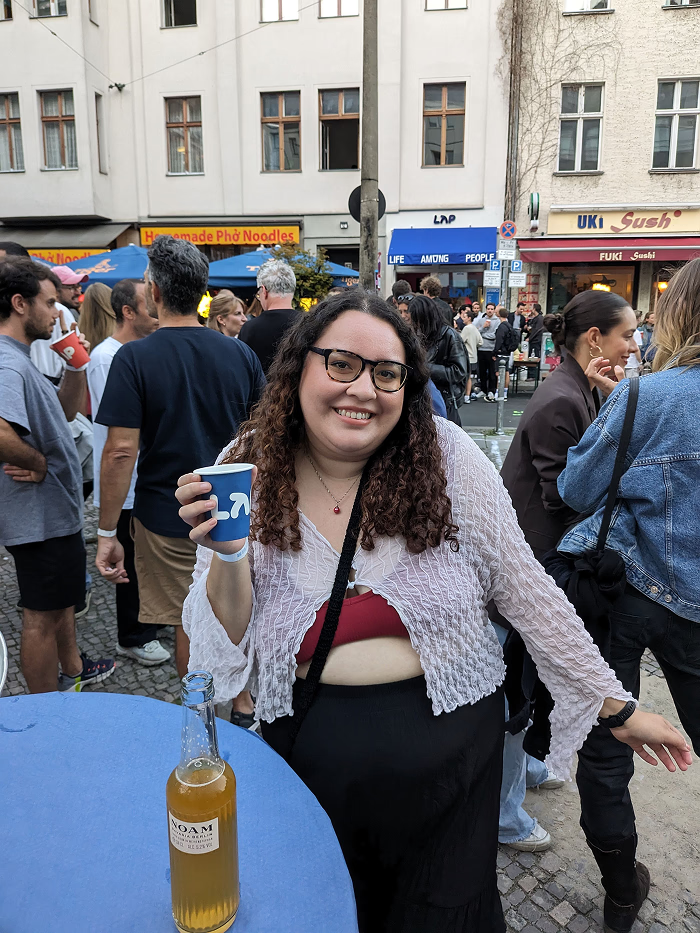
I had just posted a reel for one of my clients that corresponded with an article I had written highlighting New York-style food in Berlin. I’d interviewed local business owners, told their stories, and compiled different clips over several days - a bagel shop, a pizza slice joint, a cookie bakery - to bring it all together.
I was proud of it. It was informative, fun, personal. It felt like me.
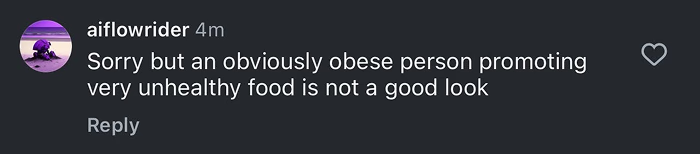
And then came the comment:
“Sorry but an obviously obese person promoting very unhealthy food is not a good look.”
My heart dropped.
I watched the video back. I was on screen smiling and eager to spotlight hard-working eateries. But now, all I could see was what that stranger decided I represented.
They didn’t care that the clips were filmed across several days, or that the food was shared, or that three meals over the course of a week don’t represent a complete diet. They didn’t care that my PCOS and sensitive stomach makes me mindful of what I eat.
They didn’t know me at all.
And yet, their words stuck. This wasn’t the first time I’d received a comment like this, but it stood out - there was more effort behind it than past remarks like “fat” or “stop eating.” And while on my personal social media pages I’d be able to delete the comment and block the user, this wasn’t possible because I wasn’t the one who posted the video.
I rushed to report the comment, hoping it’d be hidden from other viewers, anxious about other people seeing the comment… or worse, agreeing.
Being Judged Hurts (Even When You Know Better)
One of the hardest parts of putting yourself out there (especially on camera and in the food world) is that people think they have full permission to comment on your body, your health, your choices - even when that is not the focus of the content.
The more visible you are, the more you're perceived. And perception, especially on the internet, can be ruthless.

People assume things. That I must eat “junk” all the time (the contents of my fridge suggest otherwise).
That I don’t exercise (my Health and Runna app beg to differ).
That because I don’t look like their version of “healthy,” I must be shamed for it.
I’ve worked hard to savor food and not fear it, and to stop myself from succumbing to extremes, after many cycles of mistreating my body.
The Backlash is Rooted in Double Standards
But here’s what I’ve noticed - and what I’ve heard echoed again and again by other creators:
Plenty of people make food content, but it’s plus-size people, particularly plus-size women, who get the most backlash.
Not for the quality of their work or the content they share, but for daring to show up. For simply existing while talking about food.
I’ve got colleagues and friends who post mukbangs, feast-worthy food spreads, or “What I Eat in a Day” videos where they eat out for most meals.
So I’ve asked: what kinds of critical comments do you normally get?
Usually it’s people picking apart potential waste or spending. But what stands out is that the comments are almost never about their bodies.
And if it is about their body, it’s usually, “How do you eat like this and stay so thin??”

Plus-size creators have even accused platforms like TikTok of suppressing their content simply because of their bodies (via Grazia), which Tiktok has admitted to in the past, according to Netzpolitik.
And while, of course, people of all genders and sizes in the food space can experience hurtful, unsolicited comments (both online and IRL) about their looks, research conducted by Michigan State University shows women are 16 times more likely than men to face weight discrimination at work, affecting their hiring, promotion, and pay.
Online, the picture is bleak too: 71% of plus-size women report verbal harassment on dating apps simply because of their size, with men accusing some of “glorifying obesity” by simply being a plus-size woman looking for love and connection, as reported by a WooPlus survey.
Let’s be clear: these comments are rarely about health.
They’re rooted in bias.
Anonymous accounts feel entitled to say the ugliest things about someone’s body based on a photo or a few seconds of footage.
As if the mere appearance of someone’s body in a thirty-second video could possibly tell you the whole story.
You are allowed to just dislike something or someone and move on. You are allowed to critique someone without making jabs at their appearance.
And at the heart of it, this is why body neutrality resonates with me.
It’s not about loving how I look every day: it’s about letting my body be what it is, without constant judgment or commentary.
It’s about refusing to make my worth dependent on weight or aesthetics. It’s about focusing on how I feel, how I move through the world, how I nourish and care for myself... not how I’m perceived through someone else’s warped lens.
So no, I don’t need to explain my body to anyone.
And I’ll keep doing what I do, because I’m fortunate to do it.
Health Can Be Complex
We’ve been so conditioned to see health through a narrow, sanitized lens: clear skin, flat stomachs, juice cleanses. But it can be so much messier than that.
Health is also:
- A body that gets up and moves even when it’d rather stay in bed
- Knowing that it’s okay to choose a rest day over a workout
- Taking the time to cook a nourishing dinner after a long day
- Stretching before bed to improve your mobility for your future self
Sometimes it’s a plant-based Mediterranean dish. Sometimes it’s extra cheddar on chili. Sometimes it’s just taking a pause.
And none of it is anyone else’s business.
In Germany, I Learned I Could Just Exist
Moving to Germany, and particularly Berlin, has given me a new sense of freedom - not just in my career, but in my body.
One of the most surprisingly healing experiences? The sauna.
If you’ve never been to a German sauna, here’s the deal: everyone’s naked. Phones are in lockers. You rinse off before entering. You sit quietly on a towel. And no one stares.
People come in all shapes and sizes. Wrinkled, smooth, hairy, flat, round, saggy, taut.
It’s co-ed and neutral. Nobody ogles. Nobody cares.
It’s liberating in the most unexpected way: just bodies being bodies. Functional. Human. Free.
One of my favorite moments ever was visiting a lakeside sauna with my partner in western Germany. I left my towel behind and walked down the steps - completely nude - into the chilly, clear lake. Invigorating then refreshing. Peaceful and whole.
FKK culture (the German philosophy of free body movement, particularly in natural spaces) taught me something important:
You don’t have to love your body to respect it. You don’t have to fake it ‘til you make it. You can just be.

One Final Note From Me:
My story doesn’t end with a dramatic transformation montage. There’s no “after” photo, no magic fix. I didn’t conquer body image once and for all or become effortlessly confident. Because it’s not about earning the right to take up space - it’s about remembering I always had it.
And lately, I’ve been thinking a lot about how we talk about bodies, both our own and others.
Online, it’s easy to forget there’s a real person behind the screen.
What might shift if we moved through the internet with a little more gentleness?
If we paused before speaking, before judging, particularly when it comes to appearance?
Maybe the question isn’t just “Would I say this to a friend?” but rather “Why do I feel the need to say it at all?”
There’s power in choosing kindness over scrutiny. In noticing who uplifts you, and who doesn’t. In walking away from voices that make you feel small.
Sometimes the most radical thing we can do is to simply keep scrolling.
Because at the end of the day, the way we treat other people’s bodies says a lot about how we view our own.
Sources:
1. https://graziamagazine.com/us/articles/plus-size-creators-tiktok/
2. https://netzpolitik.org/2019/discrimination-tiktok-curbed-reach-for-people-with-disabilities/
3. https://msutoday.msu.edu/news/2007/msu-led-study-women-face-workplace-weight-discrimination
4. https://www.newswire.com/news/shocking-survey-says-71-of-plus-sized-women-were-verbally-insulted-for-10205567?)