28/11/25
China’s EV Meltdown: When State Power Meets Market Chaos
China’s EV Meltdown: When State Power Meets Market Chaos

In China today, you can buy a “used” electric car that has never been driven a single kilometre.
Dealers, under pressure from carmakers to inflate sales, register brand-new vehicles as sold, then quietly relist them as second-hand, turning unsold stock into “sold” units on paper - and making room for the next wave of shipments.
It is a surreal dance of statistics and desperation, one so widespread that the Communist Party’s own mouthpiece, The People’s Daily, has publicly scolded automakers for their “data worship” - an obsession with headline sales and growth figures, even when those numbers are pumped up.
To outsiders, China’s electric vehicle (EV) boom has always looked like a symbol of unstoppable ambition. But inside the industry, it’s starting to look like a slow-motion crisis.
The Dream of Domination
For over a decade, Beijing had a plan: use the EV revolution to leapfrog Western carmakers and dominate the green-tech economy. The state poured in around $230 billion from 2009 to 2023 in subsidies, tax breaks, and cheap loans. Dozens of companies rushed in - from tech giants like Xiaomi to small regional startups.
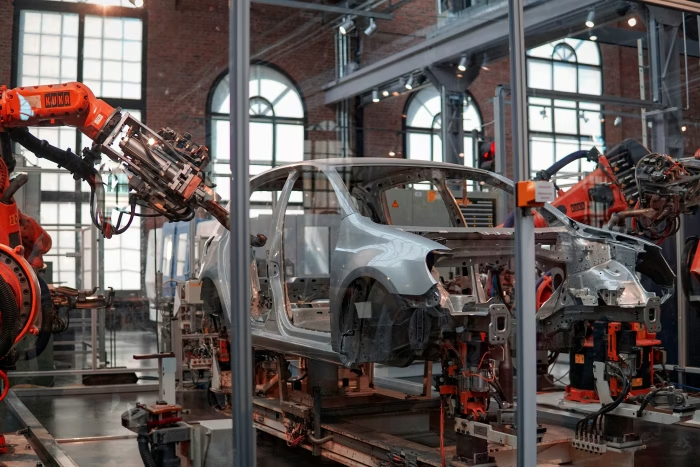
At first, it worked. China became the world’s largest EV maker and exporter. But under the surface, something was breaking: too much investment, too many players, and too little profit.
The race for dominance turned into a race for survival.
When Growth Starts to Collapse Inward
Chinese analysts have a word for this spiral – involution – a system where ever‑fiercer competition and investment fail to produce healthier returns, and instead squeeze everyone’s margins.
China’s factories can now build more than 50 million vehicles a year but sell barely half that, meaning capacity to produce roughly twice as many cars as the market absorbs.
Even leaders are feeling it: BYD, the world’s top EV seller, recently reported a near 30% drop in profit as it slashed prices across dozens of models to keep growth going.
Consultants now count around 120–130 EV and plug‑in hybrid brands in China, and one major study warns that only about 15 of them are likely to be financially viable by 2030.
In this kind of market, price wars have pushed margins to zero. Some automakers are selling cars at a loss. Others survive only through local government bailouts. But what’s happening in China won’t stay in China.
The Global Shockwave
The auto industry sits at the centre of massive industrial ecosystems. The auto sector employs tens of millions of people, and touches everything from steel and batteries to software and semiconductors.
And by the usual scorecards, China’s car industry looks unstoppable: it is now the world’s largest car exporter, its brands already account for over a fifth of global sales and that share is still rising, and EV output keeps hitting new records.
But those same numbers hide a structural problem: China built an auto sector big enough to serve more than half of global demand, without building a market that can profitably absorb that output.
China can now build roughly 55 million cars a year but sold about 27–28 million last year, shipping around 5.5 million vehicles in 2024, nearly 40% of them EVs. So when that extra capacity is turned into a wave of discounted exports, the effects are global.
Fears of a flood of low-priced Chinese EVs have already triggered defensive moves abroad. The US, Europe, Canada and Mexico have all raised tariffs on Chinese EVs.
And now, even the Western carmakers are being pulled deeper into this gravitational field.
This week, Volkswagen (VW) revealed that it can now build an EV entirely in China for half the cost of doing so in Germany.
After nearly €4 billion in Chinese partnerships, including a huge innovation hub in Hefei, VW has shortened its development cycle by 30%. That means that a car that once took about 50 months to develop can now be ready in roughly 35 months.
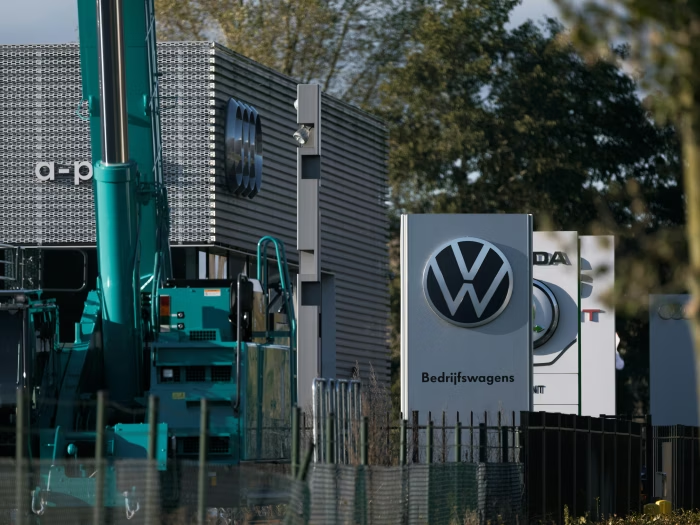
What VW’s China Bet Reveals About Market Stress
Now, China being a hub for cheap manufacturing isn’t new. What is new is core EV development for a flagship German brand being pulled into China’s hyper‑competitive ecosystem - making VW dependent on the same factories and suppliers that are already running far ahead of domestic demand.
Volkswagen’s move is a warning sign. Instead of just benefiting from lower costs, foreign brands are now deeply tied to China’s risky EV market, which suffers from too much production, shrinking profits, and intense competition. What looks like progress is also a sign of industry stress, not just a simple business success.
VW’s shift shows how China’s EV machine is both a triumph and a trap: foreign brands are tapping its cost and speed advantages, but in doing so they are tying their own futures to an industry that built far more capacity than it can profitably use at home.
A House Built on Subsidies
Beijing’s approach was always more about power than profit. The state does not necessarily need its automakers to make money; it needs them to make China indispensable. Every electric vehicle exported is also a diplomatic statement that the green future will be written in Mandarin.
But such ambition comes at a price. According to the independent economic and policy research firm Rhodium Group, government subsidies now consume roughly 3 percent of China’s central fiscal revenues. Even a superpower cannot spend endlessly.
As Beijing also tries to fund semiconductor and AI ambitions, something has to give - it’s becoming harder to justify propping up dozens of loss‑making carmakers indefinitely, rather than concentrating support on a few national champions.
And when it does, the correction could be brutal. Many companies could merge, shrink, or disappear - and only a few big players would survive.
And now? Western companies may accelerate that. If VW can build cars “the Chinese way” at half the cost, it reinforces the very pressures that are crushing weaker Chinese brands: overcapacity, price wars, and competition at breakneck speed.
What It Means for Investors
For Western investors, this unfolding drama is both warning and opportunity. The warning is clear: government-engineered booms don’t always last. State capitalism can accelerate growth, but it cannot erase basic market realities.
Yet there’s opportunity here, too.
- Consumers worldwide may benefit from cheaper EVs.
- Western automakers and battery firms have a window to innovate and reposition.
- Chinese engineering is becoming a global standard - and companies that leverage it may gain an edge.
The EV landscape is no longer “China versus the West.”
It’s becoming a hybrid system - part collaboration, part rivalry, part dependence.
The Irony of Triumph
China built the EV revolution to prove it could design the future - through enormous state support. Instead, the industry is showing how even the strongest plans can buckle under too much ambition.
And the fact that VW - once the gold standard of German engineering - now depends on China to stay competitive tells you about where power is shifting, and how quickly.
For investors, this is more than a story about cars. It’s a story about power: who controls the supply chain, who wins the price war, who earns investor trust.
In the electric age, the real power isn’t just in the batteries or the tech. It’s in the decisions governments make, the strategies companies choose, and whether investors still trust the story. Those forces will shape who wins the next decade.
Sources:
- https://www.ft.com/content/b77294bf-5f20-4b5f-9491-ed1185df090a
- https://www.reuters.com/commentary/breakingviews/chinas-carmakers-are-heading-crash-2025-09-04/
- https://xpert.digital/en/china-39-s-historic-consolidation/
- https://seekingalpha.com/article/4846822-q3-2025-china-update-at-byd-domestic-problems-dominate