
2/9/25
The importance of slowing down
The difference between busy-ness and productivity is often blurred by competing demands.

This article is republished from the Financial Times
As we reach the peak of summer, I notice that some people are still replying to messages, barely minutes after their out of office message has pinged in my inbox.
I conclude from this that many of us are not terribly good at holidays.
At least not the bit where we return from the museum and sit by the pool, unable or unwilling to slough off our work identities.
My own realisation about how bad I am at relaxing came a few years ago, when, on a glorious coastal cliff walk, I found myself cursing out loud that my mindfulness app wouldn’t download.
My expletive attracted a glance from a passing cyclist who must have seen not a sleek holiday-maker embracing nature but a stressed tourist fiddling with her phone and missing the sunset.
Much of my life involves this kind of attempt to double run, to cram in a quick meditation while doing exercise. I love a bit of woo-woo, but my approach is 80:20.
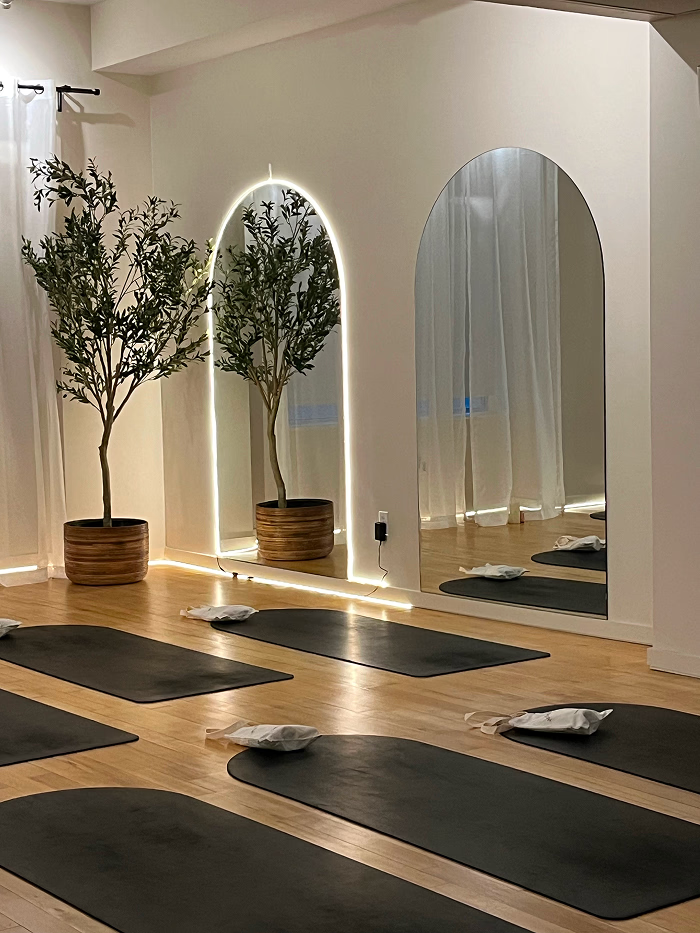
I’ll do 30 minutes of yoga but skip the final relaxation on the mat. I smuggled coffee cans into a recent detox retreat, to catch up on work without a caffeine headache.
So it is with the zeal of a convert that I can report the results of an inadvertent experiment I’ve been running, on the art of slowing down.
This was forced on me by a sports injury which precipitated two months of escalating pain, followed by surgery to repair my hip.
Being forced to take things easier has not only made life feel lighter, but has also — to my surprise — made me more productive.
This unscientific experiment fell neatly into two parts.
Until the operation, I was determined to sustain my usual hectic pace.
I got to the point where it hurt to even walk down the street but it didn’t occur to me to dial back: I simply racked up a big taxi bill.
I was grumpy at home and spiky in meetings. I loaded up my bedside table with printouts and articles I’d been saving to read later, along with books I’d ordered urgently, then couldn’t quite recall why I’d thought they were so vital.
On coming out of hospital, it took about a week for me to stop trying to read and collapse into a state of somnolent surrender.
I took my headphones out of my ears and became a person who notices the sky and smells the jasmine.
As I limped tentatively along on crutches, strangers would smile and chat.
Cars would wait patiently for me to cross.
When I finally made it as far as the post office, and asked Ali behind the counter how he was, he was much more forthcoming than usual, perhaps because I now had the time to properly listen.
It’s come as a bit of a shock, to realise that the friendly cheery woman I imagine myself to be is more often a brusque person on fast forward.
Recently, my gloom about the state of the world had morphed into a sense that other people had retreated into themselves.
Travelling in the slow lane has restored my faith in humanity. The human desire for empathy and jollity is still there, if you stop scrolling and look up.
In theory, we all know the difference between busy-ness and productivity.
In practice, they get blurred by competing demands.
With a cast-iron excuse, I deleted my email backlog, assuming that anything important would be sent again.
I finally felt able to shred the articles I’d saved up, and shed the accompanying mental load.
The consequence has been a small but satisfying increase in mental capacity.
I have started to ace puzzles which used to baffle me, especially those which require making lateral connections. I’ve had some “aha” moments for a book I’m writing, on chapters where I’d previously been stuck. I’d assumed that my six weeks off would be dead time. But I have emerged with a host of new ideas, a greater cheeriness about my fellow man, and a realisation that you don’t lose your soul if you have an empty diary.
The guru Cal Newport, author of Slow Productivity, has a threefold mantra.
Do fewer things, he says; work at a natural pace; and obsess over quality.
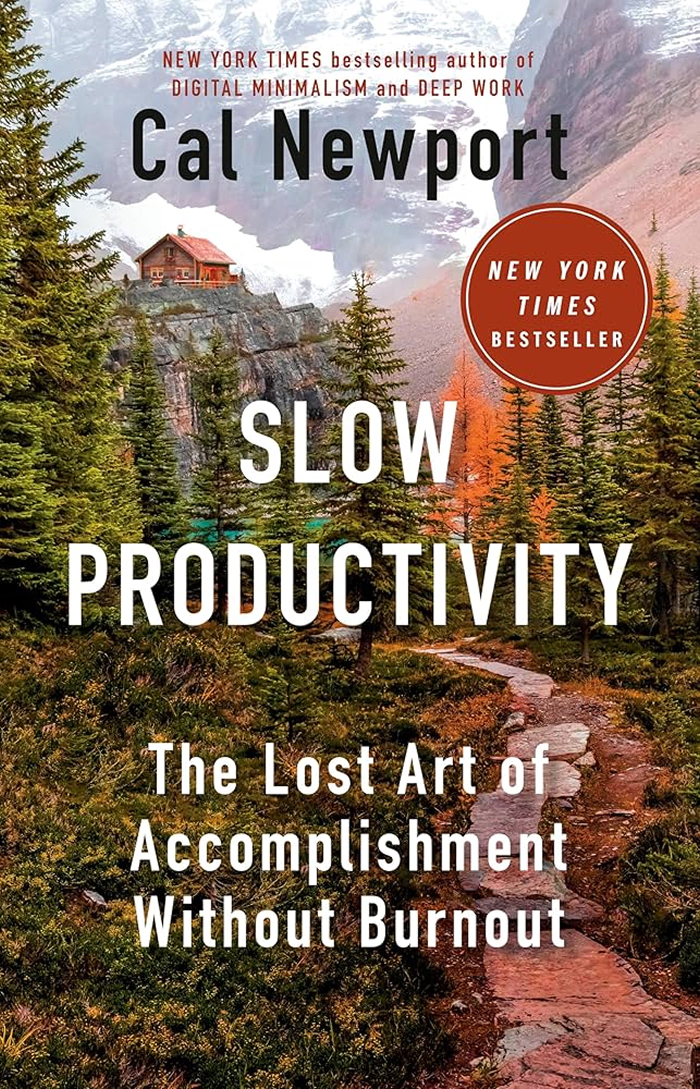
I’ve used some of his tactics in the past. But I never really understood before what he meant by setting your own pace — or how the adrenalin buzz of “pushing through” drowns out one’s natural rhythm.
Those of us lucky to have creative knowledge jobs have gained enormous flexibility from technology.
But it also creates a burden of expectation.
We are in the grip of what the sociologists Melissa Mazmanian, Wanda Orlikowski and JoAnne Yates have called the “autonomy paradox”: we have the illusion of control, but a nagging need to be always-on.
As a result, they argue, we are also likely to make mistakes.
Just before my operation I booked some return train tickets for a family trip on the wrong day, because I was scanning the diary too quickly while on the phone: it took me ages to get a refund.
I realise now that I do this kind of thing all the time.
The problem, as I discovered on that coastal walk, is that the pressure to switch off can become its own pressure.
The missing ingredient is giving ourselves permission to take a break, rather than downloading yet another podcast about doing less.
I may not be “manifesting” my best life — yet. But I am at least rehumanised.
Copyright The Financial Times Limited 2025
© 2025 The Financial Times Ltd. All rights reserved.