2/9/25
Girls Just Wanna Have Impact Funds
Our second book is probably more relevant than ever as large companies all over the world are rolling back their sustainability initiatives.

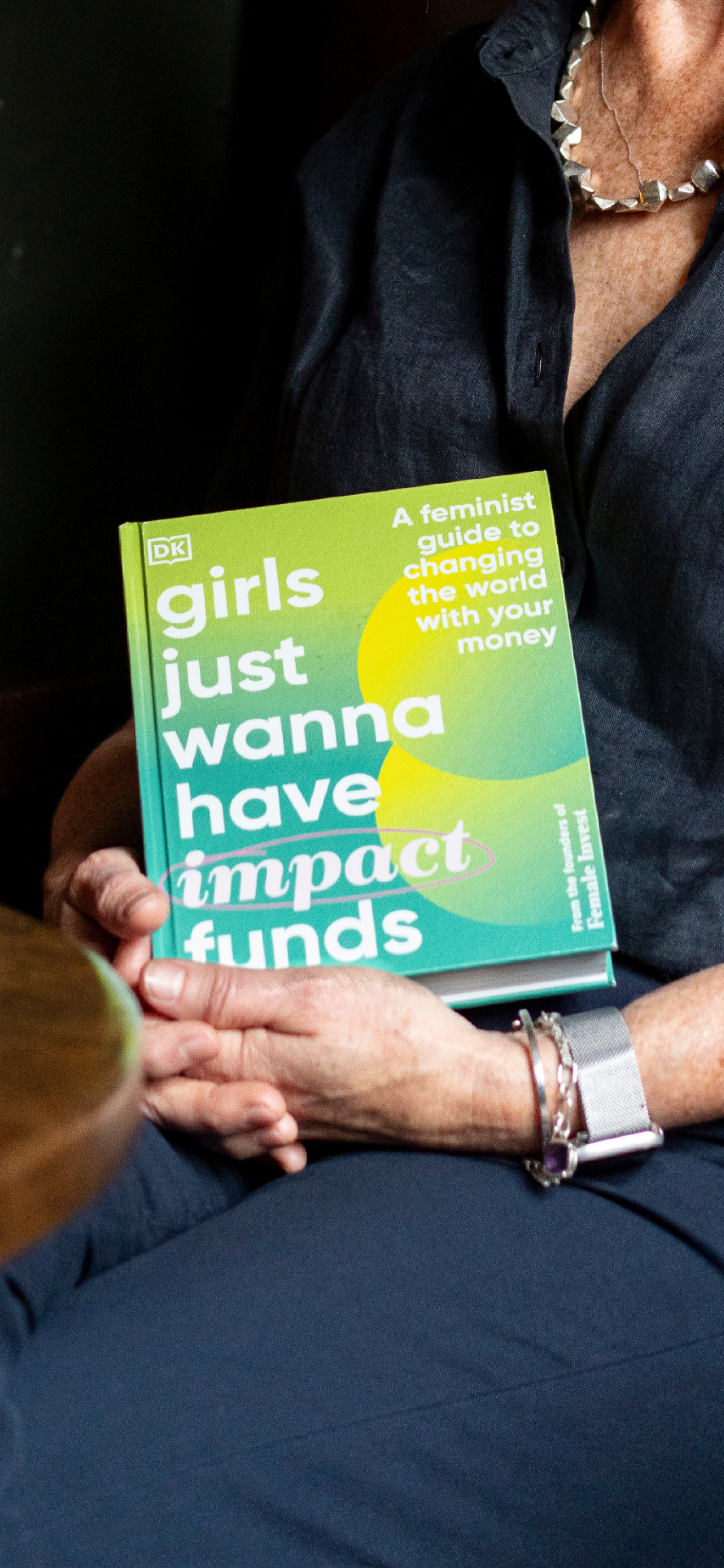
In 2023, we - Emma, Anna and Camilla - wrote our second book.
It’s called Girls Just Wanna Have Impact Funds.
Its a feminist guide to investing - not just to grow your money, but to grow your power.
It’s about using your finances as a force for good, aligning your investments with your values, and stepping boldly into the role of changemaker.
What you are about to listen to is an excerpt from the book, which we believe is more relevant than ever as large companies all over the world are rolling back their impact and sustainability initiatives.
In times like these, morals and ethics are shifting fast.
One striking example is how quickly public attitudes toward investing in weapons have changed.
When we published this book, the majority of our community agreed that investing in weapons was an unacceptable and harmful choice.
But now, mainstream media has rebranded it as “investing in defense,” and amid rising geopolitical tensions, it has become increasingly socially acceptable - even encouraged - as a legitimate investment strategy.

This shift isn’t necessarily a bad thing.
But it’s a reminder of how quickly norms evolve, and why it's critical to pause and reflect on your own values.
What do you want your money to support?
What kind of world do you want to help build?
You have so many opportunities to use your capital as a tool for change - to cast a vote for the future you believe in.
Whether you're new to investing or already have a portfolio, this book is here to show you that money isn’t just a personal tool - it’s a lever for systemic change.
The world needs more impact - and it starts with you.
P.S. In case you didn’t know, all Female Invest members get 30% off our books - just our way of saying: we’ve got your back.
Let’s dive in…
Money Can Change Lives.
Money provides the power to live life on your own terms; the power to be independent; and the power to support causes that you care about.
When we talk about money, we often talk about how it impacts us as individuals, shaping our personal opportunities in life.
But we rarely discuss how money can be used to change the lives of others – not simply through donations, but through investments.
Making money while making a difference is a powerful concept that has the potential to change the future, because every time we spend money, we cast a vote for the future that we want to live in – for ourselves and generations to come.
It’s time for women and marginalized voices to own their financial power and unleash their potential as change-makers in a world that so desperately needs it.
What to Expect From This Book
This book is not an introduction to investing – we already wrote that, it’s called Girls Just Wanna Have Funds – A Feminist Guide to Investing - and you can find an excerpt from that book here in the app as well.
Instead, this book is the ultimate guide to making money while also making the world a better place.
We want to mobilize the financial power of private investors to solve some of the world’s most pressing issues.
We especially want to mobilize the financial power of women, because they have, historically, been systematically excluded from positions of power – and this continues today.
Humanity is now facing existential threats, and women are not always being included in the conversation about how to find solutions to the problems that arise at the top of governments or companies.
Therefore, although this book is written with women and non-binary people in mind, we invite anyone who wants to change the world for the better to read it and learn from it.
Why Impact Investing?
Around the world, women are much more likely to donate their money than men.
At the same time, women are more likely to volunteer for social causes and donate their time, too.
This is great, but there is one problem: you can only spend your time and money once.
The good news?
By spending just a little time researching investment opportunities that benefit others, you can use your money to create positive change for others while growing your funds at the same time.
This way, you’ll have even more money (and power) to contribute to change and to create a positive impact on the world.
Women: A Force of Power and Choice
The focus on impact investing – using your money (and thereby power) to create a positive impact on the world – is skyrocketing, and women appear to be a driving force behind this change.
Of course, this shouldn’t come as a surprise, because women have long been known to make financial decisions based on what’s best for their children and their wider family.
However, now women are also increasingly taking a bigger-picture view.
They are aligning investments with what they feel is best for their community, their neighbours, and the planet.

Global wealth demographics have their part to play in this trend, too.
Women, overall, have more money than ever before, which makes us a sizable economic force that controls a third of the world’s wealth.
In addition, women are increasing their wealth faster now, adding $5 trillion to the wealth pool globally every year and outpacing the growth of the wealth market overall.
Clearly, given their growing financial power, the values that women hold will shape how wealth is created, mobilized, and passed down to the next generation.
This is important, because women are more efficient in acting on issues such as climate change and social injustice, and countries and companies with more women at the top generally have more ambitious climate and social policies.
At the same time, research shows that women make great investors.
So imagine how much change could happen if we unlock the potential of women.
Is the Climate Crisis Man-Made?
This question is provocative – we get it.
But hopefully what you’re about to read will provoke you even more.
Let’s start with the facts: we are facing an existential crisis in the most literal sense of the word, because the world as we know it “is in a state of climate emergency”, according to the UN.
The climate crisis is not a new phenomenon, and scientists have been warning us about this for decades.
In 2019, 11,000 scientists signed an open letter stating that the climate crisis is “threatening natural ecosystems and the fate of humanity.”
With such a threat at our doorstep, now seems like a good time to act.
However, despite increased focus on this important topic, organizing a sufficient international response and slowing the rise in global temperature has yet to happen.
The international efforts to solve the climate crisis seem to have been characterized by one thing: lack of female involvement.
At COP27 (the UN’s annual climate change conference) in 2022, only seven out of the 110 government representatives attending were female.
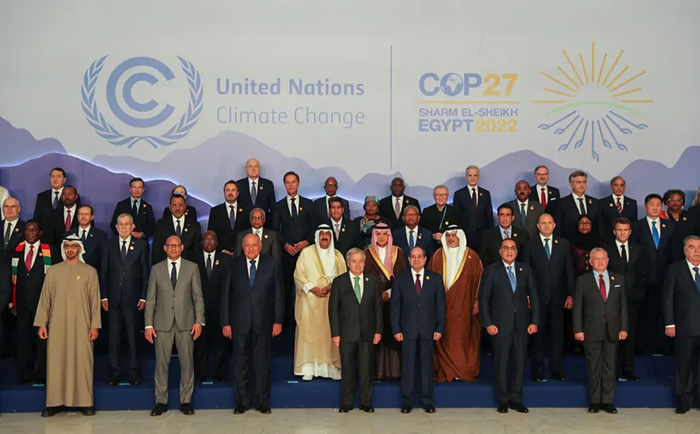
This seems ironic, as research consistently shows that women care more about sustainability than men and are more likely to be change-makers for climate change.
Joycelyn Longdon, Founder of Climate in Colour, explains: “When more women are elected into parliament, stronger environmental bills are passed and they’re enforced more strongly, more strictly.”
As a result, countries with more female parliamentarians have better climate policies and lower recorded emissions.
In addition, female investors are almost twice as likely as their male counterparts to validate the importance of integrating environmental and social factors into investment policies and decision making.
With climate change being a key concern for populations around the world, you’d think women would be elected like never before, but as of 1 January 2023, only 7.6% of world leaders are women.
We know women are severely underrepresented in government, but the same is true amongst the big companies that are playing an increasingly important role in tackling climate change.
That’s not just through responsible production, but by championing the invention of new products.
However, female representation is not looking great here, either.
Among the 500 largest listed companies in the US, only 8% have female CEOs.
Among the 350 largest listed companies in the UK, that number is only 4%.
Women are included less in discussions on climate change but are impacted harder by the consequences.
Apart from being excluded from decision-making, women also suffer disproportionate impacts of climate change.
Not only do they suffer greater economic repercussions, they also bear an additional burden of unpaid care and domestic work, have less access to resources, and are pushed to drop out of school or marry early to manage the family’s financial stress. According to the United Nations Development Program (UNDP), 80% of people displaced by climate crises are women.
Knowing this, could the climate crisis have been avoided, or at least minimized, if women had been involved in the decisions that have been made which have impacted our planet? We will never know.
Money Isn’t Fair
It’s often said that money can’t buy happiness. We disagree; money can buy you food, shelter, security, education, and access to healthcare. However, access to making and managing money isn’t fair.
In fact, it’s totally unfair.
It would be easy to make a case of men versus women, but the reality is much more complex. Looking at it on an international level, the poorest 50% of the global population share just 8.5% of total income.
At the same time, the richest 10% earn over 50% of total income. In the future, these inequalities will grow as the impacts of climate change are felt more acutely in lower-income countries – amongst those who did the least to cause it, mind you.

However, financial inequality does not just exist between countries, it also exists within them.
The level of inequality within any given country or community depends on many factors, including gender, race, sexuality, and class.
These inequalities may overlap, and they extend across generations.
As a result, the cycle of inequality is difficult to break because some people are disadvantaged from the outset.
It’s Time to Act
At the current pace of progress, climate change will have permanently transformed the world before women get equal representation – which the UN estimates it will take 140 years for women to achieve.
In addition, scientists warn that we have eight years to avoid a climate catastrophe.
We can’t wait any longer; it’s time to use the hard power that we do have – financial power – and we need to do it now.
Women are becoming educated at record rates and are accumulating wealth like never before, and we also direct the vast majority of consumption – in fact, in the US, it’s estimated that women make 80% of all purchases.
While this may be rooted in outdated gender roles of women shopping for the household, that doesn’t change the power dynamic.
Knowing this, what would the world look like if we started setting demands such as only shopping from companies that demonstrate responsible production and diverse leadership? Only supporting politicians who align with our values?
Women may be excluded at the top of governments and companies, but we can force these same institutions to follow our values if we collectively start setting demands.
It’s time to take matters into our own hands by utilizing the power we have at our disposal: money. This book is not just about how to make impact investments and feel good about ourselves, it’s about stepping into our financial power and using our money as our voices to change the world.
Worries and Reflections
Writing this book has come with several worries and reflections, because impact investing has sparked controversy around the world.
As the topic is a relatively new one, there are no official definitions of this term, which is why different studies with different focus areas and timelines have varying answers to how impact investing performs compared to the overall market.
Despite the conflicting results, one thing is certain: only investing in impact investments makes it hard to diversify your portfolio, which increases risk and reduces the likelihood of achieving the average market return.
So, what does this all mean?
It means that no matter what approach we take in this book, we’ll face criticism from scholars who are using different definitions.
But we’ve decided to write this book anyway, and we’ve put in countless hours of research to make sure these chapters offer investors a well-rounded, easily understandable introduction to the topic.
Although its a powerful tool, impact investing also dosen’t come without ethical dilemmas. As investors strive to achieve both financial returns and social impact, they must navigate complex trade-offs, which requires a deeper understanding of the problems and opportunities that come with impact investing. By rising to these challenges, impact investors have the power to create meaningful change and shape a more equitable and sustainable world.
The following is a number of dilemmas that we encourage you to reflect on.
Dilemma Number 1:
Should you put your money into companies that are already doing well in terms of ESG, or should you rather support those who are not reaching those targets yet but are working hard to do so?
Impact investing is, of course, all about impact, but it’s hard to decide how that is best achieved. On one side, supporting companies that are already doing well seems like a good approach; however, on the other side, an even bigger impact might be achieved by supporting those who are in transition and focusing on change.
Another dimension emerges when comparing a tech company that is achieving carbon neutrality (Perfection) with an energy provider transitioning from conventional to sustainable energy sources (Transition). The question emerges: who is truly making the most substantial mark?
According to the US Governance and Accountability Institute’s research, a staggering 92% of S&P 500 companies issued sustainability reports in 2021. These reports also outline strategies for improvement (though the effectiveness of these may vary). In investing, cultivating a long-term horizon of at least five years is generally prudent. The strategies outlined in these annual reports could provide insight into a company’s trajectory for the next five, ten, or even twenty years.
Dilemma Number 2:
There’s no such thing as a perfect investment when it comes to impact. Unfortunately, this means you have to compromise because you can’t get everything in one. But how do you decide which impact values you are prepared to compromise on?
Finding companies that hit all of the UN’s development goals is pretty impossible, because they don’t exist. You will find companies that do well in one area but may lag behind on others. Imagine finding a company that’s doing excellent work within climate change but the entire leadership team consists of middle-aged, white, straight, cis men. Is it worth supporting a good cause when the people in charge don’t include anyone outside their own gender or race? Imagine how that mentality might affect the company culture, not to mention how it contributes to perpetuating the problem of keeping women and ethnic minorities from positions of power. (If you follow our work you know we don’t buy the excuse of “there weren’t any qualified women or people of colour”.) You need to decide where you will draw the line.
Dilemma Number 3:
When assessing how a company fits your personal values, there are two things to consider: the product and its production.
In other words, would you be happy to invest in a company that follows a perfectly sustainable production process if the product they are offering is fast fashion?
To begin with, you need to decide whether there are industries that you simply want to avoid altogether because the products they produce have a negative environmental or societal impact – thereby making the world a worse place.
When comparing companies in terms of production processes, you need to look at companies within the same industry. It’s difficult to compare the output of a tech company with that of, say, a food company, because their operations, processes, and products will be totally different. By only comparing companies within the same industry, it’s easier to understand the benchmark.
Dilemma Number 4:
We’ve talked a lot about ethics and sustainability, but who actually decides whether a company ticks these boxes?
This is an enormous dilemma we could probably fill another 300 pages discussing, but in short, it’s complicated... There are endless opinions about this topic, but no one voice of authority.
The desire for social responsibility has grown so quickly that the infrastructure is struggling to keep up. While the UN’s principles have helped add some direction to social responsibility, the figures behind those agendas remain murky. There is no official entity that decides whether a company lives up to impact standards, but plenty of analytics companies (Refinitiv, Morningstar, Bloomberg, and Sustainalytics) have made their own rating systems. Their different ways of defining ethics and sustainability makes it complex for investors to understand, while also enabling sneaky companies to hide behind blurry definitions.
Fortunately, the EU is working on legal requirements for large companies, which will make these points easier to compare.
And this book, of course, will help you navigate the jungle of investing for impact.
The introduction to Girls Just Wanna Have Impact Funds ends here.
If you’d like to hear more excerpts from this book please let us know in the comment section.
And if you would like to read the rest of the book, you can get a 30% discount because you’re a member of Female Invest.