
2/9/25
Hot Tech Reports, Trade Deals, and Crypto - July Was a Month of Records
July delivered a true stock market rally marked by a series of new all-time highs in the key US S&P 500 index

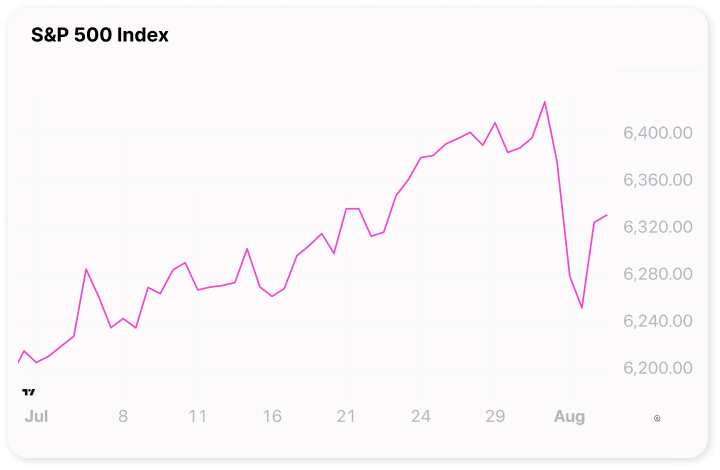
The past month on the stock market has definitively buried the traumas of spring. July delivered a true stock market rally marked by a series of new all-time highs in the key US S&P 500 index, which is now up by about 27% since Trump first displayed his tariff sign in the Rose Garden back in April.
This is a monumental sigh of relief, primarily due to a combination of new trade agreements between the US and key partners such as the EU and Japan, as well as strong financial reports from US tech companies.
We also saw the passing of Trump’s legislative package, "One Big Beautiful Bill.” A historic interest rate meeting took place in the US, and cryptocurrencies like Bitcoin reached a groundbreaking point in both the market and US legislation.
The question market participants are now left with is: "Can US stocks continue their rally into August?"
Here, you can see the speed at which the S&P 500 has moved over the past month. This sprint has also meant that the US index has now overtaken the broader European STOXX 600 index, which had the highest returns in the first half of 2025.
Daddy's Home
We'll return to the question of where US stocks are headed. First, let's take a quick look back at the last few days of June, when a good mood was already starting to bubble among investors.
At the NATO summit in The Hague, the US signed the final document, which states that Russia is the enemy and that NATO countries stand united on Article 5, also known as the "musketeer oath."
That signature removed the uncertainty about US support for NATO. At the same time, NATO countries decided to increase their defense spending to 5% of GDP by 2035—a new sky-high level for military spending in the West.
The meeting in The Hague was a huge round of applause for the American president. NATO Secretary General Mark Rutte even referred to Trump as "Daddy" about the US handling of the war between Israel and Iran.
One Big Beautiful Bill
Safely home from his triumph in The Hague, Trump used American Independence Day to sign "The One Big, Beautiful Bill" (BBB).
The legislative package has been a hot topic in financial markets in recent months, as it will have a major impact on both the US economy and Americans' finances—and therefore also the global financial markets.
In addition to a deterioration of Americans' access to public health insurance (Medicaid) and a stricter immigration policy, the legislation is, in essence, an extension of Trump's tax cuts from 2017.
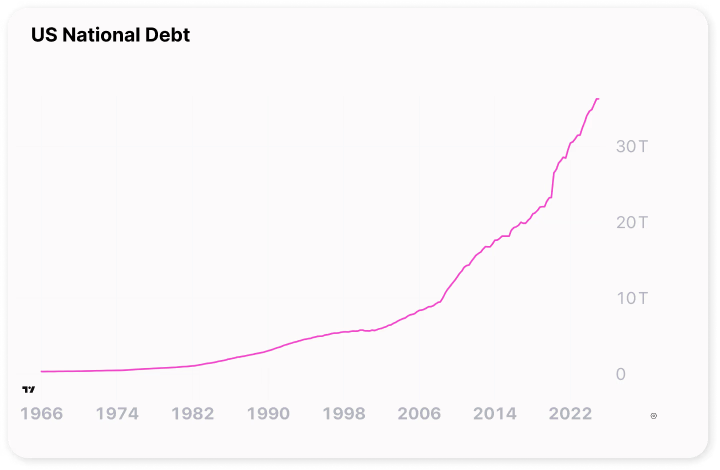
The tax cuts are unfunded and will cause the US's already explosive debt to rise. Interest payments on the debt are the largest item on the US federal budget, and today the US spends more on interest than on defense.
The rising debt in the world's largest economy is a ticking time bomb under the financial markets. Among other things, the debt has called into question the status of US government bonds as one of the safest investments in the world and has also led to a downgrade of the US by credit rating agencies, including Moody’s, back in May.
American Party
You might think that the stock market would react with a downturn after the final signing of a bill that points to an economically uncertain future for the US. But the package was expected, and now investors know exactly what they're dealing with.
The most dramatic reaction to the passing of the BBB came from the world's richest man, Elon Musk. The Tesla founder and the US president have had a public on-again, off-again relationship in recent months, with Musk calling the legislative package both "scandalous" and "an abominable abomination” because it will cause US debt to grow.
In response to the BBB's adoption, Musk has founded his political party, which he announced on his social platform X:
When it comes to ruining our country with waste and corruption, we live in a one-party system, not a democracy. Today, the America Party is formed to give you your freedom back."
However, Elon Musk's party has a long way to go, and for now, Musk is probably the only one who believes he can challenge the US's two-party system.
The EU and US Shake Hands
With one massive legislative package under his belt, Trump was now able to turn his full attention to tariff negotiations with US trading partners.
Europe and the US account for almost a third of global trade. So when Donald Trump and the President of the European Commission, Ursula von der Leyen, shook hands on the last weekend of July after months of threats and weeks of negotiations, a lot of risk and uncertainty was sucked out of the market.
Overall, the agreement calls for a 15% tariff on most European exports. This is a framework agreement, though, and specific tariff rates still need to be negotiated for individual categories, including pharmaceuticals.
Fifteen percent is lower than the 20% Trump announced during Liberation Day, and lower than the 30% he threatened in July.
However, it is higher than the 10% the EU considered very high before negotiations.
According to Von Der Leyen, the 15% was "the best we could get.”

Who are the Winners and Losers?
The agreement is an immediate victory for Trump, as the EU has not chosen to place retaliatory tariffs on American goods.
Voices in the European business community have also stated that they will lose out on the deal because European companies will now have a harder time competing in the US. The tariffs mean higher prices for European goods, which could force companies to lower their prices, resulting in lost earnings.
We should remember, however, that this is a framework agreement. The real negotiations for specific tariffs within the individual categories are only just beginning. It usually takes around 18 months to finalize a trade deal, and if there's one thing the EU has, it's patience in the art of negotiation.
So maybe Trump has won the sprint, but does he have the endurance, the tactics, and the patience for a marathon?
Tariffs and Trump: A Race of Attrition?
Besides the EU, the US has at the time of writing also finalized trade agreements with the UK, Vietnam, Indonesia, the Philippines, and Japan. This means that nearly 60 countries are left without a deal by Trump’s negotiation deadline of August 1st.
China is the biggest hurdle. During the last week of July, the Chinese and Americans gathered at the negotiating table in Stockholm, where an extension of the tariff truce for another 90 days is on the table.
The deadline for these negotiations is August 12th (China was given two extra weeks compared to the other countries), and if Trump has not signed a deal by then, the US will ramp up the tariff rates against China.
Amid all these negotiations, we also have the US Court of International Trade's ruling from last month, which declared that Trump's retaliatory tariffs are illegal.
The Trump administration has, of course, appealed the ruling. The first hearing and appeal decision will be on July 31st—and it could all end up within a few years with Trump’s tariffs being overturned by the US Supreme Court.
Crypto Records
Before we get to central bank meetings and half-year financial reports, let's look at Bitcoin and all the other cryptocurrencies, which, as a group, have now surpassed a total market capitalization of $4 trillion for the first time.
There has therefore been a lot of crypto talk in the market and in the media in recent months. But just to put things—and the current role of crypto in the overall market—into perspective: The seven largest tech companies in the S&P 500 (Apple, Nvidia, Microsoft, Amazon, Alphabet, Meta, and Broadcom) have a combined market value of approximately $18.8 trillion, and gold has a total market value of around $20 trillion.
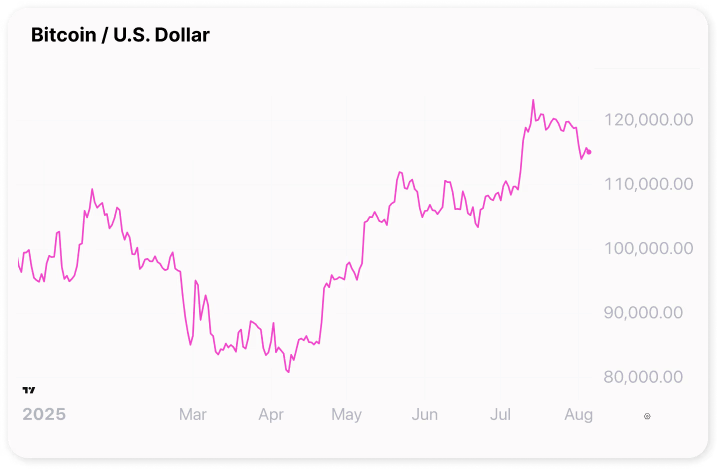
Trading in cryptocurrencies especially thrives when there is unrest in the stock market. During Trump’s constant tariff threats, crypto has therefore soared, and the largest currency, Bitcoin, set a new record in July with a value of $123,000 for a single bitcoin.
Also helping to boost the mood in the crypto community has been the passing of three major legislative bills in the US.
- GENIUS Act (the most significant) sets standards for US dollar-backed stablecoins, including capital reserve requirements and consumer protections.
- The CLARITY Act aims to clarify the oversight between the Commodity Futures Trading Commission (CFTC) and the U.S. Securities and Exchange Commission (SEC).
- The Anti-CBDC Surveillance State Act aims to prevent the creation and use of a central bank digital currency (CBDC) in the US. The main purpose of the bill is to protect financial privacy and prevent a CBDC from becoming a tool for government surveillance or control over citizens' financial activities.
The new legislation removes a major obstacle for the continued journey of blockchain and cryptocurrencies into the established financial system and was called a "financial revolution" by, among others, Brian Armstrong, CEO of Coinbase.
Calm in the EU
The European Central Bank (ECB) interest rate meeting in July went as expected.
After eight rate cuts since last June, the ECB held the rate steady at 2%.
This is due, in part, to inflation pressure in the Eurozone having subsided and because the ECB is, according to central bank head Christine Lagarde, "in a good place" right now.
With inflation under control, the full focus is now on growth in the EU. The latest GDP figures show that the Eurozone economy grew more than expected in the first half of 2025. The pace of growth is still weak, but it is finding the right rhythm.
Lagarde did not reveal the ECB's intentions for September, as there is still significant uncertainty surrounding the effect of the trade agreement with the US. However, the rising growth in the EU has led the market to lower expectations for a rate cut in September.
Powell Resisted the Pressure
There was slightly more tension around the interest rate meeting in the US, where central bank head Jerome Powell has long faced public criticism from the Trump administration, which wants to see the US interest rate lowered.
Powell held his ground and, for the fifth consecutive time, kept the rate at its current level of 4.25-4.50%, as he remains concerned about rising inflation due to tariffs. But while Federal Reserve decisions over the last 30 years have been unanimous, this time, a full two out of the Fed's 12 members voted against the common decision.
Members Christopher Waller and Michelle Bowman both voted for an immediate rate cut. It's worth noting that Waller is a potential successor to Powell, who is leaving his post next year. Meanwhile, Bowman was recently promoted by Trump to oversee US banks.
The market has now begun to get a whiff of a possible rate cut from the US central bank in September. We may become wiser on which way the wind is blowing at the end of August, when Powell hosts the annual central bank summit in Jackson Hole, Wyoming.
How Hot are US Stocks?
By the end of July, more than 80% of S&P 500 companies that have reported earnings (according to Bloomberg News) have performed better than expected, and this has greatly helped lift investor sentiment and, therefore, stock prices.
It is especially the large tech companies that have delivered. It is also the dominance of these companies in the S&P 500 that worries investors. Seven of the largest technology companies make up 35% of the S&P 500. And while their stock prices have risen by 90% since 2024, the rest of the S&P 500 has only increased by 13%.
At the same time, we are currently seeing a wind-down of the American "overallocation" in global portfolios. The US share of the MSCI World index peaked at over 70% earlier this year, and a rebalancing away from this overweight suggests that US stocks may underperform in the coming years compared to other stock markets.
This is simply because investors currently have too much exposure to the US in their portfolios and are therefore shifting their investments to other stock markets to spread their risk.
Who will bring home the biggest returns in the second half of 2025 - the S&P 500 or the STOXX 600 - depends primarily on earnings and expectations for the major US AI and chip companies.
In Europe, many point to the rising investments in the weapons and defense industry, plus Germany's ambitious €500 billion investment program for infrastructure and modernization, as the most important drivers for European stocks.