
13/2/26
To Be or Not to Be a Mother
I got pregnant by accident and was suddenly forced to confront a question I’d managed to avoid for years: Did I want to be a mother?

It was a slow day in May when I stopped by the local corner shop.
I was supposed to be picking up my usual go to: Ben & Jerry’s ice cream, but instead, I bought a pregnancy test.
My period was a week late. I already had a gut feeling, but I’d been avoiding the test. That’s how I usually handle overwhelming things - I delay and hope they’ll go away on their own.
But my cycle is like clockwork, so after pacing in circles for a week, I finally took the test. I stared at the two pink lines that appeared.
I fished the instructions out of the trash to be sure: Two lines meant pregnant.
My boyfriend and I took turns looking at the test and at each other. Neither of us said a word.
The days leading up to that moment had been rough - they reminded me of my depressive episodes in my twenties, when the line between myself and the world blurred, and I struggled to hold on to a sense of who I was.
I’d been waiting for my period to break the spell.
It never came. Instead, two unmistakable lines showed up on the test.
Forced to Decide
When my boyfriend and I met five years ago, we briefly discussed kids.
Neither of us felt strongly about having them, but we agreed to revisit the topic if that changed.
We hadn’t talked about it much since - but recently, the thought of children had started looping in my head.
I wanted so badly to decide once and for all that we wouldn’t have kids, to make it final. But I couldn’t make that call. And now, I had no choice. I had to decide.
I’ve never dreamed of being a mom.
My friends started having kids long ago - even back in school, girls would talk about what they’d name their future babies.
I’d sometimes play along, but usually I’d just say, “I’m never having kids.” People told me I was being ridiculous.
Since I’ve been with my boyfriend, I’ve felt - and often heard - society’s expectations loud and clear: “So, when is it your turn?” I’d brush it off with a smile while flipping them off in my head.
I’ve never been drawn to children. I was well into my twenties before I held a baby for the first time.
The idea of what a child would do to my personal freedom made me feel claustrophobic - not in a good way. I thought it was just disinterest.
But after the abortion, I realized it was also fear.
Fear of whether I could even be a mother.
Fear that the generational curse of postpartum depression would consume me.
It already felt like it was creeping in - and I didn’t know how to stop it.
The Maternal Inheritance
“In the end, it’s your decision,” my boyfriend said.
He promised he’d support me no matter what.
I didn’t know what I wanted - I just knew I had to decide quickly.
My mental state, which had already been unraveling before the test, kept deteriorating.
I couldn’t tell where my own desires ended and societal expectations of a 32-year-old woman in a long-term relationship began.
I knew what was expected of me.
I just didn’t know if any of it was what I wanted.
Not now. Maybe not ever.
I was carrying a tiny embryo, part of a biological duo - but I felt completely alone.
The loneliness and anxiety I’d worked so hard to leave behind came rushing back.
I cried at work, on my bike, in bed.
I cried because I didn’t own Christmas decorations or matching dinnerware - things I associated with real moms. Proof, I thought, that I could never be one.
One night, I bought four matching egg cups online to go with the two I already had.
It felt like a start. Like something I could control.
Looking back, I think I’ve always expected postpartum depression to be my fate. Like it was baked into my DNA.
In my foggy pregnancy-brain, I saw it as a family curse catching up to me. I couldn’t stop thinking about my mother and grandmother - their battles with depression, the pills, the electroshock therapy, the locked wards.
I remembered how depression found my mom again, years later, and made her disappear as a person, as a parent.
I couldn’t bear the thought of putting someone else through that.
My grandmother had no help at all - she just clenched her jaw and survived, and it became a family myth of strength.
But really, it was a story of abandonment.
There was nothing I could do about the legacy I carried - except choose not to pass it on.
Later, I learned that the hormonal spikes and drops in early pregnancy can trigger intense depressive symptoms.
It’s normal.
But because there’s so little research on women’s bodies, no one really talks about it.
Only about 4% of global research funding goes to women’s health (Forbes, 2018). We’re half the population, yet our bodies are still treated like outliers.
The clitoris wasn’t even anatomically mapped until 1998 - decades after male anatomy had been fully charted.
A Decision Takes Shape
Days went by. I still didn’t know if I wanted a child.
The thought of raising a baby in our tiny two-room apartment made me feel trapped. I was on the verge of getting fired. My boyfriend had just quit his job. I couldn’t stop spiraling.
Night after night, I woke up with my thoughts racing.
Everything was a mess - not the kind of chaos you bring a baby into. It became my way of rationalizing the decision I was edging toward. I repeated it to myself like a mantra while I called doctors, sat on hold for hours listening to depressing hold music.
I still didn’t know if I wanted a baby.
All I knew was that I needed it to be over. The pregnancy had brought all my old depression back.
The abortion became a way to hold on to the part of me I was scared of losing - the part I knew was still in there somewhere.
So I made the appointment.
I told my boyfriend I’d made up my mind.
“Then that’s what we’ll do,” he said, wrapping me in a hug.
A few days later, we sat in the gynecologist’s office.
She turned the ultrasound screen away so we wouldn’t see the embryo. But I twisted around anyway - I wanted to see it. She explained what we were looking at.
I thought it might stir something in me, give me clarity.
I still had time to change my mind. But when I looked at the screen, it may as well have been empty.
And before she even finished explaining the procedure, I swallowed the first pill.
When the Political Becomes Personal
I was eight weeks along. But I’d started caring about abortion rights long before that - when I realized that abortion in Denmark wasn’t as accessible as we liked to think.
Until recently, women had to apply for approval from a regional board if they were past 12 weeks.
And around the world, abortion rights are being rolled back.
As women, we’re expected to accept second-class treatment in the healthcare system and to constantly worry that our rights might be stripped away. Because somehow, women’s rights still aren’t seen as human rights - not really.
We only pretend they are when times are good.
Even the term “pro-life” makes me furious. How can they call themselves that when they clearly value a fetus over a woman’s actual, lived life? Our lives never seem to matter as much.
My doctor gave me painkillers, warned me about the stories circulating of women who were left to suffer during medical abortions.
“You don’t need to be afraid,” she said, tilting her head kindly. Her reassurance helped.
The first pill ended the pregnancy.
The next day, I took the others that triggered the abortion. And then I waited.
As the cramps started, I rotated between the couch, the floor, the bathroom tiles, drenched in cold sweat and crying in pain.
My boyfriend made a makeshift heating pad from towels and plastic bags, paced the apartment, ordered takeout I couldn’t eat.
That was when it hit me - the sheer imbalance of it all.
No matter how equally we split chores, no matter how fair we tried to be - it would always be my body on the line.
No matter how equally we split chores, no matter how fair we tried to be - it would always be my body on the line
That injustice still gnaws at me.
The next morning, I woke up bleeding - but I could feel the boundary between me and the world again.
It was over. I felt like myself again, whatever that means.
I celebrated by doing things I love: reading the paper, sipping coffee in the sun, going for a long run, dancing at a friend’s birthday.
And as I danced in a bar, it felt like life was opening up again.
I just needed one more thing - a final checkup to confirm it was done.
A punctuation mark to close the chapter.
The Abortion That Wouldn’t End
But it wasn’t over.
At the follow-up two weeks later, the scan showed it hadn’t worked.
“There’s still a bit left,” the doctor said and gave me the same pills again.
And again.
I ended up going through three rounds in a month.
Still no success.
Now I cried for different reasons - I cried for the embryo I’d chosen to end, as if it had wanted life more than I’d realized. Even though I knew that wasn’t true.
After the third failed attempt, the doctor called it “stubborn.”
She offered to manually remove it right there, made a face, and said she couldn’t numb me for it.
I felt ashamed of my “stubborn” body - but I still said no.
“Then we’ll have to do it surgically,” she sighed and referred me to the hospital.
At the hospital, I asked the doctor why it wasn’t working.
“No one really knows,” she said with a shrug, and I felt like a lab rat.
I also started wondering what would’ve happened if I had wanted the baby.
Would I have stayed depressed the entire pregnancy?
Would anyone have noticed? Would anyone have helped?
Or would I have just been swept onto the assembly line we call the maternity ward?
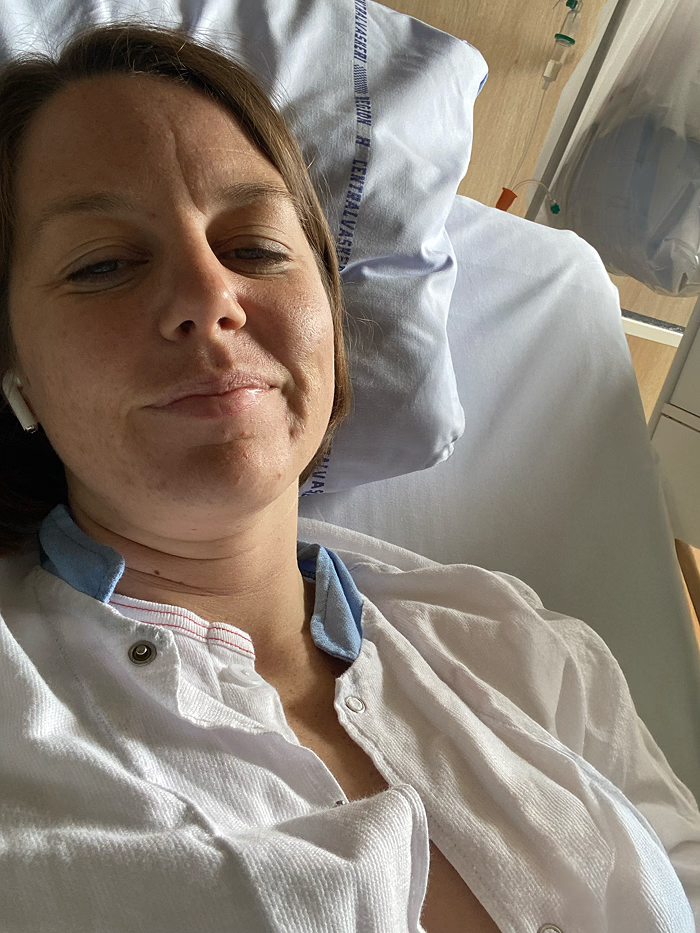
After three hospital visits and a surgical procedure, I woke up crying in the recovery room.
Crying because of the care I’d received from strangers — the surgeon who stroked my hand and said it was over, the nurse who ordered me lunch, my boyfriend who came to pick me up.
Crying because it was finally over.
When I first found out I was pregnant, I calculated the due date: January 23rd.
I saved it somewhere in my mind, told myself it was okay if I felt sad that day. But when it came, I barely noticed. And somehow, that told me something too: that I’d made the right decision.
I still have the egg cups. They were the beginning and end of my porcelain ambitions.
I still don’t own Christmas decorations. Maybe I never will. I’ve made peace with that.
My belief in the right to abortion hasn’t changed. I still see it as a basic human right — and I wouldn’t undo my choice.
But I do wish I’d known more at the time. About what pregnancy can do to your mind, not just your body.
About how overwhelming it can be, no matter who you are.
Maybe then I would’ve known that there is help available and I wasn’t as alone as I felt.