
2/9/25
From Impostor to Fulfillment – How Active Listening Freed Me from Toxic Pressure
How the pursuit of perfection and external validation nearly broke Martyna Linartas and how letting go became her greatest breakthrough.

What happens when a high-achieving woman and now a bestselling author - stops striving and starts listening?
In this candid and compelling reflection, Martyna Berenika Linartas shares how the pursuit of perfection and external validation nearly broke her, and how letting go became her greatest breakthrough.
This isn’t a typical success story. It’s a raw and wise look at imposter syndrome, privilege, and the myth of meritocracy.
Anchored by her new book Unearned Inequality, Martyna charts a personal evolution from relentless ambition to a grounded sense of joy - guided by one simple, radical practice: active listening.
For any woman who’s chased success or questioned her worth, this story offers something better than advice: permission to breathe, trust, and be fully present.

In mid-April 2025, my first book, Unearned Inequality, was released in Germany. When it reached #1 on the nonfiction list in May, I could hardly believe it.
I spent the whole day bursting into tears.
Tears of joy, of course.
Since then, I’ve recorded numerous interviews and podcasts about the book.
One of my central messages is that Germany is an inheritance society, not a meritocracy (which is why I chose the word “unearned” for the title).
The idea that anyone can rise from dishwasher to millionaire, or as we say in Germany - that everyone is the architect of their own fortune - is a myth.
Again and again, I’ve been asked why I reject this belief.
After all, as a successful migrant woman, I’m supposedly the perfect example of that narrative.
But charming anecdotes (including my own) aside, the data from numerous democracies tell a different story …and they’re hard to ignore.
Today, though, I don’t want to talk about numbers or academic research.
Nor do I want to revisit what I cover in my book: the many crucial factors behind my success that were entirely outside my control - like the fact that my parents were already academics, that I don’t “look” like a migrant, or that I was supported at pivotal moments by people ranging from my kindergarten teacher to my professors.
I’d like to get personal
Today, I want to get personal and share what, deep down, has mattered most to me.
Paradoxically, the greatest growth in both my personal and professional life came when I set aside my relentless ambition for success.
It may sound contradictory to tell a story about how I came to succeed only to then reflect on the importance of letting go of success, but holding that tension feels essential.
This is the full story, and I want to tell it honestly.
For me, discovering and practicing this new mindset was nothing short of liberating (and here comes the next paradox: I had to practice a lot in order to calm down).
Maybe parts of my journey will resonate with yours.
And maybe, just maybe, I’ll reach a few women who are already empowered and ambitious, and offer them a new way of thinking about success: one they might not expect.

This is a story about the kind of ambition that nearly broke me. About the path from imposter syndrome to a quiet ease in myself that still catches me by surprise. And about the most important lesson I learned along the way:
Never take yourself too seriously.
So, how did I get there? Believe it or not, through active listening.
Achievement was the highest currency
For far too long, that was exactly my problem: I took myself far too seriously.
This mindset was rooted in my childhood, where achievement was the currency of self-worth.
From an early age, I was conditioned to perform, to excel, to prove myself, achievement became my personal stock-in-trade.
I often found comfort in celebrating my successes; they reinforced my self-esteem and gave me the illusion of control.
I often found comfort in celebrating my successes; they reinforced my self-esteem and gave me the illusion of control
But as with all things taken to excess, this obsession became unhealthy.
Here’s an example.
During my bachelor’s studies in Madrid, I asked two professors from different seminars if I could write one extended paper and submit it to both classes.
They agreed.
One gave me an A, the other a B.
The B? It made me so furious that I punched the wall in my apartment with all my strength.
I didn’t know whether I’d broken my hand or just bruised it. Honestly, I didn’t care.
My anger quickly spiraled into a depressive slump, and I spent two days holed up in my tiny flat, doubting everything about myself.
Because the truth is, tying my self-worth to performance came hand in hand with a classic case of imposter syndrome: that nagging voice whispering that maybe I wasn’t good enough, smart enough, or capable enough to keep up.
So I pushed even harder, striving to be better, faster, smarter - caught in a vicious cycle that slowly drained me.
It took time, but eventually, I learned how to step off that performance treadmill.
Coach: What do you really want?
A crucial turning point came from the outside.
An opportunity I was given just when I was most eager to prove myself: during my PhD in a highly competitive research cluster.
The project was exceptionally well-funded, and we were offered something rare and valuable: individual coaching sessions.
I jumped at the chance. What a privilege!
I looked forward to them with the hope of becoming even better.
My coach started with a simple question: “What do you want to learn?”
I didn’t hesitate.
As a young woman in academia, pushing against the grain of mainstream economic thought and constantly afraid of failing, I told her I wanted to learn how to debate with older white men.
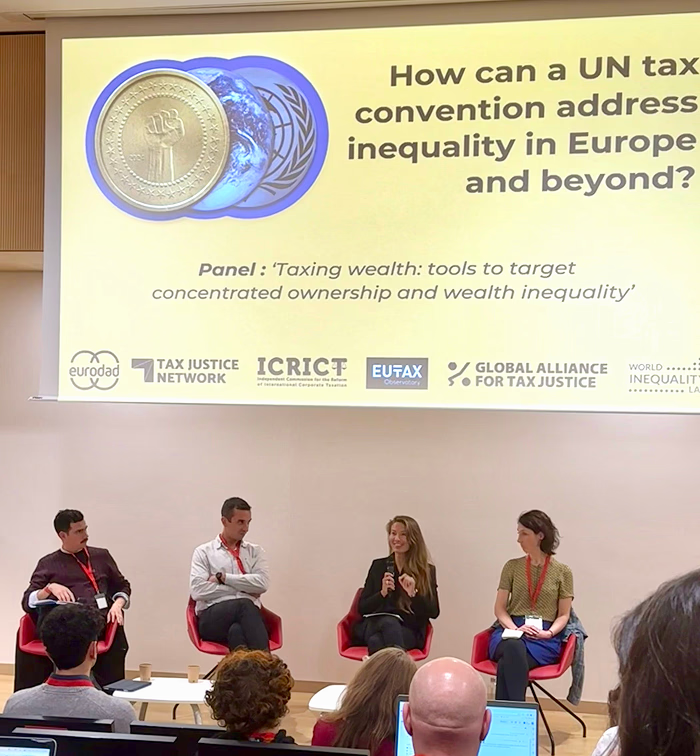
She asked if I had any role models - people I admired for their communication skills, who argued convincingly, who I genuinely enjoyed listening to.
The first name that came to mind was the German sociologist Aladin El-Mafaalani.
“So,” she said, “what do you think he does particularly well?”
I thought for a moment.
“He seems authentic. Genuine. His answers don’t feel rehearsed like a politician’s. He really engages with what the other person is saying. He listens well.”
“Can you do that too?”
“Listen well? I don’t know... honestly, no.”
“Why not?”
“Because in debates, I’m always thinking about what I want to say before I even open my mouth. I’m already planning which books or studies to cite, how to structure my argument.”
“So you’re not fully present with the person you’re speaking to.”
“Exactly. I’m not really listening. I’m just preparing my response.”
Beyond the pursuit of perfection
My problem was that I always wanted to perform perfectly.
I was desperate to seem smart, to make my point clearly and impressively, rather than simply listening and being present.
Instead, I often found myself stuck in my own head - anticipating, preparing, trying to outsmart the conversation.
In doing so, I couldn’t give my full attention to what was actually being said. My obsession with perfection made it impossible to truly achieve.
My obsession with perfection made it impossible to truly achieve
I became tense, distracted, and increasingly nervous.
"Why do you think you can’t listen actively?" my coach asked.
"Because I’m afraid of failing," I admitted.
"Martyna, everything you need is already in your mind. And even if you don’t include every single detail, no one will notice."
She was right. I had placed so much weight on perfection that it became the very thing holding me back. And so I had to ask myself: if my true goal was to listen actively, were my old goals - perfection and proving a point - actually working against that?

I saw two choices.
I could continue trying to craft the perfect response before the other person had even finished speaking, knowing that I would inevitably fall short because I wasn’t fully present.
Or I could choose to listen actively, to meet the other person in the moment, and to engage fully with their words and presence.
New goals, new mindset
I realized that a good conversation happens when both people meet on equal footing.
It is not just about taking yourself seriously, but about respecting your conversation partner enough to give them your full attention through real dialogue and exchange.
When I stayed locked in my own head, preparing what to say next, I was denying them that respect. I was failing to create a sense of equality in the conversation.
So I had to ask myself: what really mattered more? And had I created the conditions for a good conversation?
The honest answer was no.
I had made myself more important than the exchange itself.
Too important.
If I could accept that mistakes are normal, human, even necessary and if I could stop taking myself so seriously, then I could finally relax.
Only then could I truly listen and offer the same presence I wished to receive in return.
To do that, I had to trust myself.
I was showing up on panels, on the radio, on TV, because I knew what I was talking about. That knowledge already lived in my mind, ready when I needed it.

I did not have to over-prepare or fake anything. I could let go of the need to be perfect.
More than anything, I had to learn not to take myself too seriously. That was the key to loosening up and truly listening.
You know this. Trust yourself. Relax. Then you can really listen.
That is what I practiced.
Every time I noticed myself preparing answers in my head while the other person was still speaking, I gently interrupted myself and thought: no, relax, just listen.
It was a revelation.
It changed everything. And it turned out that this practice went far beyond just learning how to have better conversations.
Past and future aside
At the time, I was meditating regularly and reading several books, all of which emphasized one core idea: being present. Not dwelling on the past or worrying about the future, but fully perceiving and experiencing the here and now.
At its core, meditation is simply that - being present.
What I never expected was that active listening would become a method that embodied this same principle
It helped me loosen up, think more clearly, and actually feel what was happening in the moment.
Something clicked.
I began to redefine my goals and shift my understanding of success. I no longer wanted to succeed in the traditional sense. What I wanted was to feel joyful and grounded in the present.
Now, everything I do brings me genuine joy.
Whether or not it is seen as "successful" has become secondary. This mindset shift also made me braver and more confident in my abilities.
Because it no longer mattered what others thought.
What mattered was whether I was doing the right thing for my own growth and purpose - in my case, answering my research questions and creating new knowledge around unearned inequality through inheritance tax.
So I dared
As part of my doctoral research, I allowed myself to experiment.
I developed new methods and connected seemingly unrelated topics in unconventional ways.
Even when interviewing nearly forty of the richest and most powerful people in Mexico and Germany, I managed to stay composed.
I had prepared well for those interviews. When they began, I was calm, focused, and fully present with each person in front of me.
I listened actively and met my interviewees on equal footing.
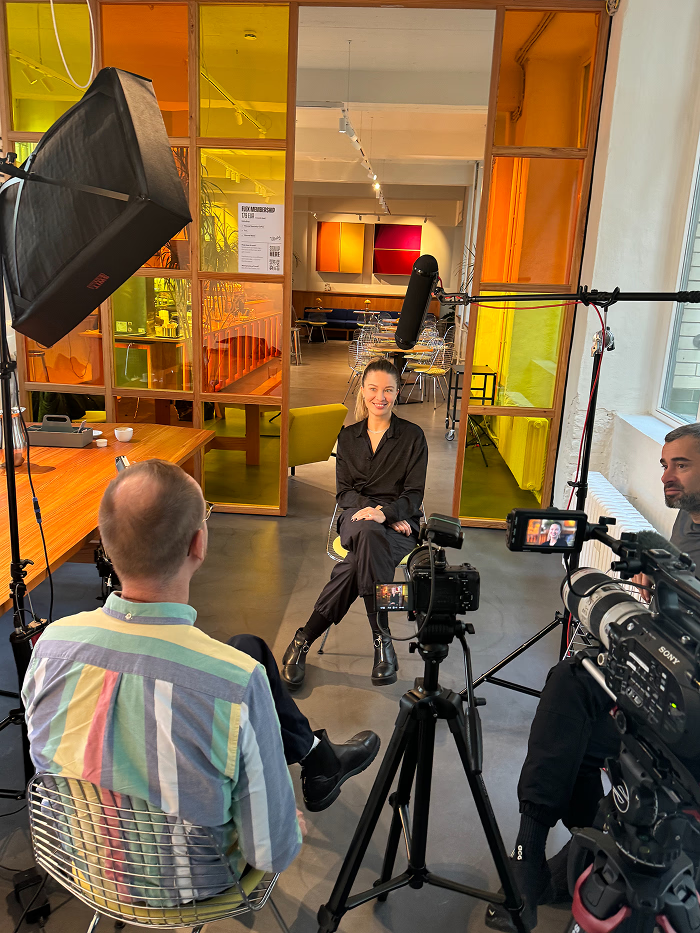
That is what active listening does.
It creates balance in the conversation. No matter how impressive someone's title or bank account may be, anyone willing to engage in a real dialogue deserves respect and attention.
In the end, nobody walks on water. And everyone, quite simply, poops. This image helps me not take anyone else too seriously either.
In the past, I used to prepare obsessively. I would review my notes over and over, sometimes for days, right up until the last possible moment.
Today, before stepping on stage, I do something different. I take a deep breath and repeat a quiet mantra to myself:
I know my stuff. I trust myself. And if I make a mistake, I simply enjoy what I do.
Walk this way…
That does not mean we should be arrogant or unprepared. But once you truly understand your subject - when it lives not only in your head but also in your heart - you no longer need to cling to a script.
You become the script.
This kind of realization is not a single moment of clarity. It has to be practiced, repeated, and lived.
Does that sound exhausting?
Try it. It is worth it.
I will not pretend I have fully internalized this mindset or that my journey is complete.
There are still tough days filled with self-doubt. I notice them by the way I start obsessively checking numbers, rehearsing answers in my head, and asking myself in silence, “Was that good enough?”
But here is the good news. Those days are becoming rarer.
Still, a word of caution. In my experience, success has a way of feeding the ego. I try to stay aware of that.
I cried when I received a summa cum laude for my dissertation. And I cried again when my book reached number one on the nonfiction list.
I am not entirely sure if I cried because I finally felt like I had made it, or because I was overcome with gratitude.
Maybe I was simply relieved.
I have often been haunted by imposter syndrome, whispering that no one would ever find this work good enough.
Most likely, it was all of those emotions at once.
The perfectionist in me still wishes I were further along. But these days, I am more gentle with myself.
It is okay. I am working on it.
And in the end, it is not really about the goal.
It is about the journey. Yes, I had to throw in that cliché. I know. That is my sense of humor.
And if you did not find it funny, then maybe I got it wrong.
But that is okay too.
Because I genuinely enjoy what I do - bad jokes included.