2/9/25
Ozempic Made Novo Nordisk a Star. Then It Lost Its Shine.
In 2023, Novo Nordisk was crowned Europe’s most valuable company. Just two years later, it had lost more than half its value. What happened?

In 2023, Novo Nordisk was crowned Europe’s most valuable company.
Just two years later, it had lost more than half its value.
So what happened?
To find out, we need to rewind because Novo’s story doesn’t start in a boardroom, but in a lab, with a scientist on a mission to make insulin accessible to everyone who needed it.
From that mission grew a pharmaceutical powerhouse. But how did it rise so high, and why has it now stumbled so dramatically?
Here’s how it unfolded.
In 1922, during a North American lecture tour, August Krogh, a freshly minted Nobel laureate, was introduced to the groundbreaking work being done in Toronto to extract and purify insulin.
Krogh shortly after received an offer that was nothing short of extraordinary: a rumored $1 million to commercialize the discovery in the United States. But Krogh, guided by a belief that medical progress should serve humanity rather than enrich a few, turned it down without hesitation.
He saw no place for proprietary walls around a treatment that could save millions. Instead, he returned to Denmark determined to replicate the Toronto team’s method and to share it freely, building a foundation rooted in open collaboration and humanitarian purpose rather than personal wealth.
The First Shipment
That mission crystallized one icy winter day in 1923, when a small crate, its glass vials chilled by the North Sea air, arrived in Copenhagen from Toronto.
Inside was insulin, a substance so new and so precious that only two years earlier it had been hailed as one of the greatest medical breakthroughs in history.
In a modest Danish laboratory, Krogh and a handful of colleagues gathered around the shipment with quiet reverence. For Krogh, this was more than scientific curiosity; it was personal. His wife, Marie, herself a pioneering physician, had type 2 diabetes - a condition that, until now, meant a slow and certain decline.
With no dreams of building a company - let alone a global empire, Krogh’s goal was disarmingly simple: make insulin in Denmark, make it accessible to everyone who needed it, and continuously improve it.
From that modest lab, a humanitarian endeavor began - one that would, over the next century, evolve into Novo Nordisk, a company that would one day supply half the world’s insulin, weather wars and fierce corporate rivalries, and survive seismic shifts in medicine.
By 2023, it would stand at the pinnacle, crowned the most valuable company in Europe.
Two years later, it would lose that crown in spectacular fashion.
Two Rivals, One Mission
The road to becoming a global pharmaceutical giant was anything but straightforward.
In the 1920s, Krogh and his partners established Nordisk Insulinlaboratorium, dedicated to producing insulin in Denmark.
Not long after, a splinter group of former employees formed a competing company, Novo Terapeutisk Laboratorium, and with it began a rivalry so fierce it would shape the next half-century.
Each company innovated independently, improving insulin extraction, developing new delivery systems, and steadily expanding production.

Patients grew loyal to one brand or the other, and while the companies competed fiercely, they also pushed each other to raise the bar - a rivalry that ultimately benefited millions living with diabetes.
In 1989, after decades of parallel paths, the two companies merged.
The new entity, Novo Nordisk, quickly became a powerhouse in diabetes care. For the next thirty years, it quietly dominated the global insulin market, a respected leader but hardly a household name outside of Denmark.
That would change with the arrival of a new drug.
The Ozempic Era
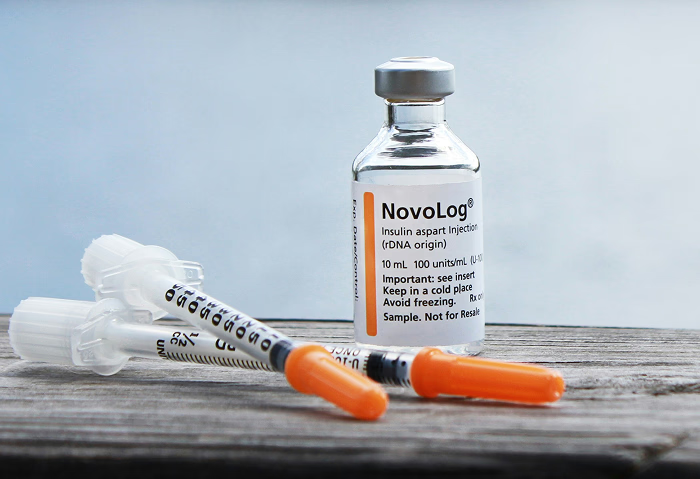
2017: Novo Nordisk launches Ozempic, the brand name for semaglutide, a synthetic version of the hormone GLP-1, which helps regulate blood sugar. Initially approved for type 2 diabetes, Ozempic shows a remarkable side effect: significant, sustained weight loss.
Physicians are stunned. Patients are thrilled. And the cultural machine takes over.
Celebrities talk about it on talk shows. TikTok fills with “Ozempic journey” videos, garnering millions of views. Magazine covers feature before-and-after stories. Analysts estimate the global market for obesity drugs could reach hundreds of billions of dollars, with one billion people worldwide qualifying as obese.
Novo rides the wave.
In 2021, it launches Wegovy, semaglutide specifically for weight loss, and demand instantly outstrips supply.
By the first half of 2025, Ozempic alone brings in $10 billion, 70% from the U.S.
By the first half of 2025, Ozempic alone brings in $10 billion
For a company that spent nearly a century in the steady business of insulin, the Ozempic boom is a dizzying leap into the cultural spotlight.
Investors can’t get enough.
In 2023, Novo Nordisk overtakes LVMH (the French luxury conglomerate behind brands like Louis Vuitton, Moët & Chandon, and Dior, and until then Europe’s most valuable company) to claim the top spot, with a market capitalization greater than Denmark’s GDP.
The Danish press hails it as a national triumph.
It seems untouchable.
The First Cracks
The first sign of trouble is a shortage.
Demand for Wegovy is so overwhelming that in 2022 the U.S. Food and Drug Administration places semaglutide on its drug shortage list.
This triggers a little-known provision in U.S. law: compounding.
Pharmacies are allowed to mix their own versions of drugs on the shortage list, bypassing patents. Intended as an emergency measure, compounding becomes a booming shadow market for cheap GLP-1 knockoffs.
When the FDA later declares the shortage over, many compounders ignore the order to wind down.
By mid-2025, more than one million Americans are using compounded GLP-1s, directly eating into Novo’s market share.
Novo fights back with cease-and-desist orders and lawsuits, sending out as many as 14 in a single day.
But the problem persists. As HSBC analyst Rajesh Kumar notes, “I’ve never seen compounding at this scale before.”
Enter Eli Lilly
For four and a half years, Novo has the GLP-1 market largely to itself.
Then, Eli Lilly arrives, an American pharmaceutical powerhouse with a long history of blockbuster drugs.
- Late 2022: Lilly launches Mounjaro, its own GLP-1 drug, initially approved for type 2 diabetes.
- Clinical trials show it delivers even greater weight loss than semaglutide, with many patients also reporting fewer side effects.
- 2023: Lilly repurposes tirzepatide for weight loss and markets it under a new brand name, Zepbound.
- By early 2025: Zepbound overtakes Wegovy in new U.S. prescriptions, a symbolic and commercial victory in the most lucrative obesity-drug market in the world.
Lilly’s edge isn’t just in efficacy - it’s in strategy. The company undercuts Novo on price by selling vials with syringes instead of expensive pre-filled pens.
It launches LillyDirect, a direct-to-consumer sales platform, in January 2024.
Novo’s own platform, NovoCare Pharmacy, doesn’t arrive until March 2025 - 14 months later.
“Lilly was doing all these things, and Novo wasn’t,” says Emily Field, an analyst at Barclays. “It felt like one big own goal.”
Pipeline and Patience
In pharmaceuticals, market value rests not just on today’s profits but on tomorrow’s pipeline.
Investors see the future in weight-loss pills cheaper, more convenient, easier to distribute.
Lilly’s daily pill, orforglipron, shows promising late-stage results: weight loss similar to injections, with fewer restrictions. Novo’s oral version is less effective, though other formulations are in development.

“The market isn’t going to be patient in any way,” says Seamus Fernandez of Guggenheim Partners. “Lilly is running faster than Novo.”
The Leadership Shock
In May 2025, Novo delivers a surprise: CEO Lars Fruergaard Jorgensen, in the role since the dawn of the Ozempic era, will step down. The move, urged by the controlling Novo Nordisk Foundation, rattles investors already nervous about slowing growth.
His successor is Maziar Mike Doustdar, the first non-Dane to lead the company, an Iranian-born Austrian who joined Novo in 1992 for what he thought would be a summer job making photocopies. Known internally for his speed and decisiveness, Doustdar inherits a company under siege from competitors, regulators, and the market’s sudden change of heart.
The Fall
By mid-2025, Novo’s share price has fallen more than 50% from its peak in 2024. The drop knocks it out of Europe’s top 10 most valuable companies… then out of the top 25 entirely.
In late July, after cutting growth forecasts, Novo loses $70 billion in market value in a single day. Many stock market analysts downgrade their recommendations from buy to hold and then to sell.
“The market’s got no patience for Novo,” says Gareth Powell of Polar Capital. “Sentiment is absolutely dire.”
The company is still posting enormous numbers - $24 billion in global sales in the first half of the year, but the story around it has shifted dramatically. In the stock market, numbers alone rarely drive performance; what matters just as much is the narrative investors tell themselves about the future.
For years, that narrative painted Novo as unstoppable.
The innovator that had redefined obesity treatment, outpacing competitors and turning medical science into cultural currency.
Now, investor psychology has flipped. The market no longer sees an invincible leader, but a company under pressure: scrambling to keep pace with Eli Lilly’s momentum, fighting a losing battle against copycat drugs, and facing questions about whether its next blockbuster will arrive in time.
It’s a reminder of what we often teach in the Female Invest app: stock prices are not just a reflection of a company’s financial results.
They are shaped, sometimes overwhelmingly, by perception, confidence, and sentiment.
When that collective confidence erodes, even a company delivering record-breaking sales can see its share price tumble.
Headwinds and Hard Truths
Beyond competition, there are structural risks. Some analysts worry the market for weight-loss drugs was overestimated. Not in size, but in how quickly it could be reached. Access remains limited by cost, healthcare systems, and political pressures.
In the United States, President Trump has been turning up the political heat on the pharmaceutical industry, publicly pushing for significant cuts to drug prices while also threatening to impose tariffs on medicines manufactured abroad - a move that would directly hit companies like Novo Nordisk, whose production and supply chains stretch across multiple countries.
Even with a leadership change at the very top, expectations for a swift reversal of fortune are muted.
The incoming CEO may be energetic and decisive, but market sentiment, competitive headwinds, and regulatory pressures have combined into a reality that will be difficult to shift in the space of a year or two.
The Bigger Question
Novo’s reversal is more than a corporate drama - it’s a parable about the speed and fragility of market sentiment.
It also raises bigger questions about access and equity.
Questions that go beyond the rise and fall of a share price. Obesity and type 2 diabetes disproportionately affect women in certain age groups, particularly in lower-income communities where access to healthy food, preventive care, and early diagnosis is limited.
These are the very populations for whom a breakthrough drug could be life-changing.
Yet drugs like Ozempic and Wegovy exist in a healthcare reality shaped by wealth, insurance coverage, and national policy.
In countries without strong public healthcare systems, access often depends on the ability to pay out of pocket, which can mean hundreds or even thousands of dollars a month.
Even in wealthier nations, insurance coverage is patchy and often excludes weight-loss drugs, treating them as lifestyle treatments rather than essential medical interventions.
The result is a widening gap: the people who might benefit most are often the least able to afford them.
And while investors frame Novo Nordisk’s troubles in terms of billions of dollars in lost market value, the human cost of inaccessibility is far more profound.
A company’s share price can recover; an investor portfolio can rebound.
But when life-changing drugs remain out of reach, what’s lost is measured not in billions, but in heartbeats — in the years of life that patients never get to live.
Full Circle
It’s been over a century since August and Marie Krogh unpacked that first crate of insulin.
They couldn’t have imagined social media buzzwords like “Ozempic face” or trillion-dollar market projections. But they would have understood the stakes: life, health, and the urgency to innovate.
Novo Nordisk has lost its crown. But the race it began in 1923 to transform the lives of millions is far from over.
Because in medicine, the true measure of value isn’t the share price. It’s the lives extended, the suffering reduced, the futures made possible.
And that’s a race worth running… even without the crown.
What about you?
If you were investing today, would Novo Nordisk’s recent stumble make you think twice, or would you see it as an opportunity to buy into the next chapter of its story?
Share your take on the company’s future below.
We’d love to hear how you’re reading the situation and what you plan to do from here.