5/11/25
The Market Crash No One on Wall Street Will See Coming - And What That Means for Your Money as an Investor
The Market Crash No One on Wall Street Will See Coming - And What That Means for Your Money as an Investor

There is a quiet tension running through Wall Street these days.
The kind that doesn’t make headlines but hums beneath every market update, every investor memo, every cautious statement from the world’s most powerful bankers.
In a recent piece titled “Why Wall Street Won’t See the Next Crash Coming,” The Economist captured that mood - a sense that everyone knows the music could stop, but no one knows when.
The irony is that even the smartest people in finance still cannot predict the next market meltdown.
And the warnings are coming from the very top.
Jamie Dimon, CEO of JPMorgan Chase, runs the largest bank in the U.S. David Solomon, who leads Goldman Sachs, oversees one of the most influential investment firms in the world.
And Jane Fraser, CEO of Citigroup, manages a global financial powerhouse that spans more than 160 countries. When these three start using words like “frothy,” “bubbly,” and “overvalued,” people pay attention.
Even the Bank of England and the IMF have weighed in, warning that the risk of a sharp correction has grown.
Everything still looks fine. Maybe even too fine. But that’s exactly what’s making people nervous.
Why the Market Feels Expensive
Let’s start with valuations - the finance world’s word for how “pricey” assets look compared to what they actually earn.
A valuation simply measures what investors think something is worth, often based on expected profits. One of the most common ways to measure it is the price-to-earnings (P/E) ratio, which compares a company’s share price to its annual profits.
A high P/E means investors are betting big on future growth; a low P/E means they’re more cautious. A forward P/E ratio is based on the companies’ projected 2026 earnings.
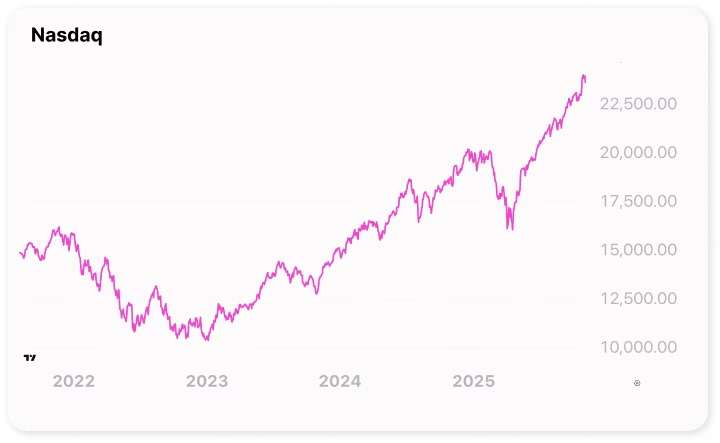
The Nasdaq is currently trading at around a forward P/E ratio of about 30, well above its 10-year average of 25.
And corporate bonds, which are supposed to offer a cushion of safety, now pay only 0.8 percentage points more than U.S. government bonds, one of the narrowest gaps in decades.
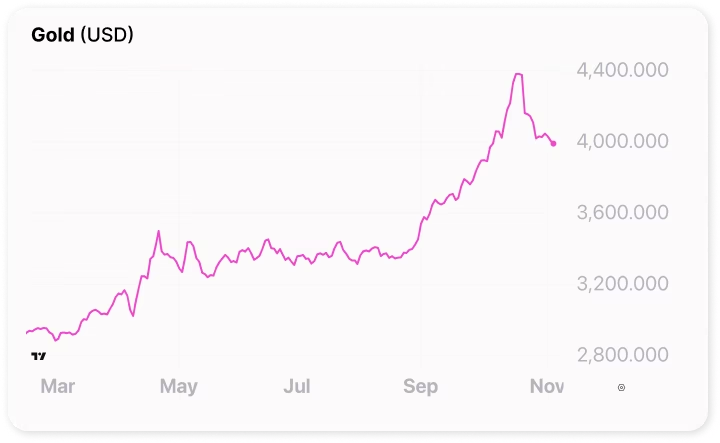
Even gold, normally the financial world’s safe corner, has been behaving erratically. After soaring to a record high in October, its price dropped by 7% in just two days.
So yes, the market feels expensive.
But what is trickier is this: it might stay that way for a while.
The AI Boom - or the New Bubble?
Since ChatGPT’s debut in late 2022, money has flooded into AI. Tech giants - Microsoft, Nvidia, Amazon, Meta, and Google - have spent billions on chips, data centers, and AI startups. Smaller firms followed.
By mid-2025, the Nasdaq was trading at a forward P/E ratio of about 30, well above its 10-year average of 25. Nvidia alone hit a $5 trillion valuation. Even companies like CrowdStrike and Palantir were valued at dizzying multiples of earnings.
Investors weren’t just betting on profits - they were betting on potential. On a future where AI transforms everything from healthcare to logistics to entertainment.
But as Wall Street has learned before, perfection rarely lasts.
Why Crashes Are So Hard to Predict
At the heart of the problem is volatility - the measure of how much prices jump around.
When markets are calm, prices move gently. When they panic, prices swing violently.
The models used by banks and traders assume tomorrow will look like today. So if it is calm today, they assume calm tomorrow.
But when the world changes fast - a bank failure, an inflation spike, a pandemic - the models collapse.
The Economist put it bluntly: they are “ill-equipped to predict the sudden jumps in volatility that accompany corrections.”
Even artificial intelligence has not cracked the code.
Firms like Bridgewater Associates, one of the largest hedge funds in the world, use machine learning to track thousands of economic variables, from GDP growth to corporate earnings, in the hope of spotting patterns. But even they admit there is no reliable way to foresee what causes a crash.
Because crashes are not just math.
They are emotion - fear, greed, and collective surprise, all hitting at once.
But It Could Also Take Years
Here is what many people forget: warnings about a crash do not mean it is coming tomorrow.
Markets can stay expensive for a long time. In fact, they often do.
During the dot-com boom of the late 1990s, investors piled into any company with “.com” in its name, driving prices far beyond what those firms were earning. When reality hit in 2000, the Nasdaq fell nearly 80%. Many companies disappeared - but those that survived, like Amazon and Microsoft, went on to dominate the next two decades.
In the housing bubble of the mid-2000s, easy money and risky loans inflated home prices until they collapsed in 2008, triggering a global financial crisis.
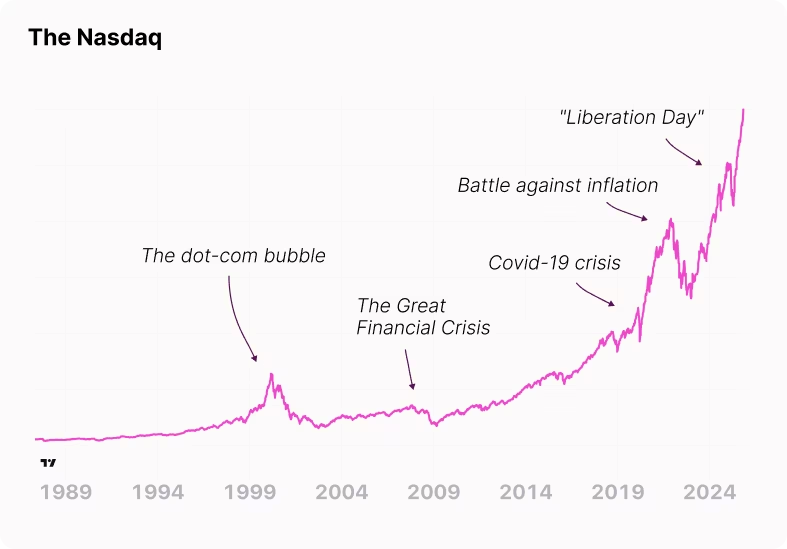
The pattern is the same: excitement, overvaluation, correction, and eventual recovery. Those who stayed diversified and focused on strong companies usually came out stronger in the long run.
The same could happen now. Yes, valuations are high. But if you sell everything and wait on the sidelines, you could miss out on some of the biggest rallies of your lifetime.
As economist John Maynard Keynes once said, “The market can stay irrational longer than you can stay solvent.”
Translation: trying to time the top is a dangerous game. The market does not crash on your schedule.
Why This Moment Feels Different
The last major crash, the 2008 financial crisis, was built on fantasy.
Banks were giving out risky loans, repackaging them into securities, and selling them as “safe” investments. It was a bubble built on bad math and wishful thinking.
This time, the risks look different.
Prices may be inflated, but there is real innovation underneath. Artificial intelligence, renewable energy, and biotechnology are not empty ideas; they are reshaping entire industries.
In your Female Invest The Daily Deep Dive article last week, we explored whether AI is a bubble or a new Industrial Revolution.
The conclusion was complicated: there is hype, yes, but also extraordinary progress.
Even Jeff Bezos made this distinction recently in an interview at Italian Tech Week.
“This is a kind of industrial bubble as opposed to financial bubbles,” he said.
“The ones that are industrial are not nearly as bad. When the dust settles, society benefits from those inventions.”
In other words, there may still be a correction, but this time, the world could end up better for it.
What This Means for You
If even Wall Street’s brightest minds cannot predict when the next crash will happen, the best thing you can do is stop trying to.
Here is what actually works:
1. Keep investing regularly.
The secret to long-term success is not timing the market, it is time in the market. If you keep investing a fixed amount every month, you automatically buy more when prices are low and less when they are high.
Think of it like averaging out the cost of your groceries over a year; you do not stop eating just because prices fluctuate.
2. Stay diversified.
Do not put all your eggs in one basket. Mix between stocks, bonds, and cash, and even within stocks, across sectors like tech, healthcare, and energy.
If one part of your portfolio falls, another can help balance it out.
3. Think long-term.
Market crashes hurt, but history shows they always recover. If you had invested in global stocks before the 2008 crash and held on, your portfolio would have doubled by now.
The investors who panic-sell miss the recovery. The ones who stay, win.
4. Ignore the noise.
The financial media thrives on fear because fear gets clicks. Headlines are written to make you act fast. Do not.
Building wealth is slow, steady, and profoundly boring - and that is exactly why it works.
The Bigger Picture
Yes, the market might be overheated.
Yes, a correction will happen eventually.
But it could be next month, or it could be three years from now. In the meantime, innovation is happening at a pace humanity has not seen since the 19th century.
The last Industrial Revolution built railroads, electricity, and factories. This one is building intelligence itself. And that means volatility and opportunity will continue to coexist, often in the same moment.
After the dot-com crash, it took the Nasdaq 15 years to regain its highs. Yet companies like Microsoft and Amazon didn’t just recover; they multiplied in value many times over. The lesson: patience and balance beat panic every time.
For investors, this frothy market is not a reason to run.
It is a reason to understand the game you are in, stay calm when others panic, and remember that the biggest rewards often come to those who did not flinch.