.avif)
19/12/25
America Just Changed Its Mind on Cannabis and the Markets Felt It Immediately
America Just Changed Its Mind on Cannabis and the Markets Felt It Immediately

For more than 50 years, marijuana has lived in the legal equivalent of the basement.
This week, the White House finally let it upstairs.
On Thursday, President Donald Trump signed an executive order directing federal agencies to reclassify cannabis under U.S. drug law. The move quietly reshapes health care, taxes, banking, and investing all at once. It is being called the most consequential shift in federal cannabis policy since the Nixon era. And for investors, it may mark the beginning of an entirely new chapter.
If you have ever wondered why cannabis stocks behave like chaos machines, why banks have avoided the industry, or why legalization never quite translated into profits, this decision fills in a major missing piece.
Let’s break it down.
What actually happened, in plain English
Under U.S. law, drugs are sorted into five “schedules.”
Schedule I is the harshest category. It is reserved for substances with no accepted medical use and a high potential for abuse.
That is where marijuana has lived since 1970, alongside heroin and LSD.
Schedule III, by contrast, includes drugs that have accepted medical use and a lower risk of abuse, such as ketamine or Tylenol with codeine.
Trump’s executive order instructs the DEA to move cannabis from Schedule I to Schedule III.
That single bureaucratic shift changes how cannabis is treated economically, medically, and institutionally.
Recreational marijuana laws do not change. States still decide legality. But from a financial and regulatory perspective, the impact is enormous.
Why this matters far beyond weed
For decades, cannabis companies have operated in a legal grey zone.
Even as states legalized marijuana, the federal government continued to treat cannabis businesses like criminal enterprises. The consequences were severe.
Companies faced crushing taxes, limited access to banking, a lack of institutional investors, and major barriers to medical research.
Now, many of those barriers begin to fall.

1. The tax problem finally eases
Cannabis companies have long been subject to a little-known but devastating tax rule called IRS Code Section 280E.
This rule prevented them from deducting normal business expenses such as rent, payroll, marketing, and utilities.
As a result, some cannabis companies paid effective tax rates of 60 to 80 percent, even when they were barely breaking even.
Once cannabis moves to Schedule III, 280E no longer applies.
This change alone could push many companies toward profitability for the first time.
That is why analysts are calling the move a financial lifeline for the industry.
2. Banking access becomes possible
Because cannabis was federally illegal, most banks refused to work with the industry.
Companies were forced to operate largely in cash, pay higher borrowing costs, and rely on private or offshore financing.
Reclassification reduces compliance risk and opens the door to traditional bank loans, institutional capital, and large asset managers that previously stayed away.
This is a key step in turning cannabis from a fringe industry into a mature one.
3. Research finally opens up
Schedule I status made cannabis research extremely difficult. Scientists faced strict approvals, limited supply, and heavy oversight.
Schedule III status makes medical research far easier, especially around CBD and therapeutic use.
That matters because the future of cannabis increasingly runs through health care.
The Medicare twist no one saw coming
Alongside the reclassification, the administration announced a second move that surprised nearly everyone.
Starting in April, Medicare will launch a pilot program allowing certain seniors to receive free, doctor-recommended CBD products.
This would mark the first time cannabis-derived therapies are introduced into federally insured health care.
The details are strict. Products must be legally compliant, third-party tested, and recommended by a doctor. They must also meet all state and federal safety requirements.
The White House framed the program as a response to patients with chronic pain, cancer, neurological disorders, seizure conditions, and service-related injuries, particularly among veterans.
This signals medical normalization rather than cultural liberalization.
For investors, it also signals something else.
Federal money.
.avif)
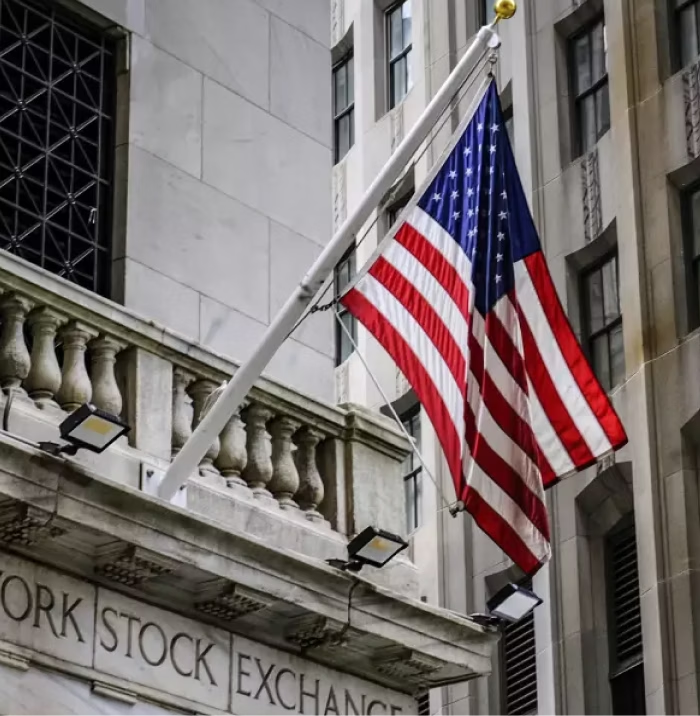
Why Wall Street reacted nervously
At first glance, this news sounds like a clear win for cannabis stocks.
Markets did not treat it that way.
Tilray rose about 6 percent. Trulieve fell roughly 15 percent. Green Thumb dropped around 5 percent. A major U.S. cannabis ETF slid more than 10 percent.
The reason is simple. This shift changes who gets to compete.
Enter Big Pharma
Once cannabis gains federal medical legitimacy, large pharmaceutical companies suddenly have strong incentives to enter the space.
They already understand FDA approval, Medicare reimbursement, large-scale distribution, and political lobbying.
Wall Street is now asking difficult questions.
Will pharmaceutical giants crowd out smaller cannabis operators?
Will CBD become heavily regulated and pharmaceuticalized?
Will margins shrink as oversight increases?
This moment creates opportunity, but it also introduces uncertainty. Markets tend to dislike uncertainty.
A reality check on CBD
CBD has surged in popularity, appearing in everything from drinks to skincare. The science, however, remains mixed.
So far, the FDA has approved only one CBD-based drug, Epidiolex, which treats rare forms of epilepsy.
Studies show inconsistent benefits for many other conditions. FDA-funded research also warns that prolonged CBD use can cause liver toxicity and interfere with other critical medications.
The administration emphasized that the executive order does not legalize recreational marijuana, does not broadly endorse CBD products, and does not bypass safety regulation.
Federal acceptance is happening slowly and cautiously.
What this means for beginner investors
If you are new to investing, this is not a simple “buy cannabis stocks” moment.
What it represents is a structural shift that improves the industry’s economics, brings federal institutions into the conversation, and shows how regulation can reshape entire markets.
Cannabis remains volatile, politically sensitive, and fiercely competitive.
At the same time, it is moving steadily from the margins toward the mainstream, especially within health care.
For long-term investors, the real lesson is not about weed. It is about how regulatory changes can quietly transform entire industries.
The bigger picture
For half a century, U.S. drug policy framed cannabis as a moral failure.
This week, it began treating it as a medical and economic reality.
The impact will unfold slowly and unevenly. Not every company will benefit. Some may struggle more than before.
But this marks a turning point away from prohibition and toward governance.
For patients, it means access.
For companies, it means opportunity paired with scrutiny.
For investors, it means complexity. It’s a good reminder that some of the biggest market shifts begin with a single line buried deep inside federal law.