
18/9/26
Shrinkflation & Skimpflation: The Inflation You Don't See in CPI
Shrinkflation & Skimpflation: The Inflation You Don't See in CPI

You reach for the same cereal box you always buy. Same brand, same price, same spot on the shelf. But it feels lighter than you remember.
That's not your imagination. And it's only half the story.
The headlines say inflation is cooling, so why does your weekly shop still feel like it's creeping up?
The answer lies in how "inflation" actually gets measured.
Every month, statistical agencies track the price of a big basket of everyday goods and services, everything from cereal to rent to petrol, and compare it to the same basket a year ago. That tracker is called the Consumer Price Index, or CPI, and it's the number behind almost every inflation headline you read.
CPI is good at spotting one thing: a price going up on the exact same product. But companies have two ways to raise prices without ever touching the sticker, and only one of them is something CPI reliably catches.
Shrinkflation: The One Statisticians Actually Catch
Start with the good news. Shrinkflation isn't invisible to official inflation data, because a smaller package is a hard number that price collectors can measure.
According to the Federal Reserve Bank of St. Louis, one of the 12 regional banks that make up the U.S. central bank system, when a product's size shrinks but its price stays the same, the Bureau of Labor Statistics applies a quantity adjustment when calculating the Consumer Price Index (CPI): it treats that shrinkage as a price increase, because on a per-unit basis, it is one.
Real examples the Fed's own research has tracked include a pack of paper towels going from 165 sheets to 147, a roll of toilet tissue dropping from 340 sheets to 312, a box of crackers falling from 16 ounces to 14.
It's been happening for decades. A pound of coffee shrank to 13 ounces in 1988, then to 11 ounces by 2003. A half-gallon tub of ice cream became a 1.5-quart tub somewhere around 2008, all while sitting in the same spot in the freezer aisle at roughly the same price.
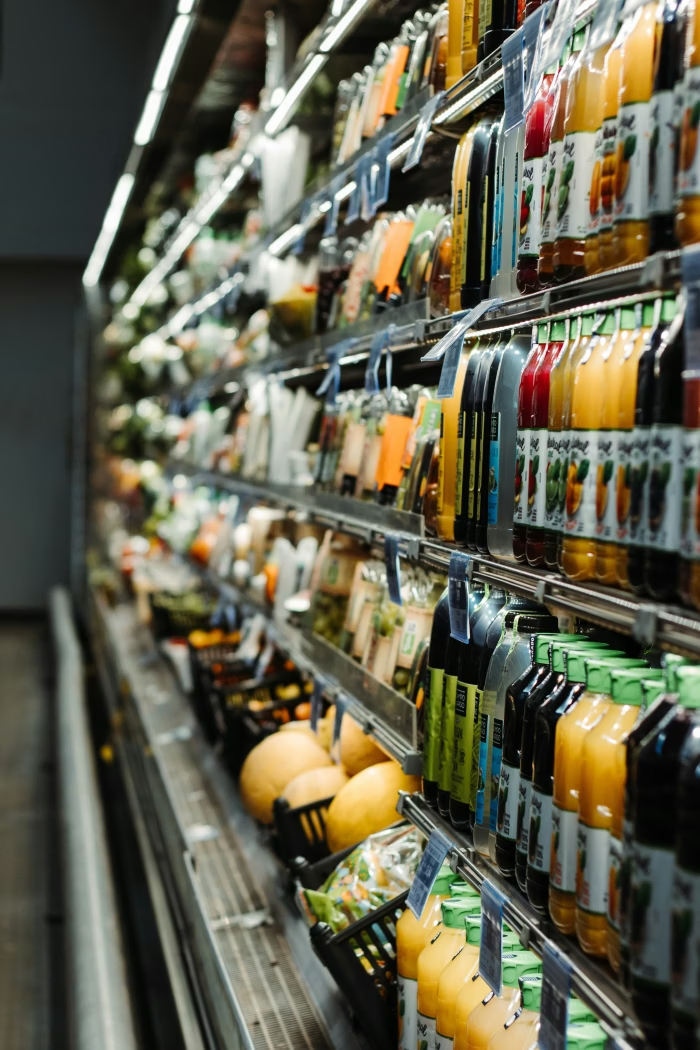
So If It's Captured, Why Does It Still Feel Hidden?
Two reasons: scale, and psychology.
On scale, a U.S. Government Accountability Office (GAO) report, published in July 2025, examined a decade of U.S. Bureau of Labor Statistics and retail scanner data. It found that shrinkflation added less than one-tenth of a percentage point to overall U.S. consumer prices between 2019 and 2024, a period when prices rose 34.5% in total. Economy-wide, it's a rounding error.
But that average hides some sharp exceptions.
In specific categories, the GAO found shrinkflation contributed meaningfully more: 3.0 percentage points for household paper products, 1.6 points for cereal, 1.4 points for coffee. And within those categories, the impact clusters: just 1.1% of cereal products were downsized, but they accounted for 8.6% of all cereal sold. A small slice of items did a disproportionate amount of the quiet price-raising.
On psychology, the GAO also points to something that should sound familiar.
Research shows shoppers are less likely to notice, or object to, a smaller package than they are an equivalent price increase on the same-sized one. A price tag going up feels like an insult. A slightly lighter bag just feels like... a bag. That's precisely why companies reach for it: not because it evades the statisticians, but because it evades you.
Skimpflation: The One That Slips Through
Here's where the "you don't see it in CPI" part of this story really lives.
The U.S. Bureau of Labor Statistics's own quality-adjustment methodology is designed to solve a different problem. When a product in the sample gets swapped out and replaced by a new version (ex. a laptop with more memory, a car with a different engine), statisticians try to net out how much of the price change was due to the item simply getting better or worse, so they're comparing like with like.
That works reasonably well for a like-for-like swap. It doesn't catch a subtler shift, like the same product, still on the same shelf, getting worse without ever triggering a "replacement" in the first place.
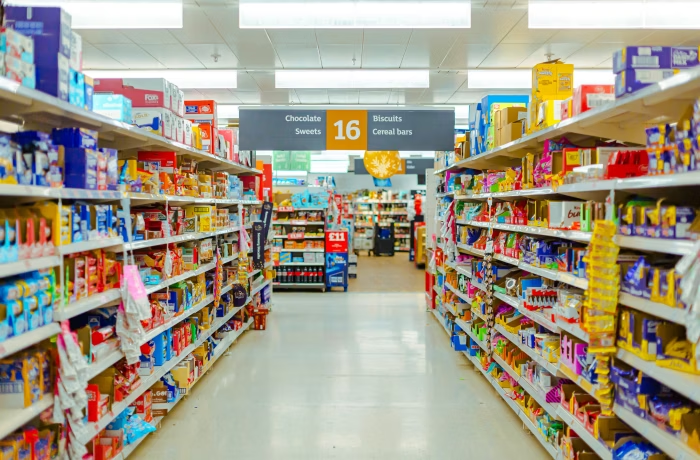
That's skimpflation. A hotel keeps its room rate exactly the same, but swaps its cooked breakfast buffet for a shrink-wrapped muffin and a banana. A supermarket keeps its prices on the shelf, but trades three staffed checkouts for one cashier and four self-service machines, shifting the labour, and your time, onto you. A restaurant keeps the menu price identical while the portion of meat gets thinner or the cut gets cheaper, without ever changing a listed weight the way a packaged product would.
None of that is a package getting smaller. It's the experience getting worse. And because nothing about the product's stated size or spec sheet changed, it rarely trips the mechanism that would flag it as a price change at all.
It just shows up, if it shows up anywhere in the data, as a small, hard-to-isolate residual that officials themselves openly acknowledge is difficult to measure.
What This Means For Your Money
None of this means CPI is broken, or that you should distrust every inflation reading you see. For shrinkflation specifically, the system largely works: a smaller box at the same price mostly does get counted as inflation.
But it does mean your own lived sense that "prices still feel high" can be entirely legitimate even when a headline inflation number is cooling, because the two things are measuring overlapping but not identical realities.

Official CPI has a decent handle on the box getting smaller. It has a much weaker handle on the box getting worse.
Two habits are worth building because of it.
First, check unit price, price per ounce, per sheet, per use, not just the price on the shelf tag, especially for packaged goods you buy on autopilot.
Second, treat a sudden "new and improved" relaunch, a redesigned self-checkout aisle, or a menu that "simplified" its offerings as a prompt to actually compare what you're getting, not just what you're paying.
And zoom out one more level: this is one small but real illustration of why cash sitting still is a losing position. Even when official inflation looks tame, the actual cost of maintaining your standard of living, in full ingredients, real service, real quantities, tends to creep in ways the headline number doesn't fully capture.
Money that's invested, rather than parked, has a better chance of outrunning that quiet erosion than money that isn't.
Sources:
- U.S. Government Accountability Office, "Consumer Prices: Trends and Policy Options Related to Shrinking Product Sizes" (GAO-25-107451, July 2025)
- Federal Reserve Bank of St. Louis, "Beyond Inflation Numbers: Shrinkflation and Skimpflation," Page One Economics (December 2022)
- U.S. Bureau of Labor Statistics, "Quality Adjustment in the CPI"