21/4/26
The Magic of Compound Interest: Why Time Is Your Best Investment Tool
The Magic of Compound Interest: Why Time Is Your Best Investment Tool

There's a reason why the most experienced investors in the world talk about compound interest like it's a superpower.
It doesn't require perfect timing, specialist knowledge, or a large sum to start with. It just requires time.
The concept is simple: your returns start earning returns of their own.
But the effect, given enough years, is anything but small.
Here's what it actually means in practice.
Interest on Your Interest
With simple interest, you only ever earn returns on the original amount you put in.
With compound interest, you earn returns on your original amount plus all the returns you've already made - your money starts earning money on itself.
Over time, compound interest is what makes investing truly life-changing.

A Simple Example
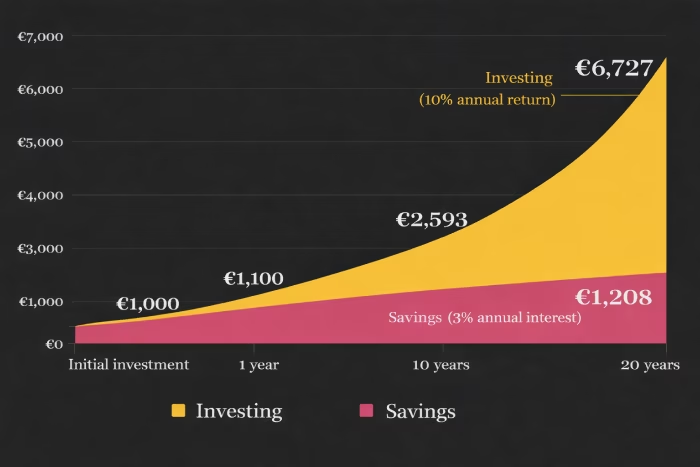
Say you invest €1,000 and it grows by 10% in the first year.
That's €100, bringing your total to €1,100.
You leave it alone.
The following year, it grows by 10% again.
But now that 10% is calculated on €1,100, not €1,000.
So you earn €110 instead of €100.
Leave that same investment untouched for ten years and your €1,000 becomes €2,593.
Wait twenty years and it grows to €6,727.
You didn't add a single euro after the initial investment - the growth came from your returns earning returns, compounding year after year.
In the early years, the numbers feel small. But give it ten, twenty, thirty years, and the growth starts to snowball. The longer it runs, the faster it builds. That's compounding in action.
To put that in perspective: a savings account earning around 3% annually would turn that same €1,000 into roughly €1,806 over twenty years.
Why Starting Early Matters More Than You Think
The most powerful ingredient in compounding isn't a high return. It's time.
And the good news is that wherever you are in life, you have more of it than you might think.
Someone who starts in their twenties has decades of compounding ahead of them, and even small contributions can grow into something significant.
But someone starting in their forties, fifties, and even sixties still has meaningful time on their side. A 55-year-old who starts today could have fifteen to twenty years of growth before they need to draw on their investments - that's plenty of time for compounding to do real work. In our community we have members in their 70s, thriving and continuing to build and grow their investments.

The point is that the best time to start was yesterday - the second best time is now.
The best time to start was yesterday. The second best time is now.
How Compounding Works in Practice
Compounding shows up in a few common places: a savings account that pays interest and reinvests it automatically, an investment fund or ETF where dividends are reinvested to buy more units, or a pension that automatically puts returns back to work rather than paying them out.
The key word in all of those is reinvesting. When your returns go back into the pot instead of being taken out, they become part of the base that earns future returns. That's the loop that makes compounding so powerful.
Breaking that loop, by withdrawing returns early or letting them sit idle, slows the whole process down.
See It for Yourself
Want to see what compounding could do for your own money?
We've built a compound interest calculator right inside the app - you'll find it in the left sidebar under Tools. Adjust the numbers, and watch what a few extra years or a slightly higher return can do!
.avif)
What This Means for How You Invest
Compounding is the reason strategies like buy and hold and dollar-cost averaging work so well over the long term (learn more about these investing strategies in the Resources tab). Both of these strategies are built on the same principle: stay invested, keep contributing, and let time do its thing.
Putting it into practice comes down to a few habits:
- Start as early as you reasonably can, even with small amounts.
- Automate contributions so the habit is consistent.
- Choose funds that reinvest returns rather than paying them out.
- And keep an eye on fees, because fees compound too, just in the wrong direction.
Compounding isn't a get-rich-quick trick. It's a slow, reliable force that rewards patience above almost everything else.
You don't have to work harder than your money. You just have to give it enough time to work for you.