14/5/26
Trump Arrived in Beijing. What Does the Xi Summit Means for Markets?
Trump’s Arrived in Beijing. What Does the Xi Summit Means for Markets?

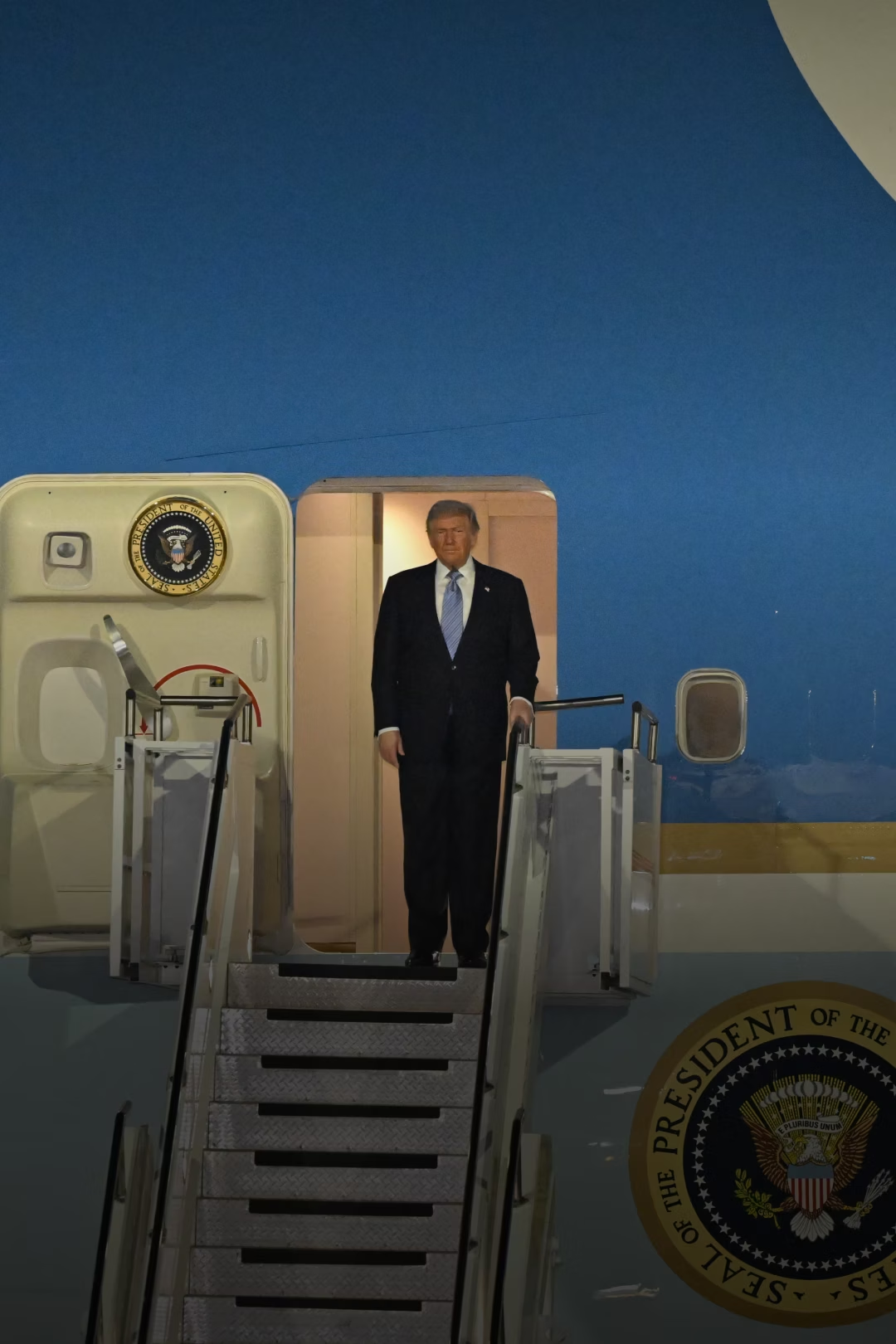
Donald Trump just landed in China for his first visit since 2017, flanked by his posse of tech tycoons: Apple’s Tim Cook, Elon Musk, Jensen Huang of Nvidia, Larry Fink of BlackRock, and others.
He's calling it a business mission, promising to ask Xi to open China up so these companies can do business.
But behind the pageantry and photo ops, this summit carries some of the most consequential questions in global politics right now. Trade, technology, Taiwan, and the Iran war are all on the agenda.
Here's what both sides want, and what investors should be watching for.
What Trump Says He Wants
Trump’s framed this trip primarily as a business mission.
He wants China to buy more American goods, particularly Boeing aircrafts, soybeans, and energy exports, and to create a more welcoming environment for US companies that have long complained of regulatory obstacles in China.
.avif)
The US is also pushing for more predictable trade terms, progress on a proposed "Board of Trade" (a joint mechanism to manage commerce in non-sensitive sectors), and a possible "Board of Investment" to handle business flows between the two countries.
Behind the business agenda, the US is also hoping Beijing will use its influence over Iran to help stabilise the conflict in West Asia.
China is the largest buyer of Iranian oil, giving it real leverage over Tehran.
What Xi Wants in Return
China comes into these talks more confident than in earlier Trump-era encounters. It showed during the tariff war that it could retaliate effectively, and has demonstrated its ability to use rare earth exports as a strategic tool.
Basically, Beijing knows it has leverage.
What China wants out of these meetings is relief from some US export controls on advanced semiconductors and the manufacturing equipment needed to make them.
It’s also seeking relief from US export controls, the restrictions Washington has placed on selling advanced chips and chip-making equipment to Chinese companies.
It wants reassurances that the US won't escalate too quickly on Taiwan or cut China off from key technologies faster than it can find alternatives.
And, it wants to project the image of a responsible, stable partner on the world stage.
Chinese analysts and officials see Trump as potentially more flexible on security issues than much of Washington, and someone who might make concessions on arms or language in exchange for commercial wins.
Xi's deeper goal, though, is to buy time: to keep the external environment calm while China pushes ahead with industrial policy, climbs the technology ladder, and reduces its dependence on Western supply chains.
Analysts call this "strategic stability." That means both sides are trying to avoid a full confrontation while quietly working on their own vulnerabilities: rare earths and critical inputs for the US, advanced chips and chip tools for China.
But Taiwan Is Making Allies Nervous
The most sensitive issue hanging over this summit, though, is Taiwan.
Trump has said he plans to discuss US arms sales to Taiwan directly with Xi, breaking with decades of practice in which Washington has kept Beijing entirely out of decisions about what weapons it sells to Taipei. That comment alone has alarmed US allies across Asia.
The concern is twofold.
First, allowing China any role in decisions about arms sales to Taiwan would effectively give Beijing influence over US security commitments it’s never had before.
Second, China has been pushing hard for the US to change its official language to say it "opposes" Taiwanese independence, rather than the current formulation that the US "does not support any unilateral change to the status quo." That might sound like a subtle difference, but for Taiwan and for US allies in the region, even this would be read as a significant concession.
Why does this matter for investors?
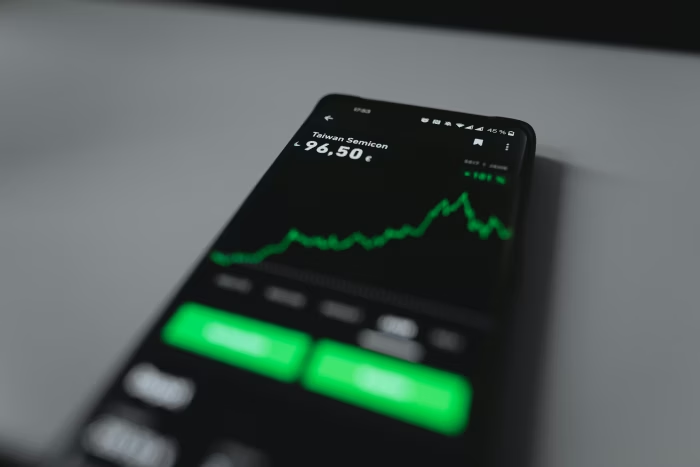
Taiwan is home to TSMC, the world's most advanced chipmaker, and sits at the centre of critical global shipping lanes. Any erosion of US commitment to Taiwan's security would send shockwaves through semiconductor stocks, Asian markets, and global supply chain confidence.
One Chapter in a Much Longer Story
Meetings between US and Chinese leaders have always been a big deal.
Nixon and Mao opened the door in 1972 after decades of hostility, Reagan and Deng expanded economic ties, and Obama and Xi agreed on cooperation across several areas.
Trump and Xi may well emerge from Beijing with big claims about friendship, a "grand bargain," and a list of deals to announce. But summits have never erased the deeper structural competition, and this one likely won't either.
Both governments are simultaneously talking about stability while simultaneously planning for long-term rivalry in technology, security, and global influence.
For investors, this meeting is worth watching closely, but it's one chapter in a much longer story.
Cover image: Yue Yuewei/Zuma/Ritzau Scanpix