3/9/25
2025 – and entrepreneurship is still “men’s work”?
We still live in a reality where entrepreneurship is too often associated with men.

It’s 2025. And yet, we still live in a reality where entrepreneurship is far too often associated with men – and where women who build companies are treated as something special. Something different. As female entrepreneurs.
You might think: “Come on – is that really a problem?”
And it is. Because language reveals something deeper: that the norm is still male. That we are still seen as the exception, not the standard. And that doesn’t just distort representation – it creates doubt, invisibility, and limited expectations.
Because why is it still surprising when women succeed in scaling global businesses, attracting capital, or disrupting conservative industries?
And why – after raising millions in funding, winning the world’s biggest startup competition, and building a global community with thousands of paying members – are we still met with the question:
“So… is it a real business?”
%402x.avif)
That is the reality we face. And it’s exactly why we can’t settle for being described as female entrepreneurs, as if we were a niche.
We’re not a niche. We’re a movement. We’re a reality. And we’re here to stay.
We Built a Global Company. And Yet We’re Underestimated.
Our journey began with a simple idea: to create a safe and inspiring learning community for women who wanted to understand and own their finances. In a short time, we hit a series of milestones that prove our ability to create both value and lasting business.
We stood out with our pioneering approach to financial equality and made it onto the Forbes 30 Under 30 list. We went on to win one of the world’s largest startup competitions thanks to our sustainable growth model and social impact.
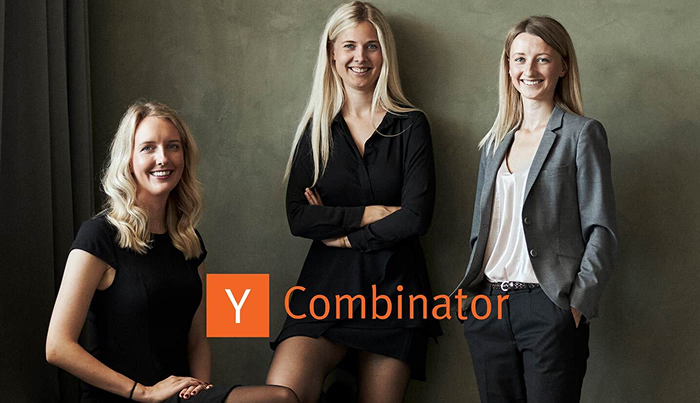
At the same time, we built a global community of more than 80,000 members, proving that our learning universe meets a real need – and our book Girls Just Wanna Have Funds has sold over 150,000 copies worldwide. That’s unprecedented.
We were accepted into the world’s most prestigious accelerator program, where only a fraction of applicants make it through. And we’ve raised millions of euros and dollars from leading European and American investors.
And after five years, we’re still here – in a market where fewer than 10% survive the first two years.
These results prove that our community is not just a niche, but a global business with sustainable growth and significant impact.
And yet we’re still met with skepticism:
“But is it real tech? Real innovation? Real entrepreneurship?”
That’s the doubt we’re putting an end to.
Examples of Female Entrepreneurs Whose Stories Almost Vanished
It’s not just today that women have had to fight for recognition as entrepreneurs. Many of the earliest pioneers are barely remembered in history books, even though their contributions were groundbreaking:
- Victoria Woodhull (1838–1927)
- The world’s first female stockbroker in New York in the 1870s and a prominent suffragist. Her firm paved the way for women’s participation in finance.
- Madam C. J. Walker (1867–1919)
- Often cited as the first self-made female millionaire in the U.S., building her fortune through haircare products for African American women.
- Margaret Hamilton (b. 1936)
- Computer scientist who led the development of Apollo’s onboard software and introduced the term “software engineering” as a discipline.
- Patricia Bath (1942–2019)
- Ophthalmologist who invented laserphaco, a groundbreaking cataract treatment that restored sight to millions.
- Mary Anderson (1866–1953)
- Invented the first functional windshield wiper in 1903 – a simple yet revolutionary innovation that still protects millions of drivers today.
- Josephine Cochrane (1839–1913)
- American inventor who, in 1886, developed the first commercially viable dishwasher for luxury hotels and homes, laying the foundation for the modern household dishwasher.
I could go on, but these examples show how women’s creativity has always shaped our world – and remind us that even when women have created innovations and success, their stories are often erased or oversimplified. Exactly the kind of invisibility we are still fighting today.
Entrepreneurship Doesn’t Have a Gender – But the Barriers Do
When we started out, it wasn’t about gender. It was about an idea. A problem we wanted to solve. A desire to create something that mattered. We saw ourselves as entrepreneurs. Full stop.
But we quickly discovered the world didn’t see us the same way.
Because gender still matters – not for our abilities, but for how we are received.
Women get more questions about risk, fewer about vision. We get asked: “How will you handle setbacks?” Men get asked: “How will you scale to global success?”
It’s not always conscious discrimination. It’s ingrained expectations. Patterns we don’t even notice we’re repeating.
But the effect is real: when women are met with skepticism before curiosity, it creates headwinds from the very beginning.
And that matters. Because when success demands double the energy, double the proof, and double the stamina, it’s no wonder many women choose another path – one where the conditions don’t feel like an experiment.
We’re not saying “poor us.” We’re saying it’s a loss for society.
Because every time a brilliant woman gives up her idea because she doesn’t feel “entrepreneurial enough,” we all lose innovation, jobs, and real solutions to real problems§.
Let’s Call It What It Is: Entrepreneurship
There’s no need for excuses, qualifiers, or special labels. Entrepreneurship isn’t reserved for one gender, one lifestyle, or one way of working.
Women have already proven they can build and scale global companies with the same ambition and innovation as anyone else.
That’s why it’s not about us adjusting to the system.
It’s the system that must adapt to new models of leadership, collaboration, and growth.
So next time you meet a woman who has created something groundbreaking: forget the label “brave” and instead ask about her approach and strategy.
And when you hear about a successful startup, don’t question whether it’s “real” entrepreneurship. Ask for facts, metrics, and results – and judge it on the same basis as any other business.
Because we are not “female entrepreneurs” as a separate category.
We are entrepreneurs.
Full stop.