28/5/26
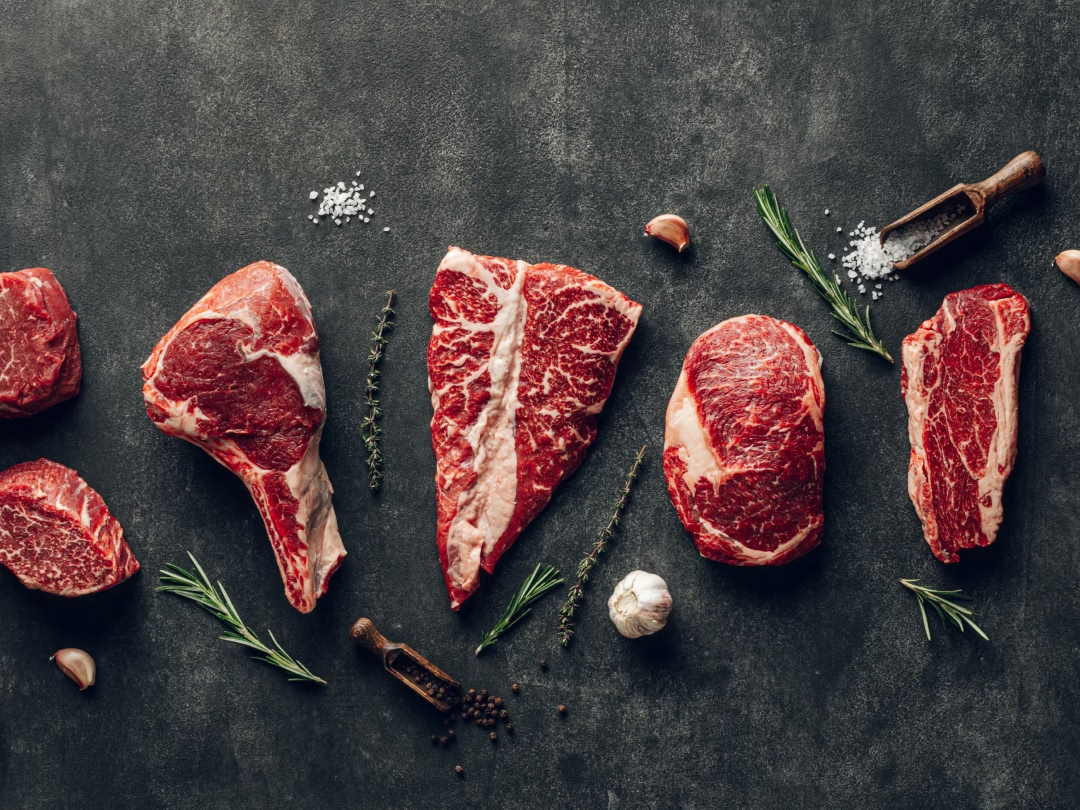
The soaring price of a steak
Beef costs have risen sharply in many countries, adding to the pressure on living standards and bringing Donald Trump into conflict

This article is republished from the Finanial Times
If there is one consumer product whose prices Donald Trump should be attuned to, it is steak.
Back in 2007, long before he entered politics, he launched Trump Steaks on the QVC home shopping channel. The brand sold packages of steaks and burgers that started at $199. Customers balked at the high prices and the business folded two months later.
Ten months into his second term as president, Trump is once again struggling with the high cost of a steak.

Across the world, beef prices are soaring as a global supply crunch bites. Herd sizes have shrunk after years of extreme weather, high input costs and disease.
The result is record prices amplified by a wave of protein-hungry consumers and by Trump’s sweeping tariffs, especially those on Brazil, the world’s biggest beef exporter.
The political fallout is not just an issue in the US. In Europe and the UK, surging beef prices have fanned food inflation, straining household budgets.
In the US, the average price of a pound of ground beef reached a record $6.32 in August — up 13 per cent in a year — while uncooked steaks averaged $12.22 per pound, an 11 per cent rise. Steakhouses have lifted menu prices, trimmed portions or both.
In Britain, beef prices have climbed nearly 25 per cent over the past year, making it one of five staples — along with butter, milk, chocolate and coffee — that together accounted for roughly 40 per cent of the increase in food prices, according to the Energy and Climate Intelligence Unit.
As a politician, Trump has cast himself as a champion of rural America and a defender of farmers. But facing a backlash over the rising cost of living, which beef prices have become a symbol of, he is now on a collision course with the cattle industry itself.
Trump has veered between blaming ranchers, many of whom are loyal supporters, and the powerful meatpacking companies that have supported his political campaigns.
“It isn’t just about standing with his partners in agriculture that have been with him from the moment he came down that escalator [to launch his first presidential bid]. It’s also about whether we can feed ourselves,” Brooke Rollins, the secretary of agriculture, tells the Financial Times. “We have to focus the top priority on affordability for Americans, but we also have to focus on supporting our food supply.”
However, the administration’s plan to expand beef imports from Argentina, which briefly sent cattle futures tumbling, has inflamed that divide.
“A lot of ranchers feel back-stabbed,” says Courtney Feigl, who rears Texan longhorns with her husband in Wisconsin. “I don’t think importing beef will solve our problems. Whatever happened to America First?”
Others warn that the politics of some rural areas have the potential to turn against him. “Trump shouldn’t underestimate the Yellowstone effect,” says Austin Frerick, an agricultural policy researcher, referring to the TV show about cattle country.
Long before the political storm erupted, the foundations of the beef market were already weakening. Repeated dry spells across the western and southern US, driven by climate change, have reduced pasture quality and pushed hay stocks to their lowest levels in decades. Many ranchers, unable to afford feed, sold cows earlier than usual and culled their heifers. The national herd is now the smallest since the 1950s.
Another constraint lies on the southern border, where ports have been largely closed for live cattle imports from Mexico following the discovery of the screwworm parasite earlier this year. Rollins says roughly a million head of cattle were waiting to cross.
In the UK and Ireland, farmers have faced higher fertiliser and feed prices since Russia’s invasion of Ukraine, says Nick Allen, outgoing chief executive of the British Meat Processors Association, while droughts in France and Spain last year reduced forage availability and forced producers to cut back on stocking levels. “You look right across Europe; the whole herd is in decline,” says Allen.
Rebuilding will take years. Unlike pigs or poultry, which can multiply rapidly, cattle breeding is a slow process: a cow has just one calf a year, and that animal takes more than two years to reach maturity. “If we wanted to expand the herd by 15 or 20 per cent, we’re looking at years down the road,” says John Maddux of the Maddux Cattle Company in Nebraska. “The industry simply can’t respond quickly to price signals.”
The trade war has only deepened the squeeze on many parts of the beef industry. Before the Trump administration levied a sweeping 50 per cent tariff on Brazil in July, the US had been steadily increasing imports from Brazil in order to keep up with domestic demand.
In the first five months of 2025, the US imported some 215,000 tonnes, more than double during the same period in 2024.
After July, the effective rate for out-of-quota Brazilian beef rose to more than 76 per cent. Exports to the US, Brazil’s second-largest beef market year-to-date, fell 41 per cent in September to $102.9mn.
To alleviate some of the tariff pain for American consumers, Trump on Friday afternoon slashed certain levies on a number of agricultural imports, including beef, as the US president tries to bring down the cost of grocery prices.
But his tariffs have already had a ripple effect on European markets, says Allen. “The Australians haven’t even got close to fulfilling their quota [of beef exports to the UK], because it’s probably more advantageous to send it to America.”
Tariffs on machinery and feed imports have also lifted producers’ costs at home.
The result is a worldwide surge in retail beef prices.

Yet demand remains stubborn. Surveys show the shift towards high-protein diets continues to accelerate: 71 per cent of US consumers reported trying to eat more protein last year, up from 59 per cent in 2022. Analysts also point to the influence of GLP-1 weight-loss drugs, which encourage users to maintain higher protein intake to preserve muscle mass.
The combination of tight supply and resilient appetite has kept beef a potent driver of inflation on both sides of the Atlantic — and, in the US, turned the burger into a political flashpoint.
“Where does the consumer feel inflation the most? It’s probably at the grocery store and at the gas station,” says Arlan Suderman, chief commodities economist at broker StoneX.
Under pressure over food prices, Trump said in late October the US would buy more Argentine beef to bring prices down. The move sparked a swift backlash.
“This plan only creates chaos at a critical time of the year for American cattle producers, while doing nothing to lower grocery store prices,” says Colin Woodall, chief executive of the National Cattlemen’s Beef Association.
Nonetheless the administration raised Argentina’s annual import quota from 20,000 to 80,000 tonnes — around two days’ worth of supply — and simultaneously announced an action plan to support American cattle ranchers.
In a post on social media, Trump lashed out at farmers, saying that they were benefiting from the tariffs he had put on Brazilian beef.
“If it weren’t for me, [the cattle ranchers] would be doing just as they’ve done for the past 20 years — Terrible! It would be nice if they would understand that, but they also have to get their prices down, because the consumer is a very big factor in my thinking, also!”
Live and feeder cattle prices on futures markets dropped dramatically in response to the president’s post.
“He’s caused an enormous amount of wealth destruction within the cattle business,” says Maddux. “I’m $500 per head in the hole compared to where I would have been three weeks ago . . . before Trump spouted off.”
On Thursday, Washington unveiled a series of framework trade agreements with Argentina, Ecuador, El Salvador and Guatemala that include provisions to ease tariffs on agricultural goods — notably beef from Argentina — as part of what the White House described as a push to “restore affordability” in the food market.
The political fallout has extended to Washington.
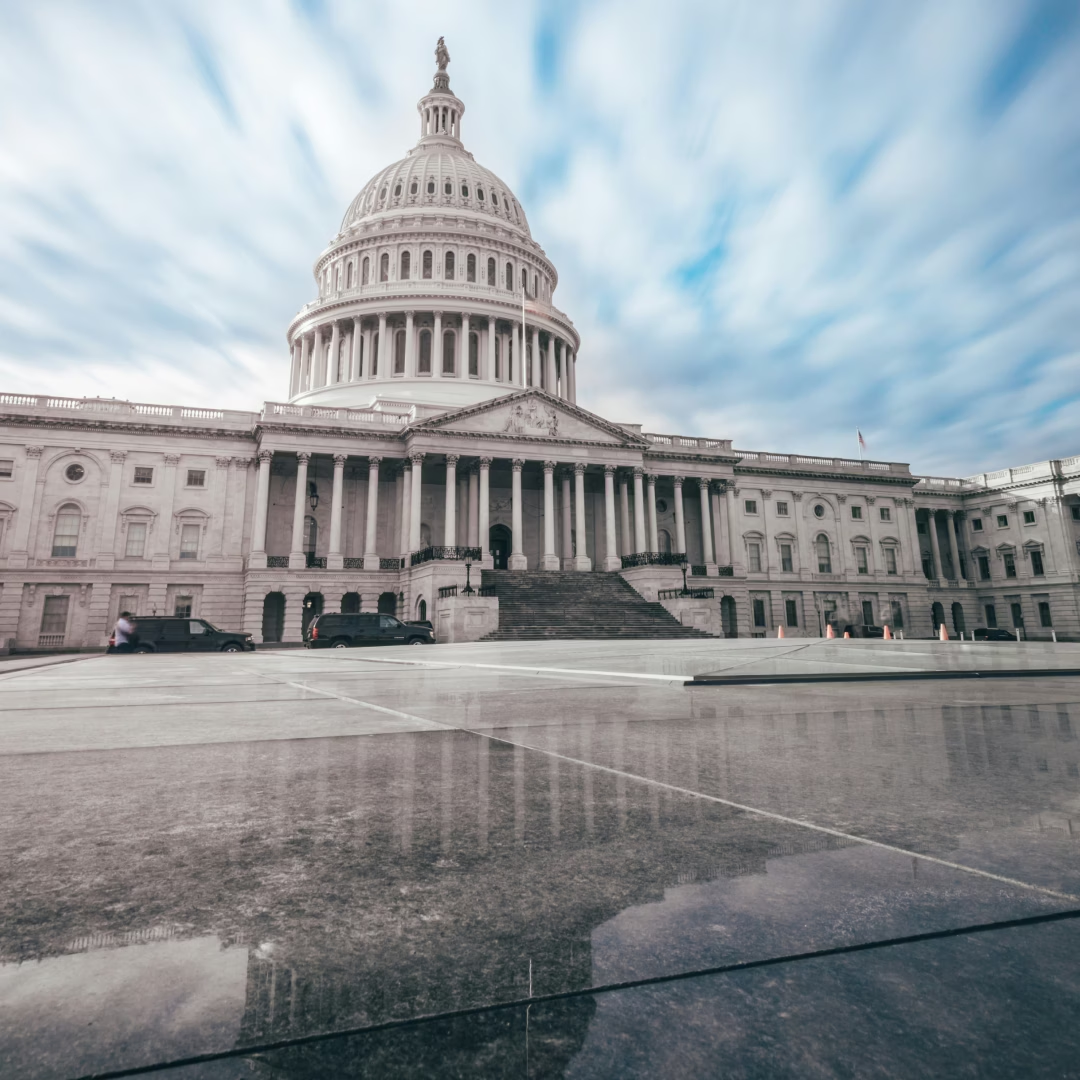
In a letter to Rollins and US trade officials this month, more than 30 members of Congress accused the administration of “destabilising cattle markets” through impulsive comments and short-term trade manoeuvres.
“These comments have contributed to multiple limit down days in the futures market, which are directly due to the President’s insistence on dictating policy through social media,” said the letter. “While this volatility may not concern the billionaires the President often prioritises, it does have real consequences for ranchers who are bringing their animals to market.”
The administration, they said, was “bailing out the Argentine economy at the expense of US farmers and ranchers”.
Trump has also turned on the meatpacking giants that dominate US processing. He ordered the Department of Justice to investigate the “Big Four” — Tyson Foods, JBS USA, Cargill and National Beef — for alleged collusion and price manipulation, accusing them of failing to pass lower cattle costs on to consumers.
The companies deny wrongdoing, blaming record cattle prices and tight global supply for retail inflation. But the scrutiny comes on top of a wave of antitrust suits.
Over the past two years, McDonald’s has sued the packers for allegedly coordinating supply cuts as far back as 2015. JBS settled related claims for $83.5mn this year without admitting liability.
Rollins says the president’s actions reflect his determination to take on entrenched interests — even those that had donated heavily to Republican campaigns.
“Anyone that thinks that this president is going to make decisions based on who his donors are has no idea of the constitution of this man,” she says. “He will, over and over again, put the American people ahead of friendships, relationships or the donor base.”
Many in the industry doubt the two aims are compatible. “I think they should reduce some of the financial burden on the US ranchers so we can produce more and accommodate the increase in our herd size and strengthen our operations,” says Feigl, the rancher from Texas. “There’s so many options other than importing beef from Argentina, right?”
Others argue Trump, ever the political mathematician, has concluded that ranchers will stick with him, and that the bigger prize lies in millions of burger-eating voters.
“There’s a hell of a lot more beef consumers than there are beef producers,” says Maddux.
© 2025 The Financial Times Ltd. All rights reserved.