30/10/25
The Chip That Ate the World: How NVIDIA Became the Most Important Company on Earth
What began as a gaming experiment would become the engine of modern artificial intelligence.

The story begins with video games. In the early 1990s, computers were slow and serious things. They were made for spreadsheets and text documents, not for the vivid digital worlds that gamers were starting to imagine.
Three engineers, Jensen Huang, Chris Malachowsky, and Curtis Priem, saw an opportunity in those early pixels.
In 1993, they founded NVIDIA to build better graphics for games.
Their idea was a chip that could handle thousands of small tasks at once, rather than one big task at a time. For gaming, this meant smoother 3D motion and more realistic visuals. For the rest of the world, it was something far more powerful.
They called it the GPU - short for graphics processing unit.
What began as a gaming experiment would become the engine of modern artificial intelligence.
From Games to Artificial Intelligence
For decades, the CPU, or central processing unit, was the heart of every computer.
It was fast and reliable but limited by the fact that it could only perform one task at a time. GPUs were different. They could handle thousands of calculations simultaneously, which made them perfect for creating graphics. Scientists later discovered that this same design was ideal for training artificial intelligence models.
By the mid-2000s, NVIDIA’s chips were quietly appearing in research labs and supercomputers. In 2012, a small team at the University of Toronto used NVIDIA hardware to train a neural network that outperformed every AI system before it.
That moment marked a turning point in the history of computing.

Since then, NVIDIA has become the hidden backbone of the AI revolution.
Every time an algorithm translates a language, creates an image, or learns to drive a car, there is likely an NVIDIA chip doing the work behind the scenes.
The Rise of an Unlikely Giant
At first, even NVIDIA did not grasp how central its technology would become.
Its most advanced chips, like the H100, are now some of the most sought-after pieces of hardware in the world.
Tech giants such as Amazon, Microsoft, and Google fill data centers with them.
AI startups rely on them.
Governments classify them as strategic technology, subject to export controls and national security debates.
In just a few years, NVIDIA’s market value has surged to levels that place it among the most valuable companies on Earth.
Its CEO, Jensen Huang, is now one of the most influential figures in Silicon Valley, often described as the person who made artificial intelligence possible at scale.
The Rest of the Chip Game
NVIDIA does not operate alone. The global chip industry is an intricate network of companies that depend on one another.
TSMC, the Taiwan Semiconductor Manufacturing Company, is the one that actually produces NVIDIA’s chips. It builds nearly all of the world’s most advanced semiconductors in facilities so controlled that a single speck of dust can destroy a batch worth millions.
This dependence on TSMC makes Taiwan one of the most important places in the global economy.
Then there is ASML, a Dutch company that manufactures the machines used to make chips. These machines are so complex that only ASML can produce them. Without its technology, modern chipmaking would be impossible.
AMD, led by Lisa Su, competes directly with NVIDIA and has gained ground in both gaming and data center chips.
Intel, once the unquestioned leader in processors, is trying to reclaim its position through heavy investment in manufacturing and new designs.
Meanwhile, companies like Apple, Google, and Amazon are creating their own chips to better control their hardware and reduce reliance on outside suppliers.
The result is a quiet but intense race for computing power.
The Next Five Years
The coming years are likely to be shaped by two forces: scarcity and independence.
The first is simple.
There are not enough advanced chips to meet global demand. Training large AI systems requires thousands of GPUs and enormous amounts of energy, and supply has not kept up.
This shortage has made NVIDIA’s chips some of the most valuable physical products in the tech world.
The second force is national independence.
Governments have realized that the ability to design and manufacture chips is not just a business advantage but a matter of national security. The United States, China, and the European Union are each investing billions in new factories and research. The goal is to make sure that their economies do not depend entirely on foreign supply chains.
What was once a story about gaming has become one about global power.
What It Means for Investors
NVIDIA’s rise has naturally drawn attention from investors. The company’s growth has been extraordinary, and it sits at the center of one of the most important technological shifts in history.
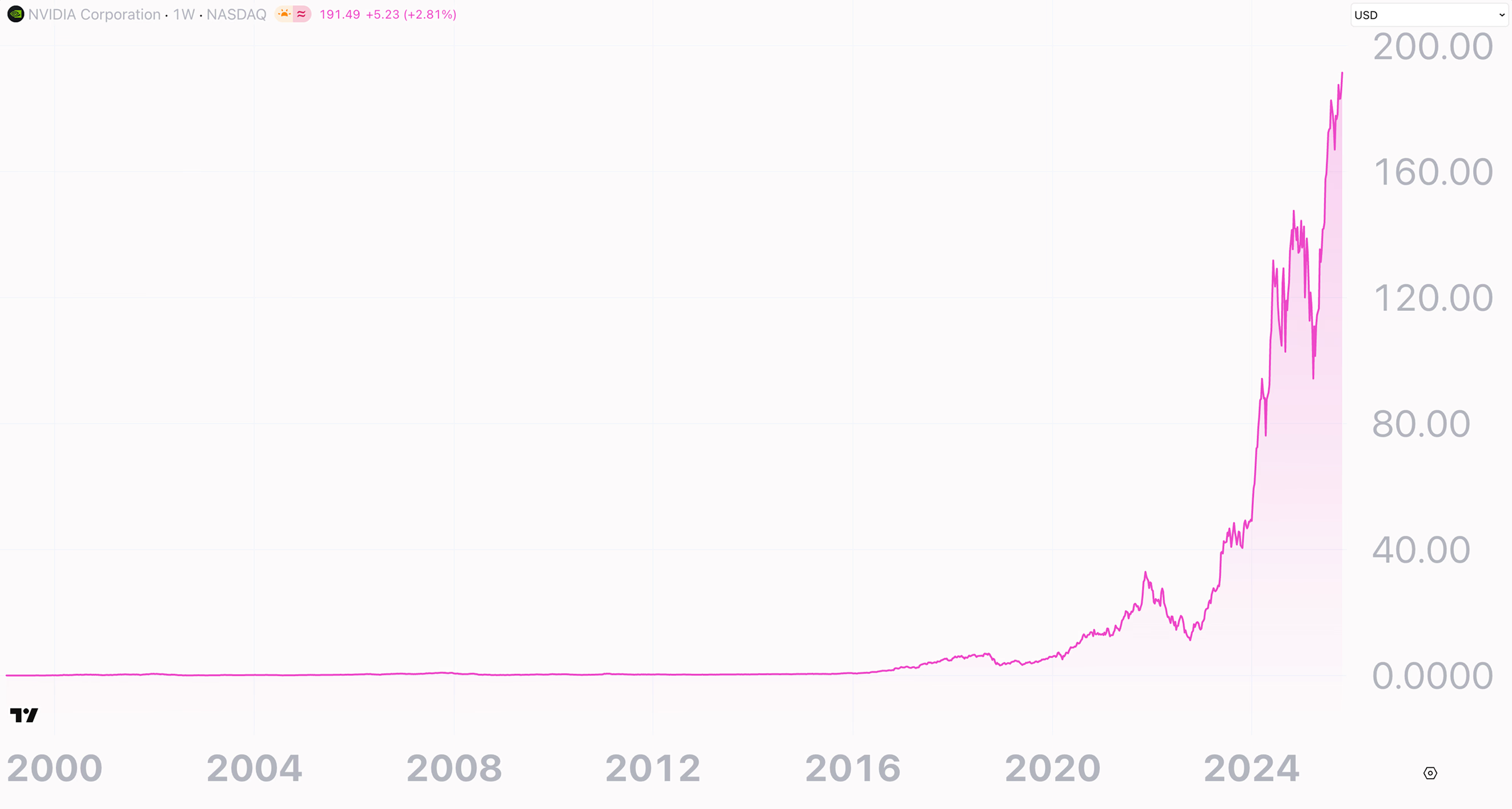
Still, it is important to remember that no company is immune to competition or market cycles.
Some investors look beyond NVIDIA to the wider ecosystem, from manufacturers like TSMC to equipment makers like ASML or competing designers such as AMD and Intel.
Together, they form a global web of companies building the physical foundation of the digital world.
That said, investing in any of them carries uncertainty.
The chip industry is cyclical, and innovation moves quickly. Anyone interested in this space should take time to understand how these companies operate, how the supply chain connects them, and how their fortunes rise and fall with the broader tech cycle.
There is no guarantee with any single stock, and past performance never predicts the future.
What is clear, though, is that semiconductors are becoming as central to the world economy as energy once was. Understanding that story — not betting on it blindly — may be the most valuable step for any curious investor.
The World Inside a Chip
A chip is a thin square of silicon, no larger than a fingernail, packed with billions of microscopic transistors. Together, those tiny circuits perform the calculations that make modern life possible.
They are what turn human ideas into machine learning, what make language models speak, and what run the servers that hold the internet together.
NVIDIA did not set out to build the world’s most important company.
It set out to make video games look better. But in doing so, it created the hardware that powers a new era of intelligence, one in which computing power is the raw material of progress itself.