26/11/25
Why London House Prices Are Falling
Why London House Prices Are Falling

London used to be the one part of the UK housing market that didn’t care what the rest of the country was doing. Prices rose because… well, because they always had. London’s market has always been insulated by its global appeal, high-paying jobs, foreign investment, and the simple fact that everyone wants to live where the action is.
But this year, something rare is happening: London prices are slipping while the rest of the UK is still creeping upward.
For anyone in this market renting, buying, or simply trying to understand the housing chaos of 2025, the shift can feel confusing - especially with rumours swirling about property taxes, council tax reform, and the UK Budget that may reshape what it costs to live in the capital.
So let’s walk through the real reasons behind London’s slowdown, in a way that actually makes sense if you’re not a property analyst.
The Data: London Is the Only Region in the UK Where Prices Are Falling
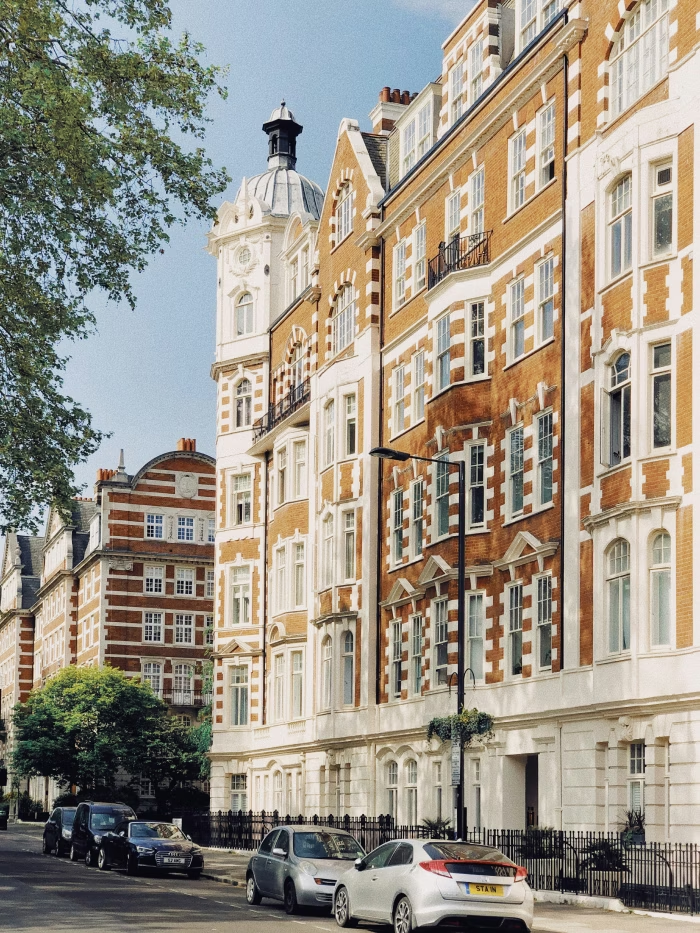
According to the Office for National Statistics, London prices fell 1.8% in the year to September - the biggest drop in almost two years - while UK prices rose 2.6%. In some boroughs, prices fell much more sharply:
- City of London: down 15%
- Kensington & Chelsea: down 11%
This doesn’t mean London is suddenly “cheap.” It means the market has run into a wall made of three things: higher borrowing costs, stretched budgets, and tax uncertainty.
Let’s go through them.
But first...
1. Mortgage Rates Went Up
A few years ago, you could take out a mortgage for around 1–1.5%. Today, a typical two-year fixed rate is closer to 4%. Why? Because interest rates rose sharply to fight inflation.
When inflation surged in recent years, driven first by supply chain issues and later supercharged by the Russia-Ukraine war and rising energy costs, the Bank of England stepped in to cool things off.
The inflation rate was around 2% before 2020, dropped near 0% in the height of the pandemic, and then climbed sharply through 2021 and 2022, peaking at over 11% in October 2022. To fight this, the Bank raised interest rates from historic lows, making borrowing (and mortgages) much more expensive.
This freezes the market because most buyers don’t work with the cash price of a property - they work with the monthly payment.
At London-level prices, a jump from 1% to 4% adds hundreds of pounds a month to a mortgage. Buyers suddenly qualify for less. Sellers don’t want to lower their expectations. And the result? Fewer deals happening.
This affects everyone - first-time buyers, families hoping to upgrade, single-income households, and women most of all (because lower average earnings = tighter borrowing limits). When affordability hits its ceiling, London hits pause.
If the Bank of England cuts interest rates in the coming months, this will ease slightly. In fact, the BoE has already trimmed its base rate from a peak of 5.25% (Aug 2023–Jul 2024) to 4% today. Mortgage rates have followed—dropping from nearly 8% at their highest last year to about 6.78% now.
While it’s unlikely we’ll see 1% mortgages return soon, the market could still surprise us.
2. Buyers Are Nervous About What the Budget Might Change
This isn’t a “luxury homes only” issue. When tax rules shift at the top end, they ripple downward, affecting confidence across the whole market.
Here’s the key rumour that’s making people hesitate:
New council tax bands for expensive properties.
Council tax is based on old property valuations from 1991 - back when London homes cost a fraction of today’s prices. The system hasn’t kept up with reality, so someone in a £300,000 home and someone in a £3 million home can easily end up paying surprisingly similar council tax.
Rachel Reeves, the UK’s Chancellor of the Exchequer (the government’s finance leader), is expected to change that by adding new, higher bands for the most expensive homes.
Even if you’re not buying a £2 million townhouse, this matters because:
- Buyers in the £500k–£1m range are waiting for clarity
- Sellers are worried they’ll be hit with higher annual bills
- The ‘mansion tax’ spooks people into pausing decisions
- When the top end slows, the chain below it slows too
The UK property market is one long domino chain. If the first tiles wobble, everyone feels it.
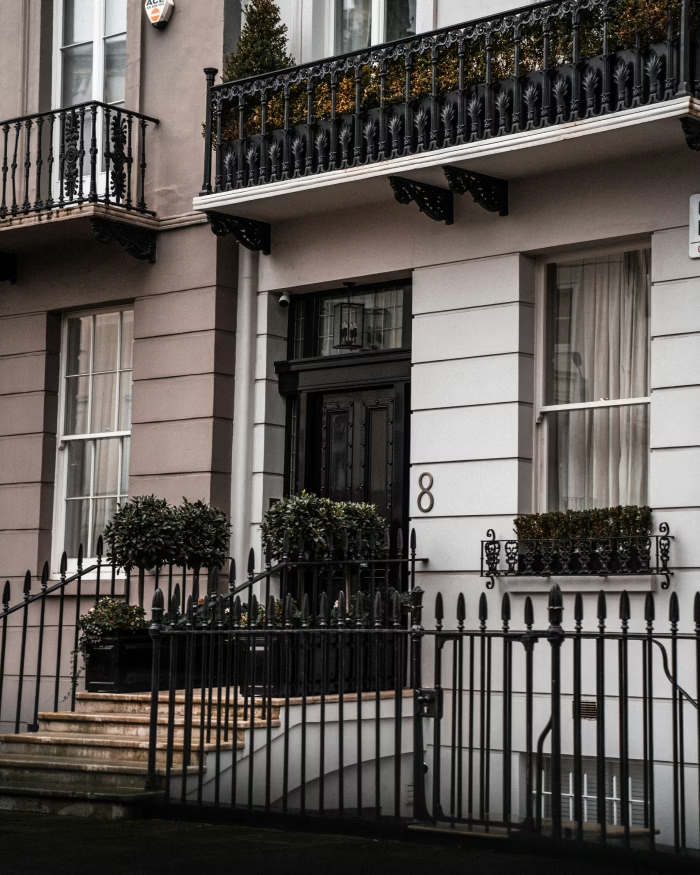
With the Budget just days away, many buyers are holding off until they know the rules.
3. There Are More Homes for Sale - But Not Enough Buyers Ready to Commit
For the first time in years, supply in London is rising. Not dramatically, but enough that buyers suddenly have a bit more choice. At the same time, higher mortgage rates and tax uncertainty mean demand is softer.
More sellers + cautious buyers = slower market + lower prices.
Across London, agreed sales are down, viewing numbers are lower, and people are taking longer to make decisions. And unlike the frenzy of 2021–22, buyers now negotiate more - which quietly pushes prices down, even when the headline numbers look small.
Meanwhile, rents - still painfully high - are rising more slowly in London than the rest of the UK. Still a nightmare at an average of £2,265, but the sharpest rent spikes appear to be behind us.
Zooming Out
London may be cooling, but it’s still London. There’ll always be a queue for overpriced lattes… and overpriced mortgages.
What’s happening now isn’t a crash; it’s a recalibration. Higher borrowing costs have forced the market to slow to a pace that makes sense again. Tax uncertainty is adding another layer of caution. And for the first time in years, buyers have space to think instead of sprint.
The Budget will shape the months ahead, but the bigger picture remains: London’s housing market has always moved in cycles, and this one is long overdue.
If you understand the forces behind those cycles - interest rates, affordability, tax policy, supply and demand - you stop feeling like the market is something happening to you.
Because your job is not to predict the future.
Your job is to understand the system well enough to make it work for you.
And that?
You’ve already started.